|
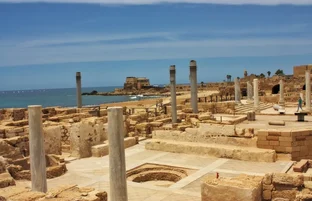
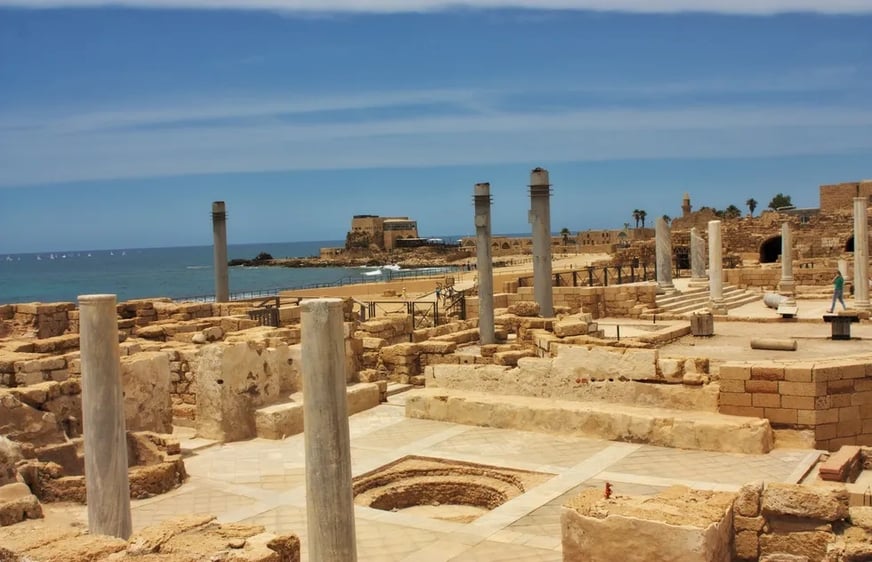
Introduction to Caesarea40km (25 miles) N of Tel Aviv; 49km (30 miles) S of Haifa; 16km (10 miles) N of Netanya This is one of my favorite places in Israel. It's relatively quiet and has beautiful beaches, dramatic ruins beside the sea, a luxury hotel, and an 18-hole golf course. Caesarea's beautiful excavations give you a real feeling for the tide of history that has washed Israel's shores. Located about a third of the way from Tel Aviv to Haifa, behind a cluster of banana groves, Caesarea is the spectacular city of Herod the Great (37 B.C.-4 B.C.), who set out to construct a port to rival Alexandria. It was Herod who built and beautified the town, adding a spectacular harbor and naming the city in honor of his Roman suzerain and benefactor, Augustus Caesar. By the time of Herod's death, Caesarea was one of the grandest port cities of the eastern Mediterranean. The city had a mixed population of Greeks, Syrians, Romans, Phoenicians, Egyptians, and some Jews. Caesarea was the headquarters of Roman rule in Israel, and figures prominently in the story of the apostle Paul: He was warned not to go to Jerusalem; he went anyway, returning to Caesarea in chains to stand trial for heresy. The Jews increasingly resented the Roman domination of their land, and tensions came to a head from A.D. 60 to A.D. 70 when pogroms against the Jewish population began, culminating in the brutal massacre of 2,000 Jews in the Caesarea amphitheater. All Judea subsequently rose in revolt, and the Romans retaliated by destroying Jerusalem in A.D. 70 and conquering Masada in A.D. 73. In A.D. 132, the rebellion of Bar Kochba brought another massacre, and the greatest sages of the time, including Rabbi Akiva, were brought to the amphitheater of Caesarea, tortured in public, then flayed and burned alive. In the next century, Roman Caesarea saw the execution of many early Christians. Under the Byzantines, the city's history was less grisly. Caesarea was home to a succession of important church scholars, who codified the church laws, and was the seat of a metropolitan bishop responsible for all the Christian communities of the eastern Mediterranean. A small but significant Jewish community thrived throughout this time. The Arab conquest, in A.D. 640, put an end to this period. In 1101, Baldwin I and his Crusader army landed in Caesarea and slaughtered the entire Arab population. Among the treasures Baldwin's troops discovered after this conquest was a green crystal vessel reputed to be the famous Holy Grail. It was taken to Italy, where it is preserved today, known as the Sacro Catino, in the Cathedral of San Lorenzo in Genoa. Caesarea changed hands several times during the following century, even though Saint Louis of France had fortified its walls in 1252 (even joining in the physical labor). Most of the Crusader ruins we see today date from Saint Louis's 13th-century fortress. When Muslim armies took the town (1265 and 1291), they did their best to pull down the defenses, remembering that this had been Baldwin's beachhead, and for the next 500 years Caesarea's impressive structures slowly became covered by sand. In the 1700s, Ahmed al Jezzar Pasha, Ottoman governor of the province, sent his workmen to Caesarea to reclaim its Carrara marble, columns of decorative stone, and finely carved capitals for use in the reconstruction and beautification of his provincial capital at Akko (Acre). The vast, beautiful city that Herod had created seemed virtually lost. An Arab village survived here, but it was abandoned by its inhabitants during the 1948 war. Caesarea's modern history really begins in 1940, when nearby Kibbutz Sedot Yam was founded. Its members discovered the unexpected richness of Caesarea's archaeological remains, and a full campaign of restoration followed. Today, the city is one of Israel's most impressive archaeological sites.
Note: This information was accurate when it was published, but can change without notice. Please be sure to confirm all rates and details directly with the companies in question before planning your trip. Related Features Partner Deals:
|
|
|||||||||||||||||||||||||||||||||||||||||||||||||||||||||||||||||||||||||||||||||||||||||||||||||||||||||||||||||||||||||||||||||||||||||||||||||||||||||||||||||||||||||||||||||||||||||||||||||||||||||||||||||||||||||||