|
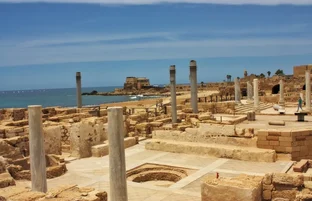
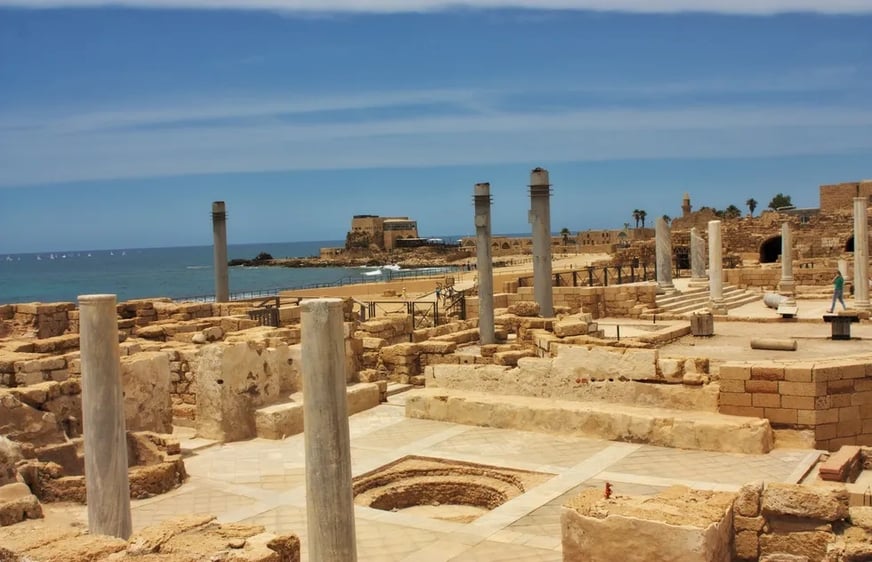
AttractionsCaesarea National Park The remains of Caesarea (Qesarya, in Hebrew) are spread along a 3km (2-mile) stretch of Mediterranean beach. There are two separate entrances: You'll arrive at either the Roman theater or the Crusader city, which are in fact right next to each other, though the entrance gates are .5km (1/4 mile) apart. Admission to Caesarea National Park is good for both the Crusader city and for the theater. You can enter the city for free after the 5pm closing time to visit restaurants that have sprung up inside the park or stroll the ruins, but special exhibits are closed at night. You can get a map showing the details of the succession of cities that have risen at this site, both on land and in the water -- the cities and harbors of Straton's Tower (the earliest settlement at the site of Caesarea), as well as the Herodian, Roman, Byzantine, and Crusader incarnations of Caesarea. I recommend that you do this, as it will give you a much better idea of the scope of the place. There is also an excellent Audiovisual Presentation (tel. 04/617-4444) that brings the site to life, with interesting information about historical figures and re-creations of what Caesarea would have looked like at different times in its history. Call ahead for information, presentation schedules, and to reserve a place. The excavations you see today are only a very small part of what's actually here, waiting to be discovered; new finds are constantly being unearthed. In recent years, ruins of a massive temple dedicated to Roman gods was uncovered and attributed to the great builder King Herod; it may be open for public viewing during the time span of this edition. I'll assume you're going to see the ruins from south to north, starting with the theater. The Roman Theater, capable of seating 5,000 spectators, was constructed in the time of Jesus and Pontius Pilate, and has been restored. You may be lucky enough to visit when a summer concert or other performance is planned, and sit on the warm, pale limestone seats with the Mediterranean as a backdrop. Test the acoustics by sitting in the stands and listening to someone speak on stage or clap hands. You enter the Crusader city on a bridge across the deep moat, then through a gatehouse with Gothic vaulting. Emerging from the gatehouse, you'll find yourself in the large fortified town, which covered a mere fraction of the great Herodian/Roman city. Sites within the fortified town are marked by signs in Hebrew and English. Especially noteworthy are the foundations of the Crusader Church of Saint Paul (1100s), down toward the sea, near the little Turkish minaret (1800s). The citadel, next to the group of shops and restaurants, was badly damaged by an earthquake in 1837, as was most of the Crusader city. The Port of Sebastos, a quay part of the Crusader port, extends from the Crusader city into the sea, but King Herod's harbor at Caesarea, completed in 10 B.C. and also named Sebastos, extended at least three times as far as what you see today. It curved around to the right, where a separate northern breakwater extended to meet it, roughly where the northern Crusader fortification walls meet the sea. The breakwater was also a wide platform, with room for large quantities of cargo, housing for sailors, a lighthouse, colossi (gigantic statues), and two large towers guarding the entrance gates to the harbor. The harbor could be closed off by a chain stretched between the two towers, preventing ships from entering; it was big enough and protected enough to permit ships to winter over, allowing the departure of ships laden with cargo from the East just as soon as winter ended. Herod's harbor was one of the largest harbors of the Roman world, mentioned by historian Flavius Josephus as an especially amazing feat of engineering because it was a total creation -- built without the usual benefit of a topographical feature such as a bay or cove. Historians did not find the harbor until 1960, when a combination of aerial photography and underwater archaeological explorations revealed the ruins sunken offshore. We don't see more evidence of this fantastic port structure because two geological fault lines are just off the coast running below the Herodian port. Historians and archaeologists believe that the harbor structure probably sank vertically downward after its construction as a result of an earthquake. The excavation of the underwater ruins is an important international project, one of the major endeavors of the Center for Maritime Studies at Haifa University. At the Caesarea Diving Center/Gal Mor Diving Center, Old City 38900, Caesarea (tel. 04/636-1787; fax 06/636-0311), at the site of the ancient harbor, you can join a guided dive with equipment supplied for NIS 250 ($63/£31) for 1 hour. The dive explores ruins of the ancient harbor, and passes by ancient shipwrecks, classical statues, and fragments of a once-great lighthouse. Usually the center requires a minimum of three people for a tour, but for a surcharge, one- or two-person tours can be arranged. All major credit cards are accepted; reserve ahead, although dives cannot be guaranteed if sea conditions are not good. An abbreviated version of the tour is available for snorkelers. Admission (including the Roman Theater and Crusader city) is NIS 28 ($7/£3.50) for adults, and half-price for children; the interactive tour is NIS 40 ($10/£5) for adults and NIS 35 ($8.75/£4.40) for students and children. Hours are Saturday to Thursday 8am to 4pm (until 5pm Apr-Sept), and Friday from 8am to 3pm. Call tel. 04/636-7080 or 636-1358 for information. The Byzantine Street Fifty meters (164 ft.) east of the Crusader city entrance, behind the little snack shop, is the Byzantine Street, or Street of Statues, which is actually part of a forum. The statues depict an emperor and other dignitaries. Much of the stone for construction of the forum was taken from earlier buildings, as was the custom at the time. The Hippodrome Head east from either the Byzantine Street or the Roman Theater to reach the ruined hippodrome, in the fields between the two access roads. Measuring 72x288m (236x945 ft.), the hippodrome could seat some 20,000 people. Some of the monuments in the hippodrome may have been brought from Aswan in Egypt -- expense was no object when Herod built for Caesar. The Jewish Quarter & Roman Aqueduct Caesarea's Jewish Quarter is outside the walls of the Crusader city, near the beach directly north of the city. The community that flourished here during Roman times was well within the boundaries, and the walls, of Herod's city. The great aqueduct north of the Jewish Quarter is almost 9km (6 miles) in length, though most of it has been buried by shifting sands. There was an earlier aqueduct here, but the present construction dates from the 2nd century A.D. The southern part of the aqueduct is exposed to view, and you can see it. The Aqueduct Beach Swim at the white, sandy lagoons beside the romantic Roman aqueduct. Even in off season (late spring, early autumn) the sea is warmer than the North Atlantic and the Pacific ever get in the States. Some days the sea is lake-calm, but at other times, as everywhere on the coast, beware of rocks and severe undertows. Currently the beach is free, with an impromptu parking area. Stow all bags in the trunk and keep your eye on the car. The New City Largely residential, the modern city of Caesarea is notable for its very worthwhile museum of Spanish and Latin American art, the Ralli Museum, located on Rothschild Boulevard (tel. 04/626-1013). The museum contains a large collection of works by Latin American and Spanish artists (including artists of Sephardic origin); is housed in a spacious, beautifully designed new building; and is one of Israel's unexpected and little publicized surprises. The gems of the collection include sculptures by Dalí and Rodin, but the works of Latin American surrealists, representing artists from Mexico to Uruguay, are powerful and impressive. The museum is open daily 10:30am to 3pm and closed on Sunday and Wednesday. Admission is free. Children 5 and under are not allowed to enter.
Note: This information was accurate when it was published, but can change without notice. Please be sure to confirm all rates and details directly with the companies in question before planning your trip.
|
|
|||||||||||||||||||||||||||||||||||||||||||||||||||||||||||||||||||||||||||||||||||||||||||||||||||||||||||||||||||||||||||||||||||||||||||||||||||||||||||||||||||||||||||||||||||||||||||||||||||||||||||||||||||||||||||||||||