Rolf E. Staerk / Shutterstock
Carcassonne Travel Guide
770km (479 miles) SW of Paris; 94km (59 miles) SE of Toulouse; 105km (65 miles) S of Albi
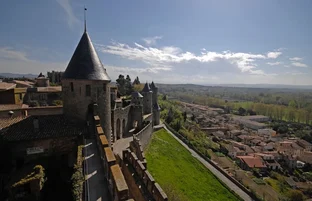
The greatest fortress city of Europe stands out against the background of the Pyrénées. Seen from afar, this glorious citadel surrounded by fortified walls suggests fairy-tale magic, but in its heyday in the Middle Ages, it was very different. Shattering the peace and quiet were battering rams, grapnels, a mobile tower (inspired by the Trojan horse), catapults, flaming arrows, and the mangonel (a type of catapult) as the forces of the French King fought the heretical Cathars.
Today the city that is used for movies (most notably as a backdrop for the 1991 movie “Robin Hood, Prince of Thieves”), is overrun with visitors. But the elusive charm of Carcassonne emerges in the evening, when the day-trippers have departed and floodlights bathe the ancient monuments.
Carcassonne is also a major stop along the Canal du Midi, that marvel of engineering that runs for 240km (150 miles) from the Garonne River at Toulouse all the way to the Mediterranean Sea at Sète. A 17th-century minor noble, Pierre-Paul Riquet, became obsessed with the idea of linking the Atlantic and the Mediterranean and devoted decades of his life and all of his fortune to make his plan a reality. Unfortunately, he died just months before the canal was officially opened in 1681. Although the arrival of the railways in the 19th century eroded much of the canal traffic, nowadays it is one of the most pleasurable ways of exploring this part of France. Barge companies run independent or skippered cruises along the full length of the canal, or you can just take short circular jaunts from ports in Carcassonne and other towns along the route. Its wide towpaths make it popular for cyclists and walkers who appreciate the combination of flat terrain and plenty of scenic restaurant stops along the way.