Home > Destinations > Europe > France > Traveler's Guide to Art & Architecture > Architecture
Bookstore Travel Talk - Our Message Boards Tips and Tools Book a Trip Deals and News Trip Ideas, Activities, Lifestyles Hotels Destinations Frommers.com Home
Frommer's - The best trips start here. Frommer's - The best trips start here.
Sign up for our FREE Newsletters! Win a FREE Trip
  Email This Article Email Print This Article Print Get Frommer's RSS Feed RSS

Architecture

While each architectural era has its distinctive features, some elements, floor plans, and terms are common to many of the eras.

From the Romanesque period on, most churches consist of either a single wide aisle or a central nave flanked by two narrow aisles. The aisles are separated from the nave by a row of columns, or more accurately by square stacks of masonry called piers, connected by arches. Sometimes in structures from the Romanesque and Gothic eras, you'll see a second level, the clerestory, above these arches (and hence above the low roof over the aisles) punctuated by windows.

This main nave and aisle assemblage is usually crossed by a perpendicular corridor called a transept, placed near the far, east end of the church so that the floor plan looks like a Latin Cross (shaped like a crucifix). The shorter, east arm of the nave is called the chancel; it often houses the stalls of the choir and the altar. If the far end of the chancel is rounded off, it is termed an apse. An ambulatory is a curving corridor outside the altar and the choir area, separating them from the ring of smaller chapels radiating off the chancel and apse.

Some churches, especially those built after the Renaissance, when mathematical proportion became important, have a Greek Cross plan, with each axis the same length -- like a giant plus sign (+).

Very few buildings (especially churches) were built in one particular style. Massive, expensive structures often took centuries to complete, during which time tastes would change and plans would be altered.

Anciant Roman (125 B.C.-A.D. 450)

Provence was Rome's first transalpine conquest, and the legions of Julius Caesar quickly subdued the Celtic tribes across France, converting it into Roman Gaul.

Roman architectural innovations include:

The load-bearing arch

The use of concrete, brick, and stone

Nîmes preserves from the 1st century B.C. a 20,000-seat amphitheater, a Corinthian temple called the "Square House," a fine archaeology museum, and the astounding pont du Gard, a 47m-long (158-ft.), three-story aqueduct made of cut stones fitted together without mortar.

From the Augustan era of the 1st century A.D., Arles preserves a 25,000-seat amphitheater, a rebuilt theater, and a decent museum. The nearby Glanum excavations outside St-Rémy-de-Provence (which houses its archaeology museum) offer a complete, albeit highly ruined, glimpse of an entire Roman provincial town, from a few pre-Roman Gallic remnants and a 20 B.C. arch to the last structures sacked by invading Goths in A.D. 480.

Romanesque (800-1100)

Romanesque churches were large, with a wide nave and aisles to accommodate the faithful who came to hear Mass and worship at the altars of various saints. To support the weight of all that masonry, the walls had to be thick and solid (meaning they could be pierced by only a few small windows) and had to rest on huge piers, giving Norman churches a dark, somber feeling.

Some of the features of this style include:

Rounded arches. These load-bearing architectural devices allowed architects to open up wide naves and spaces, channeling the weight of the stone walls and ceiling across the curve of the arch and into the ground through the columns or pilasters.

Thick walls

Infrequent and small windows

Huge piers

The Cathédrale St-Bénigne in Dijon was the first French Romanesque church, but of that era only the crypt remains. The Cathédrale St-Pierre in Angoulême has a single large nave, a rounded apse with small radiating chapels, and a pair of transept mini-apses.

Gothic (1100-1500)

By the 12th century, engineering developments freed architecture from the heavy, thick walls of the Romanesque and allowed ceilings to soar, walls to thin, and windows to proliferate. The Gothic was France's greatest homegrown architectural style, copied throughout Europe.

Instead of dark, relatively unadorned Romanesque interiors that forced the eyes of the faithful toward the altar, the Gothic interior enticed the churchgoers' gaze upward to high ceilings filled with light. The priests still conducted Mass in Latin, but now peasants could "read" the stories told in stained-glass windows.

The squat, brooding exteriors of the Romanesque fortresses of God were replaced by graceful buttresses and soaring spires, which rose from town centers like beacons of religion.

Some identifiable Gothic features include:

Pointed arches. The most significant development of the Gothic era was the discovery that pointed arches could carry far more weight than rounded ones.

Cross vaults. Instead of being flat, the square patch of ceiling between four columns arches up to a point in the center, creating four sail shapes, sort of like the underside of a pyramid. The X separating these four sails is often reinforced with ridges called ribbing.

Flying buttresses. These free-standing exterior pillars connected by graceful, thin arms of stone help channel the weight of the building and its roof out and down into the ground. Not every Gothic church has evident buttresses.

Stained glass. The multitude and size of Gothic windows allowed them to be filled with Bible stories and symbolism portrayed in colorful patterns of stained glass. The use of stained glass was more common in the later Gothic periods.

Rose windows. These huge circular windows, often the centerpieces of façades, are filled with elegant tracery and "petals" of stained glass.

Tracery. Lacy spider webs of carved stone curlicues grace the pointed ends of windows and sometimes the spans of ceiling vaults.

Spires. These pinnacles of masonry seem to defy gravity and reach toward heaven.

Gargoyles. These are drain spouts disguised as wide-mouthed creatures or human heads.

Choir screen. Serving as the inner wall of the ambulatory and the outer wall of the choir section, the choir screen is often decorated with carvings.

The Basilique St-Denis (1140-44), today in a Paris suburb, was the world's first Gothic cathedral. The statuary, spire, and some 150 glorious stained-glass windows of the Cathédrale Notre-Dame de Chartres (1194-1220) make it a must-see, while the Cathédrale Notre-Dame de Reims (1225-90) sports more than 2,300 exterior statues and stained glass from 13th-century rose window originals to 20th-century windows by Marc Chagall. The Cathédrale Notre-Dame d'Amiens (1220-36) is pure Gothic, its festival of statues and reliefs built with remarkable speed.

Paris's Notre-Dame cathedral (1163-1250) has good buttresses, along with a trio of France's best rose windows, portal carvings, a choir screen of carved reliefs, and spiffy gargoyles (many of which are actually 19th-century neo-Gothic). The sine qua non of stained glass is Paris's Ste-Chapelle (1240-50).

Renaissance (1500-1630)

In architecture as in painting, the Renaissance came from Italy and was only slowly Frenchified. And as in painting, its rules stressed proportion, order, classical inspiration, and precision to create unified, balanced structures.

Some identifiable Renaissance features include:

A sense of proportion

A reliance on symmetry

The use of classical orders. This specifies three types of column capitals: Doric, Ionic, and Corinthian.

Steeply pitched roofs. They often feature dormer windows (upright windows projecting from a sloping roof).

The Loire Valley and Burgundy are home to many Renaissance châteaux. Foremost is the Loire's Château de Chambord, started in 1519, probably according to plans by Leonardo da Vinci (who may have designed its double helix staircase). In contrast, the Château de Chenonceau, home to many a French king's wife or mistress, is a fanciful fairy tale built in the middle of a river. The best example in Burgundy is the Château de Tanlay, east of Chablis.

Classicism & Rococo (1630-1800)

While Italy and Germany embraced the opulent baroque, France took the fundamentals of Renaissance classicism even further, becoming more imitative of ancient models. This represents a change from the Renaissance preference of finding inspiration in the classic era.

During the reign of Louis XIV, art and architecture were subservient to political ends. Buildings were grandiose and severely ordered on the Versailles model. Opulence was saved for interior decoration, which increasingly (especially from 1715-50, after the death of Louis XIV) became a detailed and self-indulgent rococo (rocaille in French). Externally, rococo is noticeable only in a greater elegance and delicacy.

Rococo tastes didn't last long, and soon a neoclassical movement was raising structures, such as Paris's Pantheon (1758), that were even more strictly based on ancient models than the earlier classicist designs had been.

Some identifiable features of classicism include:

Highly symmetrical, rectangular structures based on the classical orders

Projecting central sections topped by triangular pediments

Mansard roofs. A defining feature and true French trademark developed by François Mansart (1598-1666) in the early 15th century; a mansard roof has a double slope, the lower longer and steeper than the upper.

Dormer windows

Oeil-de-bouef ("ox-eyes"). These small, round windows poke out of the roof's slope.

Mansart built town houses, châteaux, and churches (Val-de-Grâce in Paris; the Palais du Tau in Reims) and laid out Dijon's place de la Libération. But the Parisian architect is chiefly remembered for his steeply sloping namesake, "mansard" roofs.

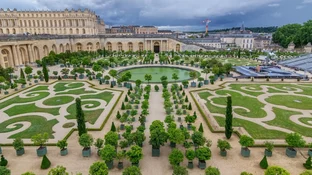
Louis Le Vau (1612-70) was the chief architect of the Louvre from 1650 to 1670 and of the Château de Vaux-le-Vicomte (1656-61) outside Paris, a gig that put him and his collaborators -- including Mansart, interior decorator Charles Le Brun (1619-90), and the unparalleled landscape gardener André Le Nôtre (1613-1700) -- on Louis XIV's radar and landed them the commission to rebuild Versailles (1669-85). Versailles is France's -- indeed, Europe's -- grandest palace.

Rococo architecture is tough to find. In Paris, seek out Delamair's Marais town house, the Hôtel de Soubise (1706-12), and the prime minister's residence, the Hôtel Matignon (1721), by Courtonne. For rococo decor, check out the Clock Room in Versailles.

The 19th Century

Architectural styles in 19th-century France began in a severe classical mode. Then they dabbled with medieval revival, delved into modern urban restructuring, and ended with an identity crisis torn between industrial-age advancements and Art Nouveau organic.

The 19th century saw several distinct styles, including:

First Empire. Elegant neoclassical furnishings -- distinguished by strong lines often accented with a simple curve -- during Napoléon's reign.

Second Empire. Napoléon III's reign saw the eclectic Second Empire reinterpret classicism in a dramatic mode. Baron Haussmann (1809-91), who cut broad boulevards through the city's medieval neighborhoods, restructured Paris.

Third Republic/early industrial. Expositions in Paris in 1878, 1889, and 1900 were the catalysts for constructing huge glass-and-steel structures that showed off modern techniques and the engineering prowess of the Industrial Revolution. This produced such Parisian monuments as the Eiffel Tower (Tour Eiffel) and Basilique du Sacré-Coeur.

Art Nouveau. Architects and decorators rebelled against the Third Republic era of mass production by stressing the uniqueness of craft. They created asymmetrical, curvaceous designs based on organic inspiration (plants and flowers) in such mediums as wrought iron, stained glass, tile, and wallpaper.

Napoléon spent his imperial decade (1804-14) refurbishing the Palais de Fontainebleau in First Empire style. The ultimate paean to the classical was the Arc de Triomphe (1836), Napoléon's imitation of a Roman triumphal arch.

In the Second Empire, Napoléon III commissioned Baron Haussmann in 1852 to remap Paris according to modern urban-planning theories -- clearing out the tangles of medieval streets to lay out wide boulevards radiating off grand squares (the Etoile anchored by the Arc de Triomphe is his classic).

In 1889, the French wanted to show how far they had come since the Revolution. They hired Gustave Eiffel (1832-1923) to build the world's tallest structure, a temporary 315m-high (1,051-ft.) tower made of riveted steel girders. Everyone agreed it was tall; most thought it was ugly. Its usefulness as a radio transmitter saved Eiffel's tower from being torn down.

Art Nouveau was less an architectural mode than a decorative movement, though you can still find some of the original Art Nouveau Métro entrances designed by Hector Guimard (1867-1942) in Paris. (A recently renovated entrance is at the Porte Dauphine station on the no. 2 line.)

The 20th Century

France commissioned some ambitious architectural projects in the last century, most of them the grand projets of the late François Mitterrand. Most were considered controversial, outrageous, or even offensive. Other than a concerted effort to break convention and look stunningly modern, nothing unifies the look of this architecture -- except that foreigners designed much of it.

Britain's Richard Rogers (b. 1933) and Italy's Renzo Piano (b. 1937) turned architecture inside out -- literally -- to craft the eye-popping Centre Pompidou (1977), Paris's modern art museum. Exposed pipes, steel supports, and plastic-tube escalators wrap around the exterior.

Chinese-American maestro I. M. Pei (b. 1917) was called in to cap the Louvre's new underground Métro entrance with glass pyramids (1989), placed smack in the center of the Palais du Louvre's 17th-century courtyard.

In 1989, Paris's opera company moved into the curvaceous, dark glass mound of space of the Opéra Bastille (1989), designed by Canadian Carlos Ott. (Unfortunately, the acoustics have been lambasted.)


Back to Top


Note: This information was accurate when it was published, but can change without notice. Please be sure to confirm all rates and details directly with the companies in question before planning your trip.


  Email This Article Email Print This Article Print Get Frommer's RSS Feed RSS
Frommer's France 2008 Frommer's France 2008

Author: Darwin Porter
Pub Date: October 01, 2007
Price: $23.99

Buy Now!
Related Titles:
France For Dummies, 4th Edition
Frommer's 24 Great Walks in London, 1st Edition
Frommer's 24 Great Walks in Paris, 1st Edition
Add Frommers.com RSS Feed  Add Frommers.com RSS Feed (What's This?)
Add Frommers.com Deals & News to Your Web Site
Add to My Yahoo!     Add to My MSN     More RSS Readers
Add Frommers.com Podcast Add Frommers.com Podcast (What's This?)
Home > Destinations > Europe > France > Traveler's Guide to Art & Architecture > Architecture