Home > Destinations > Middle East and Africa > Israel > Jerusalem > Attractions > The Old City
Bookstore Travel Talk - Our Message Boards Tips and Tools Book a Trip Deals and News Trip Ideas, Activities, Lifestyles Hotels Destinations Frommers.com Home
Frommer's - The best trips start here. Frommer's - The best trips start here.
Sign up for our FREE Newsletters! Win a FREE Trip
  Email This Article Email Print This Article Print Get Frommer's RSS Feed RSS

The Old City

The Old City is enclosed by a 40-foot-high wall built in 1538 by Suleiman the Magnificent, the greatest of the Ottoman Turkish sultans (some portions of the wall, in fact, are more than 2,000 years old). The existence of this wall, which gives unity and magnificence to the Old City, is something of a miracle. According to legend, Sultan Suleiman, who never visited Jerusalem, had a dream that he would be devoured by lions unless he rebuilt the walls that had lain in ruins around Jerusalem since the Crusader wars of the early 13th century. So disturbing was this dream to the sultan, that he sent his architects from Istanbul to reconstruct Jerusalem's walls. Either through ignorance, or because the architects hoped to keep some of the building funds for themselves, the new walls did not include the southern part of Mount Zion, which had been inside Jerusalem's defenses in earlier times. When the sultan learned of the architects' omission, he had them beheaded.

There are eight gates in the Old City fortress wall. The main gates are the Jaffa Gate, entered from Mamilla-Agron Street or Jaffa Road, and the Damascus Gate, entered from Ha-Nevi'im Street or Nablus Road. Israelis call Damascus Gate Sha'ar Shechem; the Arabic name is Bab el Amud. On the eastern side of the Old City, the Golden Gate, traditional entrance point for the Messiah, has been walled up for centuries.

The Old City itself is divided into five sections: the Christian Quarter, the Armenian Quarter, the Muslim Quarter, the Jewish Quarter, and Temple Mount (Mount Moriah), the latter including the Western (Wailing) Wall, the Dome of the Rock, and Al Aqsa Mosque. The Dome of the Rock and the Al Aqsa Mosque were built from A.D. 690 to 720, 600 years after the Temple was destroyed by Rome. Throughout the Islamic world, this complex is called Haram es Sharif, or The Noble Sanctuary.

The Jaffa Gate

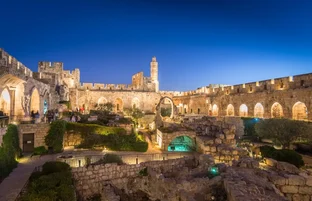
The citadel tower, beside the Jaffa Gate, is called the Tower of David, although historically, this site was developed 800 years after David had died. Three massive towers built by Herod on the foundations of Hasmonean fortifications originally stood on this spot. Just to the south, close to the protection of the garrison in the Jaffa Gate's tower, would have been Herod's palace. After the destruction of Jerusalem by the Romans in A.D. 70, the foundations of the towers guarding the Jaffa Gate were among the few structures not deliberately obliterated on orders from Rome. They were left standing to show there had once been a city that had been no pushover to subdue. Each of the subsequent rulers of Jerusalem, from Romans and Byzantines to Muslims, Crusaders, and Ottoman Turks, has rebuilt the fortifications beside Jaffa Gate, though none have come close to the scale of Herod's Towers.

The Tower of David Museum of the History of Jerusalem, Omar Ibn el Khatab Square (tel. 02/626-5233; www.towerofdavid.co.il), now fills the Citadel, hosting well-chosen, often very exciting temporary art and history exhibits and an array of permanent dioramas and multimedia presentations about Jerusalem and its history. Although some of the permanent exhibits look like illustrations from a school textbook, they are useful teaching tools. The structure of the citadel itself, with its great views of the New and Old cities, is fascinating. In the past, when tourism was up, the citadel provided a dramatic setting for an interactive teaching performance called "The Great King Herod Murder Mystery," during which the audience was invited to untangle a web of intrigues and murders that actually occurred in the Herodian court 2,000 years ago. The courtyard of the citadel has also been a venue for concerts and for performances of plays by contemporary Israeli writers. From April to October, a sound-and-light show that narrates Jerusalem's history in 40 minutes is presented in English on Saturdays at 9pm, and on Mondays and Wednesdays at 9:30pm. Bring warm clothes for evening performances. If the special performances and events are revived, look for discount admission packages to the museum, the mystery performance, and the sound-and-light show for children, students, and seniors. Admission to the tower costs NIS 30 ($6.60); there's an additional charge for special exhibits. The museum is open Sunday to Thursday 10am to 5pm; Friday 10am to 2pm; and Saturday 10am to 4pm.

A breach in the city walls beside Jaffa Gate was made for the visit of Kaiser Wilhelm II and his entourage in 1898. Here the leader of the British forces, General Allenby, liberating Palestine from Ottoman rule, entered Jerusalem in 1917. Today, this breach allows automobiles to penetrate into the area of the Old City just inside the Jaffa Gate.

If you head straight into the bazaar (the suq) from the Jaffa Gate, you'll enter David Street, bustling with shops selling religious crafts and souvenirs, maps, and household items. On your left, just past the entrance to David Street, is the Petra Hotel, which in its day (more than a century ago) was Jerusalem's most elegant accommodation for visitors. Although the Petra Hotel is now a backpacker's hostel, the view from the roof is one of the most spectacular in Jerusalem, with the Dome of the Rock perfectly centered in front of you, and the entire Old City at your feet. Ask to visit the roof at the desk just inside the lobby on the second floor; the fee is NIS 5 ($1.10) per person. After this overview, you'll have a better idea of where things are in the maze you're about to enter.

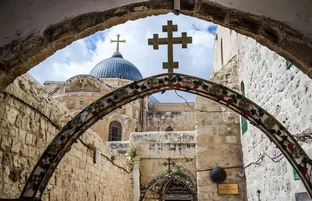
If your first destination is the Church of the Holy Sepulcher, then take the first left off David Street, called Christian Quarter Road. Follow this road until you come to St. Helena's Road, a stepped bazaar on the right that will lead you down to the entrance to the Church.

If the Western Wall and the Temple Mount are your first goal, continue straight along David Street. It makes a quick jog to the right and then to the left in the heart of the covered bazaar, where it changes its name to Street of the Chain (Silsileh, Shalshelet). Follow the street downhill as the bazaar continues. Eventually, a right on a small side street marked Ha-Kotel leads to the Western Wall. If you go straight down the Street of the Chain, however, you arrive at the Gate of the Chain, an entrance to the Temple Mount, otherwise known as the Noble Enclosure (Haram es-Sharif), with the Dome of the Rock and Al Aqsa Mosque its main attractions. At present, entrance to the Temple Mount for Tourists is permitted only through the Mograbi Gate, just to the right of the Western Wall.

Armenian Quarter

As you enter Omar Ibn el Kattab Square on David Street, you'll see a road heading off to the right, past the moat. This route is the Armenian Patriarchate Road, leading into the Armenian Quarter, a quiet residential area centered around Armenian religious structures. Armenia was the first nation to adopt Christianity, predating Emperor Constantine's conversion of the Roman Empire by several decades. From that time on there has always been an Armenian presence in Jerusalem.

In the Armenian Quarter are many hidden enclaves and ancient buildings, including the Church of the Holy Archangels, from the early medieval period, and the Gulbenkian Library, containing more than 4,000 illuminated manuscripts, some of which can be seen during special exhibits. Access to these sites is variable.

The splendid St. James Cathedral, entered through the Armenian Monastery on Armenian Patriarchate Road, dates from the 11th and 12th centuries and is built on the site of earlier churches. It commemorates the place where James the Elder, son of Zebedee, was put to death by order of Herod Agrippas I in A.D. 44 (Acts 12:2). The cathedral also contains the tomb of James, the oldest brother of Jesus and first bishop of the Jerusalem Christian community. This James was the author of the Epistle of James and was stoned to death in A.D. 62. The cathedral, with its rich interior of hanging lamps, censers (for burning incense), and ceremonial objects, may be visited for services daily from 3 to 3:30pm.

The Helen and Edward Mardigian Museum of Armenian Art and History (tel. 02/628-2331) displays a magnificent collection of artifacts and religious objects as well as a chronicle of Armenian history. It is open Monday to Saturday from 10am to 5pm; admission is NIS 5 ($1.10).

The Armenian Patriarchate Road follows the inside of the Old City wall and winds around to the left, passing the Zion Gate, the Jewish Quarter parking lot (inside the Old City walls) and eventually leading downhill to the Western Wall and above the Western Wall, the Dome of the Rock.

Note: The intricacies of the secluded Armenian Quarter are difficult to explore on your own. Mr. Aram Khatchadourian, a licensed guide and member of Jerusalem's Armenian community, gives full or half day private walking tours of the Armenian and other quarters of the Old City, with a special emphasis on the Armenian Quarter. He can be reached at tel. 050/735-1859; P.O. Box 14003 Old City, Jerusalem, Israel.

Damascus Gate & the Bazaars

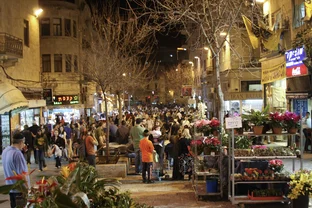
The Damascus Gate, largest and most magnificent of all the entrances to the Old City, is the main route into the Old City from East Jerusalem. Once you are inside the gate, cafes, shops, and market stalls line a wide-stepped entrance street going downhill; Arabs sit inside and out smoking water pipes and watching you as you watch them. The game they're playing is shesh-besh, a sort of backgammon. Music emanates from coffeehouses and shops. Whether you take El-Wad Road (the Valley Rd.) to the left, or Suq Khan es-Zeit (the Market of the Inn of the Olive Oil) to the right, the way becomes very narrow and confusing. Unlike the markets near the Jaffa Gate, which cater primarily to visitors, this part of the bazaar is an authentic market used by the people of East Jerusalem. You'll see stalls of spices and coffees, blacksmiths, craft shops, pastry and bread bakeries, shops selling sneakers and children's wear, butcher stalls, tiny one-chair barber establishments, shoe stores, and fruit and vegetable stands.

Suq Khan es-Zeit eventually becomes the covered Suq el Attarin, or Bazaar of the Spices, now mostly a clothing bazaar. In other centuries, this covered market was lined with open sacks of curry, cocoa, sesame, pepper, saffron, and all kinds of beans, dried herbs, medicines, and vegetables. Parallel and to the right of this central market street is the covered Suq El-Lahhamin (the Butchers' Bazaar), its pavement often slippery with puddles of blood.

If you continue walking straight, eventually Suq El Attarin will cross David Street and soon thereafter, it becomes the recently excavated and renovated Cardo (the main street of Roman and Byzantine Jerusalem), which runs through the restored Jewish Quarter. The area, incidentally, is well patrolled by police officers.

The Old City Ramparts

A good place to explore is the walk on the Old City walls. You can enter the wall route at Damascus Gate, although you can also enter at Zion Gate or Jaffa Gate. The views are thrilling and an entire circuit of the walls is about 4km (2 1/2 miles), or less than an hour's walk. Underneath the present Damascus Gate, the Roman-era gate, to the left and below, has been excavated. Within this classical, triple-arched gate (which may have been extant in Jesus' time) there's a small museum, displaying laser reconstructions of the original gate, and worth a quick visit. Again, notice how much lower ground level was before 2,000 years of destruction and rebuilding.

Note: It's not a great idea for anyone to walk alone on the ramparts at any time of day. The ramparts are at times patrolled by groups of unruly local kids and unsavory illegal "guides."

The entry ticket costs NIS 18 ($4) for adults, NIS 10 ($2.20) for students, and is good for 2 days (3 days if you buy on Fri). The ramparts are open Saturday to Thursday from 10am to 4pm, and on Friday from 9am to 2pm.

Street of the Chain

Perpendicular to the Suq El Attarin-Cardo market is the Street of the Chain, which runs gently downhill to the Gate of the Chain, the most important entrance to the Haram es Sharif or Temple Mount. This was the great residential street of medieval Islamic Jerusalem. It starts out as a typical market passageway, but as you get closer to the Haram, you'll begin to notice monumental, richly ornamented doorways of Mameluk period mansions and buildings decorated with carved stonework in "stalactite" patterns over the entranceways. You can only surmise this area's affluent past; like much of the Old City, the neighborhood is overcrowded and has not yet benefited from programs of preservation and renovation.


Back to Top


Click the names below for more detailed information.


Maps

Note: This information was accurate when it was published, but can change without notice. Please be sure to confirm all rates and details directly with the companies in question before planning your trip.


  Email This Article Email Print This Article Print Get Frommer's RSS Feed RSS
Frommer's Israel, 4th Edition Frommer's Israel, 4th Edition

Author: Robert Ullian
Pub Date: November 06, 2006
Price: $21.99

Buy Now!
Related Titles:
Frommer's Dubai, 1st Edition
Frommer's Egypt, 1st Edition
Frommer's Israel, 5th Edition
Add Frommers.com RSS Feed  Add Frommers.com RSS Feed (What's This?)
Add Frommers.com Deals & News to Your Web Site
Add to My Yahoo!     Add to My MSN     More RSS Readers
Add Frommers.com Podcast Add Frommers.com Podcast (What's This?)
Home > Destinations > Middle East and Africa > Israel > Jerusalem > Attractions > The Old City