Home > Destinations > Middle East and Africa > Israel > Jerusalem > Attractions > West Jerusalem Attractions
Frommers.com Frommers.com
Most Recent Destination Forum Posts
Most Recommended Articles
Most Commented Articles
  Print This Article Print Get Frommer's RSS Feed RSS

West Jerusalem Attractions

Rechov Ha-Nevi'im (Street of the Prophets) was the "Christian street" of 19th-century West Jerusalem, and still has a variety of churches and missionary societies. From Zion Square, in the heart of downtown Jerusalem, cross Jaffa Road and go up the hill on Ha-Rav Kook Street. Opposite the intersection of Ha-Rav Kook and Ha-Nevi'im streets is the entrance to the narrow, high-walled Ethiopia Street, with its 19th-century stone mansions. Here you'll find the splendid Abyssinian (Ethiopian) Church. The elegant building with the Lion of Judah carved into the gate above the courtyard is the spiritual home of the Coptic Ethiopian clergy. The lion symbolizes the meeting of the Queen of Sheba, the Ethiopian empress, and King Solomon, from whom she traditionally received the emblem. The interior of the turn-of-the-20th-century circular church is filled with a wonderful array of icons and paintings; although none are in the Ethiopian tradition, many were chosen for their charm and native beauty. Bungalows for clergy and pilgrims from Ethiopia surround the church enclave.

Notre Dame de France is on Shivtei Israel Street at Zahal Square, just opposite New Gate in the Old City walls. The Assumptionist Fathers built this monastery in 1887 to serve as a pilgrim's hostel. The monumental buildings of the complex, on the old border between East and West Jerusalem, were badly damaged during heavy fighting in the 1948 war. Part of the complex, restored in the 1970s, serves as a hospital, a restaurant, a hotel, and a pilgrimage center.

Saint Andrew's Church of Scotland was built by the people of Scotland in 1929 and was dedicated by General Allenby, who liberated Jerusalem from the Ottoman Empire in 1917. This Presbyterian Church is situated on a hilltop near Abu Tor and the Jerusalem railroad station. Also at the top of Abu Tor, and built over the foundations of a medieval church, is the Greek Orthodox Monastery, called the "Church of Evil Counsel." It contains catacombs and crypts. Private cottages on the grounds are rented to fortunate Jerusalemites, including one of the country's most talented and respected poets.

The Russian Orthodox Holy Trinity Cathedral is just off Jaffa Road. This white multidomed architectural gem in the Renaissance style was originally constructed after the Crimean War for pilgrims of the Russian Orthodox faith.

There are also a number of interesting churches and monasteries in Ein Kerem and Rechavia, and in Abu Ghosh.

Two Dreams Restored -- Israel's earlier branch of Hadassah Hospital is on Mount Scopus, overlooking Jerusalem's Old City. Opened in 1938, in an ultramodern building designed by Erich Mendelssohn and funded by Hadassah supporters throughout the world, it was the pride of the Jewish community of British Mandate Palestine and the embodiment of a dream to bring quality medical care to all in Jerusalem, "without regard to nationality or religion." But at the time of the cease-fire at the end of Israel's War of Independence in 1948, Hadassah Hospital on Mount Scopus found itself a small Israeli-held bastion in middle of Jordanian-controlled East Jerusalem, protected by international agreement but cut off from Israeli-held West Jerusalem. So a new Hadassah Hospital was built in Ein Kerem at the far western edge of Jerusalem, where it would be relatively safe in case fighting again broke out. Ironically, when the Six-Day War erupted in 1967, one of the first places hit by Jordanian bombardment was the new hospital. When Marc Chagall learned that the windows he had created for the hospital's synagogue had been damaged, he promised to replace them, making them "more beautiful than ever." He more than succeeded. Today, Hadassah Mount Scopus is again open, and both Hadassah hospitals serve all the communities of Jerusalem.

Exploring West Jerusalem Neighborhoods

Yemin Moshe -- In the 1850s, British philanthropist Sir Moses Montefiore, with the help of Judah Touro from New Orleans, built the nucleus of this residential quarter, the first outside the walls of the Old City, in an effort to bring indigent Jews from the Old City into a more healthful environment. The project included a now-famous windmill for grinding flour. Despite its magnificent view and graceful architecture, the neighborhood remained poor for more than a century.

Today, Yemin Moshe is a picturesque, beautifully restored neighborhood -- an architectural treasure and one of the most elegant addresses in town. There are no shops, but the views are spectacular. It's a fascinating place for an early-evening or winter-afternoon stroll; however, a noontime walk in the hot July sun is not recommended. The steep pedestrian-street staircases of Yemin Moshe may make it a bit difficult for some.

Down one of the first flights of staircases is the Yemin Moshe Windmill, which houses a museum dedicated to Sir Moses Montefiore. It is open Sunday to Thursday from 9am to 4pm, and until 1pm on Friday. Admission is free. Below the windmill is the original row of old stone buildings (Mishkanot Sha'ananim), the first Jewish houses built outside the walls of the Old City since ancient times. Ornamented by Victorian ironwork porches, the buildings are now used as a residence by visiting artists and diplomats.

A replica of the Liberty Bell in Philadelphia stands in the center of Jerusalem's Liberty Bell Garden, not far from the windmill. The 2.8-hectare (7-acre) garden has a picnic area, vine-covered trellises, a large children's playground, and an entertainment area. You may wonder why a copy of the Liberty Bell has been made into the centerpiece of a Jerusalem park. The words inscribed on the American original were spoken by one of Jerusalem's most famous inhabitants, the Prophet Isaiah, more than 2,500 years before the Declaration of Independence was written: "Proclaim liberty throughout the land, and to all the inhabitants thereof." It was with these words that Israel's independence was announced in 1948.

Mea Shearim -- This area, a few blocks north of Jaffa Road, is populated by Hasidic and ultra-Orthodox Jews of East European origin. It is a world unto itself, and a visit here is like going back in time to the world of religious eastern European Jewry that existed before the Holocaust. Originally built in the late 19th century as a semifortified agricultural community in what was at that time open countryside, about a mile beyond the walls of the Old City, the neighborhood consists of numerous courtyards designed to be defended against unruly Bedouin marauders. In the 20th century, the area came to be inhabited by Hasidic rabbinical courts and followers of the many Hasidic sects that emigrated to Jerusalem from Europe. Some married women in this area, according to strict East European Orthodox tradition, wear wigs and scarves over their shaved heads. A number of residents speak only Yiddish in conversation, as Hebrew is considered too sacred for daily use. Some don't even recognize the laws of the Israeli government, believing that no State of Israel can exist before the coming of the Messiah. Demonstrators protesting such issues as medical autopsies, driving on Saturday, and coed swimming pools have clashed with police. The neighborhood is filled with synagogues, yeshivas, and small workshops and shops selling religious objects.

Architecturally, Mea Shearim has the feel of an 18th-century Polish ghetto, the more so because of the traditional dress and lifestyle of its residents. Visitors to this area are requested to dress modestly (no shorts, short skirts, uncovered arms or shoulders for women; slacks for men). Men and women are advised not to walk in close proximity (certainly not hand in hand), and visitors are advised to stow away cameras and to be very discreet in taking photographs. No inhabitant of Mea Shearim will voluntarily pose for snapshots, and there have been incidents in which improperly dressed visitors have been spat upon or stoned.

German Colony & Baka -- About 1.6km (1 mile) south of downtown West Jerusalem, these two picturesque neighborhoods, filled with overgrown gardens, are undergoing a process of gentrification. For many years, the old cottages and mansions (built at the start of the 20th c. by German Protestants and affluent Arabic families) housed Israelis from exotic places such as Kurdistan and Morocco, but more recently, members of Jerusalem's American, British, and Latin American immigrant communities have been moving in. The two charming neighborhoods offer family-run restaurants and shops that tend to reflect the area's ambience. Emek Refaim Street (a southern continuation of King David St.) is the German Colony's main artery; a walk down Yehoshua Ben Nun Street, which runs parallel to Emek Refaim 1 block to the west beginning at Rachel Immenu Street, gives you a better idea of the neighborhood's interesting residential architecture. Because of the area's newfound popularity, modern apartment buildings are being squeezed into every possible garden and empty lot. Much of the area was saved from demolition through efforts lead by Sara Fox Kaminiker, who came to Israel from the United States and served on the city council under the administration of Teddy Kollek (Sara Fox Kaminiker's book of walking tours, Footloose in Jerusalem, which includes this neighborhood, is highly recommended -- it's currently out of print, but you might be able to find it online or at smaller bookstores).

In Baka, the main street is Derech Bethlehem. On many of the narrow side streets running off this thoroughfare, you'll find eccentric examples of Arabic mansions and 1930s bungalows. For those who like architecture, the quiet back streets of both neighborhoods are good places to meander by bike.

Rechavia-Talbeyeh -- A turn to the west from King George V Avenue, at either the Jewish Agency compound or the Kings Hotel, will bring you into Jerusalem's most beautiful residential section, with its middle- and upper-class, tree-lined streets. Rechavia's glory is its collection of 1930s International Style apartment buildings and houses. Talbeyeh, just to the south, is filled with elaborate villas and mansions built mainly by Jerusalem's Arab Christian community in the 1920s and 1930s. Abandoned when their original owners fled in 1948, these houses are now inhabited by Israelis. Hovei Zion Street is lined with examples of these gracious homes.

Sights in the area include the prime minister's residence, at the corner of Balfour and Smolenskin; and the Alfasi grotto (also called the "Tomb of Jason"), on Alfasi Street, a frescoed and inscribed tomb discovered by builders while they were digging foundations (daily 10am-4pm). The medieval Monastery of the Cross, in the Valley of the Cross outside Rechavia, was built by Gregorian monks in the 11th century and is now maintained by the Greek Orthodox Church. According to tradition, the beautiful monastery is located on the spot where the tree stood from which the cross was made. If you don't want to walk down the rocky hillside from Rechavia to the monastery, take bus no. 9 or 17. The monastery is open Monday to Friday from 9am to 4pm. Admission is NIS 5 ($1.25/60p). At the southern edge of Rechavia, in Kiryat Shmuel, is Bet Ha-Nassi, the president's residence. You can look through the gates, but except for receptions, it is not open to the public.

Ein Kerem -- This ancient village, in a deep valley at the western edge of Jerusalem, is traditionally regarded as the birthplace of John the Baptist. Now incorporated into Jerusalem, you can reach it in less than 30 minutes by bus no. 17 from King George Street or Jaffa Road. The lanes and gardens of Ein Kerem (Well of the Vineyard) are lovely; the old Arabic-style houses have been grabbed up and renovated by some of the city's most successful and famous inhabitants; and high above the area, on the crest of the mountains, is the vast Hadassah-Ein Kerem Medical Center (not accessible from Ein Kerem itself). Ein Kerem contains a number of 19th-century European churches, convents, and monasteries. Most important is the Church of Saint John in the center of town, marking John the Baptist's birthplace (daily 6am-noon and 2-5pm); on request you can see the grotto beneath the church with its Byzantine mosaic. On Ma'ayan Street, you'll find the Church of the Visitation (daily 8-11:45am and 2-5pm), commemorating the visit of Mary to her cousin Elizabeth, the mother of John the Baptist. It was often depicted in medieval and early Renaissance paintings as a scene in which the two expectant women touch each other's stomachs, and according to legend, the two infants jumped for joy inside their mothers' wombs when Mary and Elizabeth met. Below the Youth Hostel off Ma'ayan Street is a mosque and minaret marking the well from which Mary drew water; farther along the ridge is the Russian Convent, known as the Moscobiyah, a fascinating enclave of 40 Jerusalem stone buildings scattered among a wooded area of pines and cypresses. The nuns live in small ocher-painted houses reminiscent of wooden cottages in Russia. You can make an appointment to visit by calling tel. 06/625-2565 or 02/541-2887. Bring a snack or canteen along, or you can pick up something in the grocery at the center of town. Restaurants here look appealing, but meals are expensive and nothing special. The times for return to Jerusalem should be posted at the bus stop in the center of Ein Kerem; you may have to wait in downtown Jerusalem for up to 30 minutes until the infrequent bus no. 17 to Ein Kerem picks you up.

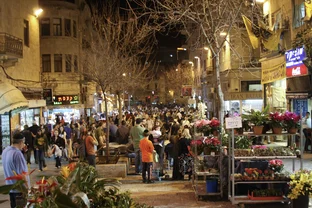
Machane Yehuda -- The Old Market Quarter -- liveliest on Wednesday and Thursday -- is off Jaffa Road, 1km (1/2 mile) west of Zion Square. In a square off Machane Yehuda and Jaffa Road, there is a war memorial commemorating the "Davidka," an improvised weapon used in the defense of Jerusalem.


Back to Top


Click the names below for more detailed information.

Note: This information was accurate when it was published, but can change without notice. Please be sure to confirm all rates and details directly with the companies in question before planning your trip.


  Print This Article Print Get Frommer's RSS Feed RSS
Destination Guide
Destination Guide Destination Guide Destination Guide
Destination Guide Destination Guide Frommer's Israel, 5th Edition Destination Guide Frommer's Israel, 5th Edition

Author: Robert Ullian
Pub Date: November 24, 2008
Price: $23.99

Add to Cart
Destination Guide Destination Guide Destination Guide Related Titles:
Frommer's Dubai and Abu Dhabi Day by Day
Destination Guide
Frommer's Dubai, 1st Edition
Destination Guide
Frommer's Egypt, 1st Edition
Destination Guide
Destination Guide Destination Guide
Destination Guide Destination Guide Destination Guide
Destination Guide
Destinations
Destinations
Home > Destinations > Middle East and Africa > Israel > Jerusalem > Attractions > West Jerusalem Attractions