Home > Destinations > Middle East and Africa > Israel > Jerusalem > Attractions > The Old City > The Jewish Quarter
Bookstore Travel Talk - Our Message Boards Tips and Tools Book a Trip Deals and News Trip Ideas, Activities, Lifestyles Hotels Destinations Frommers.com Home
Frommer's - The best trips start here. Frommer's - The best trips start here.
Sign up for our FREE Newsletters! Win a FREE Trip
  Email This Article Email Print This Article Print Get Frommer's RSS Feed RSS

The Old City

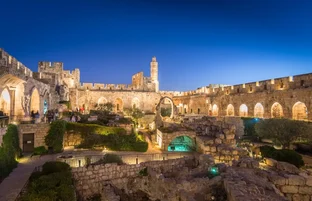
Let's take a detour through the Jewish Quarter on our way to the Western Wall and Temple Mount. By doing so, you'll save an uphill walk, as the wall lies well below most of the quarter. But first, some history and information about this part of town and its relationship to the other parts of the Old City.

The Jewish Quarter lies directly west of the Temple Mount and sits on a higher hill than the Temple Mount itself. With the exception of the sacred Temple Mount, the entire original city of Jerusalem from the time of David (1000 B.C.) was outside the walls of the present Old City, just downhill and to the south. Over the centuries, ancient Jerusalem spread northward, up the slope. By the time of King Hezekiah, around 700 B.C., much of the uphill area now occupied by the Jewish Quarter had become a new addition to the city, surrounded by the Broad Wall. But the wall and its many towers were not strong enough to keep out Nebuchadnezzar of Babylon, who conquered and laid waste to Jerusalem in 586 B.C.

Jews returned to Jerusalem after the Babylonian Captivity, but it took centuries for the city to regain its former size. In the late Second Temple period, Jerusalem again expanded uphill and the area that is now the Jewish Quarter was inhabited once more and developed into the aristocratic and priestly residential neighborhood, with many luxurious mansions overlooking the Temple Mount. The main market street of Herodian Jerusalem developed at the bottom of the Tyropoean (Cheesemakers') Valley, which separates the heights of the Jewish Quarter from the Temple Mount. The market street continued northward to the Damascus Gate. In order that thousands of religious pilgrims could make their way to the Temple Mount without becoming entangled in the crush of the market, two massive pedestrian staircases and overpasses were constructed above the market street. By the 1st century A.D., Herodian Jerusalem had expanded further northward, beyond the present Old City's northern wall and the Damascus Gate. A new, bustling upper market developed where the present Suq Khan el Zeit market leads toward the Damascus Gate. The original City of David, the oldest part of town, came to be known as the Lower City.

Jerusalem was again leveled in A.D. 70 by Roman armies (the remains of houses burned in that conflagration have been uncovered in what is now the Jewish Quarter); 65 years after the Romans destroyed Jerusalem, they (and later their Byzantine successors) rebuilt the city. You can visit several recently uncovered vestiges of Byzantine times in the Jewish Quarter, including the Nea Church, and the southern end of the city's colonnaded north-south thoroughfare, the Cardo Maximus. Jews were forbidden to reside in Jerusalem during the long Byzantine period, which began in A.D. 326, and many Jewish inhabitants of the area allied themselves with the then pagan Persians, who conquered and occupied the Jerusalem from A.D. 614 to 629. The Byzantines returned, followed quickly by the Muslims, who conquered Jerusalem in A.D. 638. Under their more tolerant rule, a permanent Jewish community was reestablished in the northeast quadrant of the Old City, on the site of the present Muslim Quarter. The Crusaders conquered Jerusalem in 1099 and celebrated their triumph by massacring most of the city's Jewish population as well as thousands of Muslims and local Christians.

In 1267, after the Crusaders were driven from Jerusalem, a small Jewish community reestablished itself in the ruins of what is now the Jewish Quarter. This area has been the center of the Jewish community in the Old City ever since.

The Jewish Quarter's most recent destruction came during and after the 1948 war with Jordan, when all the synagogues and most other buildings in the quarter were severely damaged, and over the next 2 decades fell into almost total ruin; many were systematically demolished. Since the Israeli conquest of the Old City during the 1967 War, the quarter has been rebuilt and revitalized. Although some buildings have been carefully re-created, and many new structures were designed to blend in with them, the basic nature of the current Jewish Quarter is quite different from the impoverished, densely populated neighborhoods that existed here before 1948.

Following St. James Road (a left turn off Armenian Patriarchate Rd.) to where it becomes Or Hayim Street, you'll come to the Old Yishuv Court Museum, 6 Or Hayim St. (tel. 02/628-4636). This museum displays artifacts and crafts typical of Ashkenazi and Sephardic communities in the Jewish Quarter from the middle of the 19th century to the end of Turkish rule in 1917. Admission is NIS 14 ($3), and it's open Monday to Thursday from 9am to 2pm.

The Cardo Maximus is a recently excavated 2nd- to 6th-century A.D. street that was Roman and Byzantine Jerusalem's main market and processional thoroughfare, once bordered by stately columns and lined with portico-shaded shops. What you see now, some 8 feet beneath the level of the bordering Jewish Quarter Road, dates from the Byzantine period. The original street is said to have been laid out by the Roman Emperor Hadrian (A.D. 117-38) when he rebuilt the city as Aelia Capitolina after the Bar-Kokhba Revolt of A.D. 132-35. In late Byzantine times, the Cardo was extended southward and served as the processional route between the Holy Sepulcher and the Nea, Jerusalem's two largest churches of that era.

The southern portion of the Cardo is open to the sky; the rest is beneath the modern buildings of the Jewish Quarter. At the end of Or Hayim Street, you can visit the open area of the Cardo; its imposing columns, found by archaeologists, have been reerected. As you walk northward along the reconstructed Cardo, where modern tourist shops have been installed, you can see on your right the walled-up facades of Crusader-era shops built into arches. In this restored section you can look down well-like structures that reveal how far above the original level of the land the city has risen in its constant rebuilding on the ruins of each wave of destruction. You'll also see fragments of the city's defensive walls dating from the First Temple period, about 700 B.C.

Parallel to the Cardo is the Jewish Quarter Road. At the far side of the parking lot at the southern end of Jewish Quarter Road are the ruins of the Nea Church, long sought by archaeologists and only recently uncovered. The Nea (or "New" in Greek) was Byzantine Jerusalem's largest and second most important church after the Church of the Holy Sepulcher. Built by Justinian in A.D. 543, the Nea was destroyed either by an earthquake in the late 6th century, or during the Persian conquest of A.D. 614. So complete was the Nea's eradication that its precise location was only discovered during excavations in the 1980s. Some historians theorize that the many marble columns needed to build the vast Nea may have been salvaged from the ruins of the Herodian temple, which had lain abandoned after its destruction in A.D. 70. Procopius, a contemporary Byzantine historian, reports a bit skeptically that the columns needed to build the Nea had magically appeared near the construction site as if from heaven. If the Nea's columns had indeed been taken from the Temple Mount, then outraged Jews who aided the Persians in their conquest of the city in A.D. 614, may have made a special effort to demolish a building constructed from pieces of their ruined Temple. Ironically, these building materials may have returned to the Temple Mount in the 7th century when the Islamic conquerors of Jerusalem reused material from the city's many ruined Byzantine structures to build the Al Aqsa Mosque and the Dome of the Rock. To the untrained eye, unfortunately, there is not much to see, but these few recently discovered fragments of the long-lost Nea provide a physical basis to one of Jerusalem's great and elusive legends.

Many Jewish Quarter buildings from other times are today recalled by only a single arch, doorway, or minaret. You can inspect the haunting arches, altar, apse, and ruined cloister from the once lost Crusader Church of Saint Mary of the Teutonic Knights (1128) on Misgav Ladach Street. If you enter the ruins, walk back to the apse, where the windows frame a wonderful view of the Temple Mount. Across from the entrance to the church is a small covered square known as the Seven Arches. In the pre-1948 Jewish Quarter, the Seven Arches was the heart of a lively market packed with vegetable vendors and customers. Rebuilt in its original form after 1967, the Seven Arches no longer host a market, and seem to perform no function. To the west, you'll see the minaret from the Sidnah Omar Mosque, and beside it a single broad, graceful arch, rebuilt from the remains of the Hurva Synagogue, which was once the Great Synagogue of the Jewish Quarter. Its name, meaning "ruin," recalls its difficult and unfortunate history. The original Hurva was built in the 16th century with Ottoman permission, but was soon destroyed by Ottoman decree. Over the centuries, the name "hurva" became attached to the desolate site that had been built with so much hope and pride. In the 1850s, a new synagogue was authorized and built. Heavily damaged in the 1948 war, it was destroyed after the Jordanians captured the Jewish Quarter. Since 1967, there have been a number of movements and plans (including one by the visionary American architect, Louis Kahn) calling for a new Hurva, but for now, the arch, marking the line of the building's domed roof, stands as a memorial to the synagogue that once was.

Between the minaret and the Hurva Arch is the Ramban Synagogue of Rabbi Moshe Ben-Nachman, who helped reconstitute the Jewish community of Jerusalem in 1267, after it had been obliterated by the Crusaders. You'll also want to take a look at the complex of four small Sephardic synagogues named for Rabbi Yochanan Ben-Zakkai, whose school, according to tradition, occupied this site during the Second Temple period. One of the four is named for the rabbi himself, another for Eliyahu Ha-Navi (Elijah the Prophet); the other two are the Central Synagogue and the Istanbuli Synagogue. During Muslim rule, no church or synagogue was allowed to exceed the height of the nearest mosque, so to gain headroom, the floors of these synagogues were laid well below ground level. The synagogues are open Sunday to Thursday from 9:30am to 4pm, and Friday from 9:30am to noon. Admission is NIS 12 ($2.60).

The Tiferet Israel (or Yisrael) Synagogue (Ashkenazi, or Eastern European Jewish) was founded by Nisan Bek and inaugurated in 1865. Dedicated to the Hasidic Rabbi Israel Friedmann of Ruzhin (the synagogue's name means "Glory of Israel"), it was destroyed after the War of Independence and was recently restored.

Moving eastward across the Jewish Quarter in the direction of the Western Wall, you can visit two remnants of the neighborhood's elegant Herodian past.

The Herodian Quarter Wohl Museum (tel. 02/628-3448) contains archaeological excavations, done in the 1970s, of the wealthy residential quarter of Herodian Jerusalem. It includes remains of a palatial mansion with painted faux marble walls, mosaic floors, an atrium pool, and ritual bath installations indicative of the prevailing standard of living and religious observance in this affluent quarter. Admission is NIS 14 ($3), or by combined ticket NIS 20 ($4.40) with the Burnt House. It's open Sunday to Thursday from 9am to 5pm, on Friday from 9am until 1pm.

The Burnt House (tel. 02/628-7211) is a remnant of the destruction of Jerusalem by the Romans in A.D. 70. The wealthy Upper City, site of the present Jewish Quarter, held out for a despairing month after the Lower City and Temple Mount fell. From these heights, the inhabitants of the Upper City stood on their roofs and watched with horror as the temple went up in flames. When the Romans finally decided to storm the Upper City, they found little resistance; much of the population was near death from disease and starvation. The Burnt House chillingly brings to light the day when the Romans burned the Upper City. In the 1970s, when archaeologists excavated what was the kitchen or workroom of this building, they found the forearm bones of a young woman amid the debris. As diggers continued to excavate the area of the room that lay where the arm pointed, they uncovered a wooden spear, almost as if the young woman had been reaching for this weapon when she met her death. Most tantalizing of the household artifacts found on this site is a set of weights marked with the name "Bar Kathros," a priestly family mentioned in the Talmud (and also in an ancient folk song as one of the wealthy families that oppressed the poor). Historians know the House of Bar Kathros was responsible for the manufacture of incense for the temple. The excavated house, now preserved beneath modern buildings, is a museum with a brief slide show about the site. The entrance to the house is marked on a modern door in the Seven Arches off Misgav Ladach Road (ask if you have difficulty finding the door). The house is open Sunday to Thursday from 9am to 5pm, on Friday from 9am until noon. Admission is NIS 14 ($3); a combined ticket to Burnt House and Herodian Quarter can be purchased for NIS 20 ($4.40).


Back to Top


Click the names below for more detailed information.

Note: This information was accurate when it was published, but can change without notice. Please be sure to confirm all rates and details directly with the companies in question before planning your trip.


  Email This Article Email Print This Article Print Get Frommer's RSS Feed RSS
Frommer's Israel, 4th Edition Frommer's Israel, 4th Edition

Author: Robert Ullian
Pub Date: November 06, 2006
Price: $21.99

Buy Now!
Related Titles:
Frommer's Dubai, 1st Edition
Frommer's Egypt, 1st Edition
Frommer's Istanbul, 1st Edition
Add Frommers.com RSS Feed  Add Frommers.com RSS Feed (What's This?)
Add Frommers.com Deals & News to Your Web Site
Add to My Yahoo!     Add to My MSN     More RSS Readers
Add Frommers.com Podcast Add Frommers.com Podcast (What's This?)
Home > Destinations > Middle East and Africa > Israel > Jerusalem > Attractions > The Old City > The Jewish Quarter