Home > Destinations > Europe > Spain > Madrid > Planning a Trip > Getting There
Bookstore Travel Talk - Our Message Boards Tips and Tools Book a Trip Deals and News Trip Ideas, Activities, Lifestyles Hotels Destinations Frommers.com Home
Frommer's - The best trips start here. Frommer's - The best trips start here.
Sign up for our FREE Newsletters! Win a FREE Trip
  Email This Article Email Print This Article Print Get Frommer's RSS Feed RSS

Getting There

Getting There by Car

If you're touring the rest of Europe in a rented car, you might, for an added cost, be allowed to drop off your vehicle in a Madrid.

Highway approaches to Spain are across France on expressways. The most popular border crossing is near Biarritz, but there are 17 other border stations between Spain and France. If you plan to visit the north or west of Spain (Galicia), the Hendaye-Irún border is the most convenient frontier crossing. If you're going to Barcelona or Catalonia and along the Levante coast (Valencia), take the expressway in France to Toulouse, then the A-61 to Narbonne, and then the A-9 toward the border crossing at La Junquera. You can also take the RN-20, with a border station at Puigcerdà.

If you're driving from Britain, make sure you have a cross-Channel reservation, as traffic tends to be very heavy, especially in summer.

The major ferry crossings connect Dover and Folkestone with Dunkirk. Newhaven is connected with Dieppe, and the British city of Portsmouth with Roscoff. Taking a car on the ferry from Dover to Calais on P & O Ferries (tel. 800/677-8585 in North America or 08705/20-20-20; www.poferries.com) costs £99 ($188) and takes 1 1/4 hours. This cost includes the car and two passengers.

One of the fastest crossings is by hovercraft from Dover to Calais. It costs more than the ferry, but it takes only about half an hour. For reservations and information, call Hoverspeed (tel. 800/677-8585 for reservations in North America, or 0870/240-8070 in England; www.hoverspeed.com). The hovercraft takes 35 minutes and costs £138 to £215 ($262-$409) for the car and two passengers. The drive from Calais to the border would take about 15 hours.

You can take the Chunnel, the underwater Channel Tunnel linking Britain (Folkestone) and France (Calais) by road and rail. Eurostar tickets, for train service between London and Paris or Brussels, are available through Rail Europe (tel. 800/EUROSTAR; www.eurostar.com for information). In London, make reservations for Eurostar at tel. 0870/530-00-03. The tunnel also accommodates passenger cars, charter buses, taxis, and motorcycles, transporting them under the English Channel from Folkestone, England, to Calais, France. It operates 24 hours a day, 365 days a year, running every 15 minutes during peak travel times, and at least once an hour at night. Tickets may be purchased at the tollbooth at the tunnel's entrance. With "Le Shuttle," gone are the days of weather-related delays, seasickness, and advance reservations.

Once you land, you'll have about a 15-hour drive to Spain.

If you plan to transport a rental car between England and France, check in advance with the rental company about license and insurance requirements and additional drop-off charges. And be aware that many car-rental companies, for insurance reasons, forbid transport of one of their vehicles over the water between England and France.

Car Rentals -- Many of North America's biggest car-rental companies, including Avis, Budget, and Hertz, maintain offices throughout Spain. Although several Spanish car-rental companies exist, we've received lots of letters from readers of previous editions telling us they've had hard times resolving billing irregularities and insurance claims, so you might want to stick with the U.S.-based rental firms.

Note that tax on car rentals is a whopping 15%, so don't forget to factor that into your travel budget. Usually, prepaid rates do not include taxes, which will be collected at the rental kiosk itself. Be sure to ask explicitly what's included when you're quoted a rate.

Avis (tel. 800/331-1212; www.avis.com) maintains about 100 branches throughout Spain, including about a dozen in Madrid. If you reserve and pay for your rental by telephone at least 2 weeks before your departure from North America, you'll qualify for the company's best rate, with unlimited kilometers included.

You can usually get competitive rates from Hertz (tel. 800/654-3131; www.hertz.com) and Budget (tel. 800/472-3325; www.budget.com); it always pays to comparison shop. Budget doesn't have a drop-off charge if you pick up a car in one Spanish city and return it to another. All three companies require that drivers be at least 21 years of age and, in some cases, not older than 72. To be able to rent a car, you must have a passport and a valid driver's license; you must also have a valid credit card or a prepaid voucher. An international driver's license is not essential, but you might want to present it if you have one; it's available from any North American office of the American Automobile Association (AAA).

Two other agencies of note include Kemwel Holiday Auto (tel. 877/820-0668; www.kemwel.com) and Auto Europe (tel. 800/223-5555; www.autoeurope.com).

Many packages include airfare, accommodations, and a rental car with unlimited mileage. Compare these prices with the cost of booking airline tickets and renting a car separately, in order to see if these offers are good deals. Internet resources can make comparison shopping easier. Expedia (www.expedia.com) and Travelocity (www.travelocity.com) help you compare prices and locate car-rental bargains from various companies nationwide. They will even make your reservation for you once you've found the best deal.

Most cars rented in Spain are stick shift, not automatic. Most have air-conditioned, and nearly all use unleaded gas.

Driving Rules -- Spaniards drive on the right side of the road. Drivers should pass on the left; local drivers sound their horns when passing another car and flash their lights at you if you're driving slowly (slowly for high-speed Spain) in the left lane. Autos coming from the right have the right-of-way.

Spain's express highways are known as autopistas, which charge a toll, and autovías, which don't. To exit in Spain, follow the SALIDA (exit) sign, except in Catalonia, where the exit sign says SORTIDA. On most express highways, the speed limit is 120kmph (75 mph). On other roads, speed limits range from 90kmph (56 mph) to 100kmph (62 mph). You will see many drivers far exceeding these limits.

The greatest number of accidents in Spain is recorded along the notorious Costa del Sol highway, Carretera de Cádiz.

If you must drive through Madrid -- or any other Spanish city -- try to avoid morning and evening rush hours. Never park your car facing oncoming traffic, as that is against the law. If you are fined by the highway patrol (Guardia Civil de Tráfico), you must pay on the spot. Penalties for drinking and driving are very stiff (N.B. breathalyzers are far more strictly used than in the past).

Maps -- For one of the best overviews of the Iberian Peninsula (Spain and Portugal), get Michelin map no. 990 (folded version) or map no. 460 (spiral-bound version). For more detailed looks at Spain, Michelin has a series of six maps (nos. 441-446) showing specific regions, complete with many minor roads.

For extensive touring, purchase Mapas de Carreteras -- España y Portugal, published by Almax Editores and available at most leading bookstores in Spain. This cartographic compendium of Spain provides an overview of the country and includes road and street maps of some of its major cities.

The American Automobile Association (www.aaa.com) publishes a regional map of Spain that's available free to members at most AAA offices in the United States. Incidentally, the AAA is associated with the Real Automóvil Club de España (RACE; tel. 90-240-45-45; www.race.es). This organization can supply helpful information about road conditions in Spain, including tourist and travel advice. It will also provide limited road service, in an emergency, if your car breaks down.

Breakdowns -- These can be a serious problem. If you're driving a Spanish-made vehicle that needs parts, you'll probably be able to find them. But if you are driving a foreign-made vehicle, you may be stranded. Have the car checked before setting out on a long trek through Spain. On a major motorway you'll find strategically placed emergency phone boxes. On secondary roads, call for help by asking the operator to locate the nearest Guardia Civil, which will put you in touch with a garage that can tow you to a repair shop.

As noted above, the Spanish affiliate of AAA can provide limited assistance in the event of a breakdown.

All highways within Spain radiate outward from Madrid, connecting on both inward and outward journeys with the M-30 and M-40 highways that encircle the city. The following are the major highways into Madrid, with information on driving distances to the city:

Highways to Madrid --
Route From Distance to Madrid

N-I Irún 507km (315 miles)

N-II Barcelona 626km (389 miles)

N-III Valencia 349km (217 miles)

N-IV Cádiz 625km (388 miles)

N-V Badajoz 409km (254 miles)

N-VI Galicia 602km (374 miles)

By Bus

Bus travel to Spain is possible but not popular -- it's quite slow. But coach services do operate regularly from major capitals of Western Europe to Madrid, from which bus connections can be made to Seville. The busiest routes are from London and are run by Eurolines Limited, 52 Grosvenor Gardens, London SW1W 0AU (tel. 0990/143-219 or 020/7730-8235). The journey from London's Victoria Station to Madrid is provided by two services: Service 180 is an express from Victoria Station to Madrid, departing London daily at 9pm, arriving in Madrid the following day at 9:30pm; and Service 181 leaves London at 9pm on the first day, arriving in Madrid at 12:30am on the third day.

If you're touring the rest of Europe in a rented car, you might, for an added cost, be allowed to drop off your vehicle in Madrid.

By Train

If you're already in Europe, you may want to get to Spain by train, especially if you have a Eurailpass. Even if you don't, the cost is moderate. Rail passengers who visit from Britain or France should make couchette (bunk beds in a sleeper car) and sleeper reservations as far in advance as possible, especially during the peak summer season.

Since Spain's rail tracks are of a wider gauge than those used for French trains (except for the Talgo and Trans-Europe-Express trains), you'll probably have to change trains at the border unless you're on an express train . For long journeys on Spanish rails, seat and sleeper reservations are mandatory.

The most comfortable and fastest trains in Spain are the AVE, Altaria, TER, Talgo, and Electrotren. You will have to pay a supplement to ride on these fast trains, however. Both first- and second-class fares are sold on Spanish trains. Tickets can be purchased in either the United States or Canada at the nearest office of French Rail or from any reputable travel agent. Confirmation of your reservation will take about a week.

If you want your car carried, you must travel Auto-Expreso in Spain. This type of auto transport can be booked only through travel agents or rail offices once you arrive in Europe.

To go from London to Spain by rail, you'll need to change not only the train but also the rail terminus in Paris. In Paris it's worth the extra bucks to purchase a Talgo express or a "Puerta del Sol" express -- that way, you can avoid having to change trains once again at the Spanish border. Trip time from London to Paris is about 6 hours; from Paris to Madrid, about 15 hours or so, which includes 2 hours spent in Paris changing trains and stations. Many rail passes are available in the United Kingdom for travel in Europe.

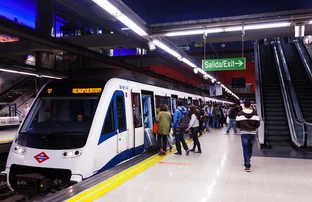
The main train station for arrivals from the north is Chamartín (the other main station is Atocha, which serves the south and east). From here there are direct Metro routes to all parts of Madrid. The Barcelona-to-Madrid Talgo currently takes 5 1/2 hours, but this will be cut by 2 hours by 2008. Other high-speed times to and from Madrid are: Seville (AVE), 2 1/2 hours; Valencia (Altaria). 3 1/2 hours; and Málaga (Talgo), 4 1/4 hours.


Back to Top


Note: This information was accurate when it was published, but can change without notice. Please be sure to confirm all rates and details directly with the companies in question before planning your trip.


  Email This Article Email Print This Article Print Get Frommer's RSS Feed RSS
Frommer's Madrid, 2nd Edition Frommer's Madrid, 2nd Edition

Author: Peter Stone
Pub Date: January 23, 2007
Price: $17.99

Buy Now!
Related Titles:
Frommer's Barcelona Day by Day, 1st Edition
Frommer's Barcelona, 2nd Edition
Frommer's Mediterranean Spain with Your Family: From Tranquil Villages to the Bustling Costas, 1st Edition
Add Frommers.com RSS Feed  Add Frommers.com RSS Feed (What's This?)
Add Frommers.com Deals & News to Your Web Site
Add to My Yahoo!     Add to My MSN     More RSS Readers
Add Frommers.com Podcast Add Frommers.com Podcast (What's This?)
Home > Destinations > Europe > Spain > Madrid > Planning a Trip > Getting There