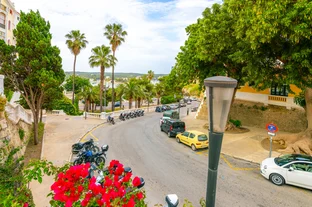
Adrian Sediles Embi / Shutterstock
Minorca Travel Guide
Barely 15km (9 1/3 miles) wide and less than 52km (32 miles) long, Menorca, the second largest of the Spanish Balearic Islands, is one of the most beautiful islands in the Mediterranean. Its principal city is Mahón (also called Maó), set on a rocky bluff overlooking the great port, which was fought over for centuries by the British, French, and Spanish.
Menorca has about 60,000 permanent inhabitants, and while it hosts half a million visitors a year, it is not overrun by tourism. The island has some industry, including leatherwork, costume-jewelry production, dairy farming, and even gin manufacturing. Life here is quiet and relaxed. Some clubs in Ibiza don’t even open until 4am, but on Menorca nearly everybody is in bed well before then.
Beaches are the island’s greatest attraction—Menorca has more beaches than Mallorca, Ibiza, and Formentera combined, stretching along 217km (135 miles) of pine-fringed coastline. Many are not connected by roads, and nude bathing is commonplace. (Technically, nudity is legal on any beach in Spain—as long as no one complains.) Our favorite beach is Cala En Porter, 11km (6[bf]3/4 miles) west of Mahón. Towering promontories guard the slender estuary where this spectacular beach is found. Another of Menorca’s treasures, Cala Galdana, is 36km (22 miles) west of Mahón; its gentle bay and excellent sandy beach afford the most scenic spot on the island.
In addition to trips to the beach, there are some fascinating things to do for those interested in history, archaeology, music, and art. Many artists live in Menorca, and exhibitions of their work are listed regularly in the local paper. The Catedral de Santa María in Mahón has one of Europe’s great pipe organs, at which world-famous organists have given concerts. Golf, tennis, and sailing are available at reasonable fees.
Start Exploring