Home > Destinations > Europe > France > Paris > Getting to Know > Neighborhoods in Brief
Bookstore Travel Talk - Our Message Boards Tips and Tools Book a Trip Deals and News Trip Ideas, Activities, Lifestyles Hotels Destinations Frommers.com Home
Frommer's - The best trips start here. Frommer's - The best trips start here.
Sign up for our FREE Newsletters! Win a FREE Trip
  Email This Article Email Print This Article Print Get Frommer's RSS Feed RSS

Neighborhoods in Brief

Each of Paris's 20 arrondissements possesses a unique style and flavor. You'll want to decide which district appeals most to you and then try to find accommodations there. Later on, try to visit as many areas as you can so you get the full taste of Paris.

1st Arrondissement (Musée du Louvre/Les Halles) "I never knew what a palace was until I had a glimpse of the Louvre," wrote Nathaniel Hawthorne. Perhaps the world's greatest art museum, the Louvre, a former royal residence, still lures visitors to the 1st Arrondissement. Walk through the Jardin des Tuileries, Paris's most formal garden (laid out by Le Nôtre, gardener to Louis XIV). Pause to take in the classic beauty of place Vendôme, the opulent home of the Hôtel Ritz. Zola's "belly of Paris" (Les Halles) is no longer the food-and-meat market of Paris (traders moved to the new, more accessible suburb of Rungis); today the Forum des Halles is a center of shopping, entertainment, and culture.

2nd Arrondissement (La Bourse) Home to the Bourse (stock exchange), this Right Bank district lies between the Grands Boulevards and rue Etienne-Marcel. From Monday to Friday, brokers play the market until it's time to break for lunch, when the movers and shakers of French capitalism channel their hysteria into the area restaurants. Much of the eastern end of the arrondissement (Le Sentier) is devoted to wholesale outlets of the Paris garment district, where thousands of garments are sold (usually in bulk) to buyers from clothing stores throughout Europe. "Everything that exists elsewhere exists in Paris," wrote Victor Hugo in Les Misérables, and this district provides ample evidence of that.

3rd Arrondissement (Le Marais) This district embraces much of Le Marais (the swamp), one of the best-loved Right Bank neighborhoods. (It extends into the 4th as well.) After decades of decay, Le Marais recently made a comeback, though it may never again enjoy the prosperity of its 17th-century aristocratic heyday; today it contains Paris's gay neighborhood, with lots of gay/lesbian restaurants, bars, and stores, as well as the remains of the old Jewish quarter, centered on rue des Rosiers. Two of the chief attractions are the Musée Picasso, a kind of pirate's ransom of painting and sculpture, which the Picasso estate had to turn over to the French government in lieu of the artist's astronomical death duties, and the Musée Carnavalet, which brings to life the history of Paris from prehistoric times to the present.

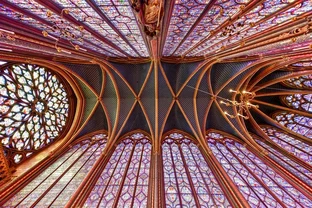
4th Arrondissement (Ile de la Cité/Ile St-Louis & Beaubourg) It seems as if the 4th has it all: Notre-Dame on Ile de la Cité, and Ile St-Louis and its aristocratic town houses, courtyards, and antiques shops. Ile St-Louis, a former cow pasture and dueling ground, is home to dozens of 17th-century mansions and 6,000 lucky Louisiens, its permanent residents. Seek out Ile de la Cité's two Gothic churches, Sainte-Chapelle and Notre-Dame, a majestic structure that, according to poet E. E. Cummings, "doesn't budge an inch for all the idiocies of this world." You'll find France's finest bird and flower markets along with the nation's law courts, which Balzac described as a "cathedral of chicanery." It was here that Marie Antoinette was sentenced to death in 1793. The 4th is also home to the freshly renovated Centre Pompidou, one of the top three attractions in France. After all this pomp and glory, you can retreat to place des Vosges, a square of perfect harmony and beauty where Victor Hugo lived from 1832 to 1848 and penned many of his famous masterpieces. (His house is now a museum.)

5th Arrondissement (Quartier Latin) The Latin Quarter is the intellectual heart and soul of Paris. Bookstores, schools, churches, clubs, student dives, Roman ruins, publishing houses, and expensive boutiques characterize the district. Discussions of Artaud or Molière over cups of coffee may be rarer than in the past, but they aren't out of place. Beginning with the founding of the Sorbonne in 1253, the quarter was called Latin because students and professors spoke the language. You'll follow in the footsteps of Descartes, Verlaine, Camus, Sartre, James Thurber, Elliot Paul, and Hemingway as you explore. Changing times have brought Greek, Moroccan, and Vietnamese immigrants, among others, offering everything from couscous to fiery-hot spring rolls and souvlaki. The 5th borders the Seine, and you'll want to stroll along quai de Montebello, inspecting the inventories of the bouquinistes (secondhand-book dealers), who sell everything from antique Daumier prints to yellowing copies of Balzac's Père Goriot in the shadow of Notre-Dame. The 5th also has the Panthéon, built by Louis XV after he recovered from gout and wanted to do something nice for St. Geneviève, Paris's patron saint. It's the resting place of Rousseau, Gambetta, Zola, Braille, Hugo, Voltaire, and Jean Moulin, the World War II Resistance leader whom the Gestapo tortured to death.

6th Arrondissement (St-Germain/Luxembourg) This is the heartland of Paris publishing and, for some, the most colorful Left Bank quarter, where waves of young artists still emerge from the Ecole des Beaux-Arts. The secret of the district lies in discovering its narrow streets, hidden squares, and magnificent gardens. To be really authentic, stroll with an unwrapped loaf of sourdough bread from the wood-fired ovens of Poilâne at 8 rue du Cherche-Midi. Everywhere you turn, you'll encounter historic and literary associations, nowhere more so than on rue Jacob. At no. 7, Racine lived with his uncle as a teenager; Richard Wagner resided at no. 14 from 1841 to 1842; Ingres lived at no. 27 (now it's the office of the French publishing house Editions du Seuil); and Hemingway once occupied a tiny upstairs room at no. 44. The 6th takes in the Jardin du Luxembourg, a 24-hectare (59-acre) playground where Isadora Duncan went dancing in the predawn hours and a destitute Ernest Hemingway went looking for pigeons for lunch, carrying them in a baby carriage back to his humble flat for cooking.

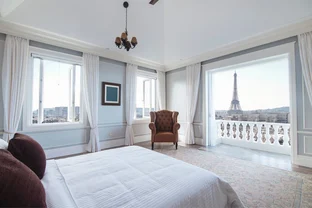
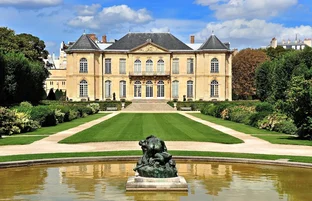
7th Arrondissement (Eiffel Tower/Musée D'Orsay) Paris's most famous symbol, la Tour Eiffel, dominates Paris and especially the 7th, a Left Bank district of residences and offices. The tower is one of the most recognizable landmarks in the world, despite the fact that many Parisians (especially its nearest neighbors) hated it when it was unveiled in 1889. Many of Paris's most imposing monuments are in the 7th, like the Hôtel des Invalides, which contains Napoleon's Tomb and the Musée de l'Armée, and the Musée d'Orsay, the world's premier showcase of 19th-century French art and culture, housed in the old Gare d'Orsay. But there's much hidden charm here as well. Rue du Bac was home to the swashbuckling heroes of Dumas's The Three Musketeers and to James McNeill Whistler, who moved to no. 110 after selling Mother. Auguste Rodin lived at what's now the Musée Rodin, 77 rue de Varenne, until his death in 1917.

8th Arrondissement (Champs-Elysées/Madelaine) The showcase of the 8th is the Champs-Elysées, stretching from the Arc de Triomphe to the Egyptian obelisk on place de la Concorde. By the 1980s, the Champs-Elysées had become a garish strip, with too much traffic, too many fast-food joints, and panhandlers. In the 1990s, Jacques Chirac, then the Gaullist mayor, launched a cleanup, broadening the sidewalks and planting new trees. Now you'll find fashion houses, elegant hotels, restaurants, and shops. Everything in the 8th is the city's best, grandest, and most impressive. It has the best restaurant (Taillevent), the sexiest strip joint (Crazy Horse Saloon), the most splendid square (place de la Concorde), the best rooftop cafe (La Samaritaine), the grandest hotel (the Crillon), the most impressive arch (Arc de Triomphe), the most expensive residential street (avenue Montaigne), the world's oldest subway station (Franklin-D.-Roosevelt), and the most ancient monument (the 3,300-year-old Obelisk of Luxor).

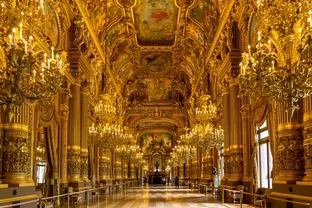
9th Arrondissement (Opéra Garnier/Pigalle) From the Quartier de l'Opéra to the strip joints of Pigalle (the infamous "Pig Alley" of World War II GIs), the 9th endures, even if fashion prefers other addresses. Over the decades, the 9th has been celebrated in literature and song for the music halls that brought gaiety to the city. The building at 17 bd. de la Madeleine was where Marie Duplessis, who gained fame as the heroine Marguerite Gautier in Alexandre Dumas the younger's La Dame aux Camellias, died. (Greta Garbo played her in the film Camille.) Place Pigalle has nightclubs, but is no longer home to cafe La Nouvelle Athènes, where Degas, Pissarro, and Manet used to meet. Other attractions include the Folies-Bergère, where cancan dancers have been high-kicking since 1868. It is the rococo Opéra Garnier (home of the Phantom) that made the 9th the last hurrah of Second Empire opulence. Renoir hated it, but generations later, Chagall painted its ceilings. Pavlova danced Swan Lake here, and Nijinsky took the night off to go cruising.

10th Arrondissement (Gare du Nord/Gare de l'Est) The Gare du Nord and Gare de l'Est, along with porno houses and dreary commercial zones, make the 10th one of the least desirable arrondissements for living, dining, or sightseeing. We try to avoid it except for one of our longtime favorite restaurants: Brasserie Flo (tel. 01-47-70-13-59), 7 cour des Petites-Ecuries, best known for its formidable choucroute, a heap of sauerkraut garnished with everything.

11th Arrondissement (Opéra Bastille) For many years, this quarter seemed to sink lower and lower into decay, overcrowded by working-class immigrants from the far reaches of the former Empire. The opening of the Opéra Bastille, however, has given the 11th new hope and new life. The facility, called the "people's opera house," stands on the landmark place de la Bastille, where on July 14, 1789, 633 Parisians stormed the fortress and seized the ammunition depot, as the French Revolution swept across the city. Over the years, the prison held such luminaries as Voltaire and the Marquis de Sade. The area between the Marais, Ménilmontant, and République is now being called "blue-collar chic," as the artistes of Paris who've been driven from the costlier sections of the Marais can now be found walking the gritty sidewalks of rue Oberkampf. Hip Parisians in search of a more cutting-edge experience are now living and working among the decaying 19th-century apartments and the 1960s public housing with graffiti-splattered walls.

12th Arrondissement (Bois de Vincennes/Gare de Lyon) Very few out-of-towners came here until a French chef opened a restaurant called Au Trou Gascon. The 12th's major attraction remains the Bois de Vincennes, sprawling on the eastern periphery of Paris. This park is a longtime favorite of French families who enjoy its zoos and museums, its royal châteaux and boating lakes, and its Parc Floral de Paris, a celebrated flower garden boasting springtime rhododendrons and autumn dahlias. Venture into the dreary Gare de Lyon for Le Train Bleu, 20 bd. Diderot (tel. 01-43-43-09-06), in the Gare de Lyon, 12e, a restaurant whose ceiling frescoes and Art Nouveau decor are national artistic treasures; the food is good, too. The 12th, once a depressing urban wasteland, has been singled out for budgetary resuscitation and is beginning to sport new housing, shops, gardens, and restaurants. Many will occupy the site of the former Reuilly rail tracks.

13th Arrondissement (Gare D'Austerlitz) Centered on the grimy Gare d'Austerlitz, the 13th might have its devotees, but we've yet to meet one. British snobs who flitted in and out of the train station were among the first of the district's foreign visitors and wrote the 13th off as a dreary working-class counterpart of London's East End. The 13th is also home to Paris's Chinatown, stretching for 13 square blocks around the Tolbiac Métro stop. It emerged out of the refugee crisis at the end of the Vietnam War, taking over a neighborhood that held mostly Arab-speaking peoples. Today, recognizing overcrowding in the district, the Paris civic authorities are imposing new, not particularly welcome, restrictions on population densities.

14th Arrondissement (Montparnasse) The northern end of this large arrondissement is devoted to Montparnasse, home of the "Lost Generation" and stomping ground of Stein, Toklas, Hemingway, and other American expatriates of the 1920s. After World War II, it ceased to be the center of intellectual life, but the memory lingers in its cafes. One of the monuments that sets the tone of the neighborhood is Rodin's statue of Balzac at the junction of boulevards Montparnasse and Raspail. At this corner are some of the world's most famous literary cafes, including La Rotonde, Le Select, La Dôme, and La Coupole. Though Gertrude Stein avoided them (she loathed cafes), other American expats, including Hemingway and Fitzgerald, had no qualms about enjoying a drink here (or quite a few of them, for that matter). Stein stayed at home (27 rue de Fleurus) with Alice B. Toklas, collecting paintings, including those of Picasso, and entertaining the likes of Max Jacob, Apollinaire, T. S. Eliot, and Matisse.

15th Arrondissement (Gare Montparnasse/Institut Pasteur) This is a mostly residential district beginning at Gare Montparnasse and stretching to the Seine. In size and population, it's the largest quarter of Paris, but it draws few tourists and has few attractions except for the Parc des Expositions, the Cimetière du Montparnasse, and the Institut Pasteur. In the early 20th century, many artists -- like Chagall, Léger, and Modigliani -- lived here in a shared atelier known as "The Beehive."

16th Arrondissement (Trocadero/Bois de Boulogne) Originally the village of Passy, where Benjamin Franklin lived during most of his time in Paris, this district is still reminiscent of Proust's world. Highlights include the Bois de Boulogne; the Jardin du Trocadéro; the Maison de Balzac; the Musée Guimet (famous for its Asian collections); and the Cimetière de Passy, resting place of Manet, Talleyrand, Giraudoux, and Debussy. One of the largest arrondissements, it's known today for its well-heeled bourgeoisie, its upscale rents, and some rather posh (and, according to its critics, rather smug) residential boulevards. The arrondissement also has the best vantage point to view the Eiffel Tower: place du Trocadéro.

17th Arrondissement (Parc Monceau/Place Clichy) Flanking the northern periphery of Paris, the 17th incorporates neighborhoods of bourgeois respectability (in its west end) and less affluent neighborhoods in its east end. It boasts two of the great restaurants of Paris, Guy Savoy and Michel Rostang.

18th Arrondissement (Montmartre) The 18th is the most famous outer quarter of Paris, containing Montmartre, the Moulin Rouge, Sacré-Coeur, and ultratouristy place du Tertre. Utrillo was its native son, Renoir lived here, and Toulouse-Lautrec adopted the area as his own. The most famous enclave of artists in Paris's history, the Bateau-Lavoir of Picasso fame, gathered here. Max Jacob, Matisse, and Braque were all frequent visitors. Today, place Blanche is known for its prostitutes, and Montmartre is filled with honky-tonks, souvenir shops, and terrible restaurants. You can still find pockets of quiet beauty, though. The city's most famous flea market, the Marché aux Puces de Clignancourt, is another landmark.

19th Arrondissement (La Villette) Today, visitors come to what was once the village of La Villette to see the angular Cité des Sciences et de l'Industrie, a spectacular science museum and park built on a site that for years was devoted to the city's slaughterhouses. Mostly residential and not at all upscale, the district is one of the most ethnically diverse in Paris, the home of people from all parts of the former Empire. A highlight is Les Buttes Chaumont, a park where kids can enjoy puppet shows and donkey rides.

20th Arrondissement (Père-Lachaise Cemetery) The 20th's greatest landmark is Père-Lachaise Cemetery, the resting place of Edith Piaf, Marcel Proust, Oscar Wilde, Isadora Duncan, Sarah Bernhardt, Gertrude Stein and Alice B. Toklas, Colette, Jim Morrison, and many others. Otherwise, the 20th arrondissement is a dreary and sometimes volatile melting pot comprising residents from France's former colonies. Though nostalgia buffs sometimes head here to visit Piaf's former neighborhood, Ménilmontant-Belleville, it has been almost totally bulldozed and rebuilt since the bad old days when she grew up here.


Back to Top


Note: This information was accurate when it was published, but can change without notice. Please be sure to confirm all rates and details directly with the companies in question before planning your trip.


  Email This Article Email Print This Article Print Get Frommer's RSS Feed RSS
Frommer's Paris 2008 Frommer's Paris 2008

Author: Darwin Porter
Pub Date: August 27, 2007
Price: $17.99

Buy Now!
Related Titles:
France For Dummies, 4th Edition
Frommer's 24 Great Walks in London, 1st Edition
Frommer's 24 Great Walks in Paris, 1st Edition
Sponsored Links: What's This?
You Never Know What's Out There. That's Why There's AIG Travel Guard.
Add Frommers.com RSS Feed  Add Frommers.com RSS Feed (What's This?)
Add Frommers.com Deals & News to Your Web Site
Add to My Yahoo!     Add to My MSN     More RSS Readers
Add Frommers.com Podcast Add Frommers.com Podcast (What's This?)
Home > Destinations > Europe > France > Paris > Getting to Know > Neighborhoods in Brief