Home > Destinations > Europe > France > Paris > Attractions > Neighborhoods Worth a Visit
Bookstore Community Tips and Tools Book a Trip Deals and News Trip Ideas, Activities, Lifestyles Hotels Destinations Frommers.com Home
Frommer's - The best trips start here. Frommer's - The best trips start here.
Sign up for our FREE Newsletters! Win a FREE Trip
  Email This Article Email Print This Article Print Get Frommer's RSS Feed RSS

Neighborhoods Worth a Visit

Some of Paris's neighborhoods are attractions unto themselves. The 1st Arrondissement probably has a higher concentration of attractions per block than anywhere else. Though all Paris's neighborhoods are worth wandering, some are more interesting than others. This is especially true of Montmartre, the Latin Quarter, and the Marais, so we've featured them as walking tours in chapter 9.

Islands in the Stream: Ile de la Cité & Ile St-Louis

Ile de la Cité -- Where Paris Was Born -- Medieval Paris, that blend of grotesquerie and Gothic beauty, bloomed on this island in the Seine (Métro: Cité). Ile de la Cité, which the Seine protects like a surrounding moat, has been known as "the cradle" of Paris ever since. As Sauval once observed, "The Island of the City is shaped like a great ship, sunk in the mud, lengthwise in the stream, in about the middle of the Seine."

Few have written more movingly about its heyday than Victor Hugo, who invited the reader "to observe the fantastic display of lights against the darkness of that gloomy labyrinth of buildings; cast upon it a ray of moonlight, showing the city in glimmering vagueness, with its towers lifting their great heads from that foggy sea." Medieval Paris was a city not only of legends and lovers, but also of blood-curdling tortures and brutalities. No story illustrates this better than the affair of Abélard and his charge Héloïse, whose jealous uncle hired ruffians to castrate her lover. (The attack predictably quelled their ardor; he became a monk, and she, an abbess.) You can see their graves at Père-Lachaise.

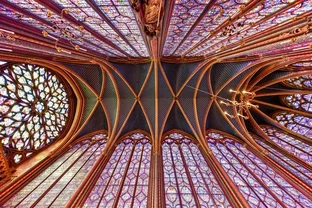
Because you'll want to see all the attractions on Ile de la Cité, begin at the cathedral of Notre-Dame. Proceed next to the Sainte-Chapelle, moving west. After a visit there, you can head northeast to the Conciergerie. To cap off your visit, and for the best scenic view, walk to the northwestern end of the island for a view of the bridge, pont Neuf, seen from square du Vert Galant.

The island's stars, as mentioned, are Notre-Dame, Sainte-Chapelle, and the Conciergerie -- all described earlier. Across from Notre-Dame is the Hôtel Dieu, built from 1866 to 1878 in neo-Florentine style. This is central Paris's main hospital, replacing the 12th-century hospital that ran the island's entire width. Go in the main entrance, and take a break in the spacious neoclassical courtyard whose small garden and fountain make a quiet oasis.

Don't miss the ironically named pont Neuf (New Bridge) at the tip of the island opposite from Notre-Dame. The span isn't new -- it's Paris's oldest bridge, begun in 1578 and finished in 1604. In its day, it had two unique features: It was paved, and it wasn't flanked with houses and shops. Actually, with 12 arches, it's not one bridge but two (they don't quite line up) -- one from the Right Bank to the island and the other from the Left Bank to the island. At the Musée Carnavalet, a painting called The Spectacle of Buffoons shows what the bridge was like between 1665 and 1669. Duels were fought on it, the nobility's great coaches crossed it, peddlers sold their wares, and entertainers such as Tabarin went there to seek a few coins from the gawkers. As public facilities were lacking, the bridge also served as a de facto outhouse.

Just past pont Neuf is the "prow" of the island, the square du Vert Galant. Pause to look at the equestrian statue of beloved Henri IV, who was assassinated by Ravaillac. A true king of his people, Henri was also (to judge from accounts) regal in the boudoir -- hence the nickname "Vert Galant" (Old Spark). Gabrielle d'Estrées and Henriette d'Entragues were his best-known mistresses, but they had to share him with countless others, some of whom would casually catch his eye as he was riding along the streets. In fond memory of the king, the little triangular park continues to attract lovers. It appears to be a sunken garden because it remains at its natural level; the rest of the Cité has been built up during the centuries.

Ile St-Louis -- Cross the pont St-Louis, the footbridge behind Notre-Dame, to Ile St-Louis, and you'll find a world of tree-shaded quays, town houses with courtyards, restaurants, and antiques shops. (You can also take the Métro to Sully-Morland or Pont Marie and cross the bridge.) The fraternal twin of Ile de la Cité, Ile St-Louis is primarily residential; nearly all the houses were built from 1618 to 1660, lending the island a remarkable architectural unity. Plaques on the facades identify the former residences of the famous. Marie Curie lived at 36 quai de Béthune, near pont de la Tournelle, and sculptor Camille Claudel (Rodin's mistress) lived and worked in the Hôtel de Jassaud, 19 quai de Bourbon.

The most exciting mansion -- though perhaps with the saddest history -- is the 1656-57 Hôtel de Lauzun, 17 quai d'Anjou, built for Charles Gruyn des Bordes. He married Geneviève de Mouy and had her initials engraved on much of the interior decor; their happiness was short-lived, because he was convicted of embezzlement and sent to prison in 1662. The next occupant was the duc de Lauzun, who resided there for only 3 years. He had been a favorite of Louis XIV until he asked for the hand of the king's cousin, the duchesse de Montpensier. Louis refused and had Lauzun tossed into the Bastille. Eventually, the duchesse pestered Louis into releasing him, and they married secretly and moved here in 1682, but domestic bliss eluded them -- they fought often and separated in 1684. Lauzun sold the house to the grandnephew of Cardinal Richelieu and his wife, who had such a grand time throwing parties, they went bankrupt. Baron Pichon bought it in 1842 and rented it out to a hashish club. Tenants Baudelaire and Gaultier regularly held hashish soirees in which Baudelaire did research for his Les Paradis Artificiels and Gaultier for his Le Club des Hachichins. Now the mansion belongs to the city and is used to house official guests. The interior is sometimes open for temporary exhibits, so call the tourist office.

Hôtel Lambert, 2 quai d'Anjou, was built in 1645 for Nicholas Lambert de Thorigny. The portal on rue St-Louis-en-l'Ile gives some idea of the splendor within, but the house's most startling element is the oval gallery extending into the garden. Designed to feature a library or art collection, it's best viewed from the beginning of quai d'Anjou. Voltaire and his mistress, Emilie de Breteuil, lived here; their quarrels were legendary. The mansion also housed the Polish royal family for over a century before becoming the residence of actress Michèle Morgan. It now belongs to the Rothschild family and isn't open to the public.

Nos. 9, 11, 13, and 15 quai d'Anjou also belonged to the Lamberts. At no. 9 is the house where painter/sculptor/lithographer Honoré Daumier lived from 1846 to 1863, producing hundreds of caricatures satirizing the bourgeoisie and attacking government corruption. He was imprisoned because of his 1832 cartoon of Louis-Philippe swallowing bags of gold extracted from the people.

Near the Hôtel de Lauzun is the church of St-Louis-en-l'Ile, no. 19 bis rue St-Louis-en-l'Ile. Despite a dour exterior, the ornate interior is one of the finest examples of Jesuit baroque. Built between 1664 and 1726, this church is still the site of many weddings -- with all the white stone and gilt, you'll feel as if you're inside a wedding cake. Look for the 1926 plaque reading "In grateful memory of St. Louis in whose honor the city of St. Louis, Missouri, USA, is named."

Right Bank Highlights

Les Halles -- For 8 centuries, Les Halles (Métro: Les Halles; RER: Châtelet-Les Halles) was the city's major wholesale fruit, meat, and vegetable market. In the 19th century, Zola called it "the underbelly of Paris." The smock-clad vendors, beef carcasses, and baskets of vegetables all belong to the past, for the original market, with zinc-roofed Second Empire "iron umbrellas," has been torn down. Today the action has moved to a steel-and-glass edifice at Rungis, a suburb near Orly. In 1979 the Forum des Halles, 1-7 rue Pierre-Lescot, 1er, opened. This large complex, much of it underground, contains shops, restaurants, and movie theaters. Many of the shops are unattractive, but others contain a wide display of merchandise that has made the mall popular with residents and visitors.

For many visitors, a night on the town still ends in the wee hours with a bowl of onion soup at Les Halles, usually at Au Pied de Cochon (The Pig's Foot), 6 rue Coquillière, 1er (tel. 01-40-13-77-00), or at Au Chien Qui Fume (The Smoking Dog), 33 rue du Pont-Neuf, 1er (tel. 01-42-36-07-42). One of the classic scenes of old Paris was elegantly dressed Parisians (many fresh from Maxim's) standing at a bar drinking cognac with blood-smeared butchers. Some writers have suggested that 19th-century poet Gérard de Nerval introduced the custom of frequenting Les Halles at such an unearthly hour.

A newspaper correspondent described today's scene: "Les Halles is trying to stay alive as one of the few places where one can eat at any hour of the night."

Left Bank Highlights

St-Germain-des-Prés -- This neighborhood in the 6th Arrondissement (Métro: St-Germain-des-Prés) was the postwar home of existentialism, associated with Sartre, De Beauvoir, Camus, and an intellectual bohemian crowd that gathered at Café de Flore, Brasserie Lipp, and Les Deux Magots. Among them, black-clad poet and singer Juliette Greco was known as la muse de St-Germain-des-Prés, and to Sartre, she was the woman who had "millions of poems in her throat." Her long hair, black slacks, black sweater, and black sandals launched a fashion trend adopted by young women everywhere. In the 1950s, new names appeared, such as Françoise Sagan, Gore Vidal, and James Baldwin, but by the 1960s, tourists were firmly entrenched.

St-Germain-des-Prés still retains an intellectually stimulating bohemian street life, full of many interesting bookshops, art galleries, cave (basement) clubs, bistros, and coffeehouses. But the stars of the area are two churches, St-Germain-des-Prés, 3 place St-Germain-des-Prés, and St-Sulpice, rue St-Sulpice, and the Musée National Eugène Delacroix, 6 place de Furstenberg. Nearby, rue Visconti was designed for pushcarts and is worth visiting today. At nos. 20-24 is the residence where dramatist Jean-Baptiste Racine died in 1699. And at no. 17 is the house where Balzac established his printing press in 1825. (The venture ended in bankruptcy, forcing the author back to his writing desk.) Such celebrated actresses as Champmeslé and Clairon also lived here.

Montparnasse -- For the "Lost Generation," life centered around the cafes of Montparnasse, at the border of the 6th and 14th arrondissements (Métro: Montparnasse-Bienvenüe). Hangouts like the Dôme, Coupole, Rotonde, and Sélect became legendary, as artists -- especially American expats -- turned their backs on touristy Montmartre. Picasso, Modigliani, and Man Ray came this way, and Hemingway was also a popular figure. So was Fitzgerald when he was poor (when he wasn't, you'd find him at the Ritz). Faulkner, MacLeish, Duncan, Miró, Joyce, Ford Maddox Ford, and even Trotsky spent time here.

The most notable exception was Gertrude Stein, who never frequented the cafes. To see her, you had to wait for an invitation to her salon at 27 rue de Fleurus. She bestowed this favor on Sherwood Anderson, Elliot Paul, Ezra Pound, and, for a time, Hemingway. When Pound launched himself into a beloved chair and broke it, he incurred Stein's wrath, and Hemingway decided there wasn't "much future in men being friends with great women."

American expatriate writer Natalie Barney, who moved to Paris as a student in 1909 and stayed for more than 60 years, held her grand salons at 20 rue Jacob (actually in St-Germain-des-Prés). Every Friday, her salon attracted the literati of her day, such as Gertrude Stein, Djuna Barnes, Colette, Sherwood Anderson, T. S. Eliot, Janet Flanner, James Joyce, Sylvia Beach, Marcel Proust, and William Carlos Williams. The group met on and off for half a century, interrupted only by two world wars. Near place de Furstenberg, Barney's former residence is landmarked but not open to the public. In the garden you can see a small Doric temple bearing the inscription A l'Amitié, "to friendship."

Aside from the literary legends, one of the most notable characters was Kiki de Montparnasse (actually named Alice Prin). She was raised by her grandmother in Burgundy until her mother called her to Paris to work. When a sculptor discovered her, she became an artist's model and adopted her new name; soon she became a prostitute and would bare her breasts for anyone who'd pay three francs. She sang at Le Jockey, 127 bd. du Montparnasse, which no longer exists. In her black hose and garters, she captivated dozens of men, among them Frederick Kohner, who went so far as to title his memoirs Kiki of Montparnasse. Kiki later wrote her own memoirs, with an introduction by Hemingway. Papa called her "a Queen," noting that it was "very different from being a lady."

Completed in 1973 and rising 206m (676 ft.) above the skyline, the Tour Montparnasse (tel. 01-45-38-52-56; www.tour-montparnasse.com; Métro: Montparnasse-Bienvenüe) was denounced by some as "bringing Manhattan to Paris." The city soon passed an ordinance outlawing any further structures of this size in the heart of Paris. Today, the modern tower houses an underground shopping mall, as well as much of the infrastructure for the Gare de Montparnasse rail station. You can ride an elevator up to the 56th floor (where you'll find a bar and restaurant) and then climb three flights to the roof terrace. The view encompasses virtually every important Paris monument, including Sacré-Coeur, Notre-Dame, and La Défense. Admission is 9€ ($12) for adults, 6.50€ ($8.45) for students, and 4€ ($5.20) for kids 7 to 15. Free for children 6 and under. It's open April to September daily 9:30am to 11:30pm, October to March daily 9:30am to 10:30pm (Métro: Montparnasse-Bienvenue).

The life of Montparnasse still centers around its cafes and exotic nightclubs, many only a shadow of what they used to be. Its heart is at the crossroads of boulevard Raspail and boulevard du Montparnasse, one of the settings of The Sun Also Rises. Hemingway wrote that "boulevard Raspail always made dull riding." Rodin's controversial statue of Balzac swathed in a large cape stands guard over the prostitutes who cluster around the pedestal. Balzac seems to be the only one in Montparnasse who doesn't feel the weight of time.


Back to Top


Click the names below for more detailed information.

Note: This information was accurate when it was published, but can change without notice. Please be sure to confirm all rates and details directly with the companies in question before planning your trip.


  Email This Article Email Print This Article Print Get Frommer's RSS Feed RSS
Frommer's Paris 2009 Frommer's Paris 2009

Author: Darwin Porter
Pub Date: September 02, 2008
Price: $18.99

Buy Now!
Related Titles:
France For Dummies, 4th Edition
Frommer's 24 Great Walks in London, 1st Edition
Frommer's 24 Great Walks in Paris, 1st Edition
Add Frommers.com RSS Feed  Add Frommers.com RSS Feed (What's This?)
Add Frommers.com Deals & News to Your Web Site
Add to My Yahoo!     Add to My MSN     More RSS Readers
Add Frommers.com Podcast Add Frommers.com Podcast (What's This?)
Home > Destinations > Europe > France > Paris > Attractions > Neighborhoods Worth a Visit