Frommer's
Redwood National and State Parks Travel Guide
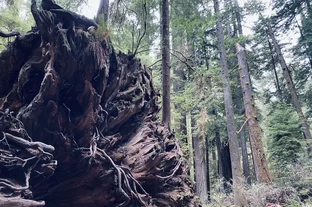
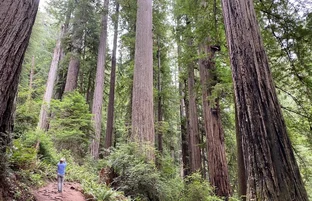
It's impossible to explain the feeling you get in the old-growth forests of Redwood National and State Parks without resorting to Alice in Wonderland comparisons. Like a tropical rainforest, the redwood forest is a multistoried affair, the tall trees being only the top layer. Everything is big, misty, and primeval; flowering bushes cover the ground, 10-foot-tall ferns line the creeks, and the smells are rich and musty. Out on the parks' crowd-free trails, it's impossible not to feel as if you've shrunk, or the rest of the world has grown, or else that you've gone back in time to the Jurassic epoch -- dinosaurs would fit in here nicely.
When Archibald Menzies noted the existence of the coast redwood in 1794, more than 2 million acres of redwood forest carpeted California and Oregon. By 1965, logging had reduced that to 300,000 acres, and it was obvious something had to be done. The state created several parks around individual groves in the 1920s, and in 1968 the federal government created Redwood National Park. In 1994, the National Park Service and the California Department of Parks and Recreation signed an agreement to manage the four contiguous redwood parks cooperatively -- hence the name Redwood National and State Parks.
The modern 131,983-acre park complex offers a lesson in ecology. When the park was created to protect the biggest coast redwoods, logging companies continued to cut much of the surrounding area, sometimes right up to the park boundary. Redwoods in the park began to suffer as the quality of the Redwood Creek drainage declined from upstream logging, so in 1978 the government purchased a major section of the watershed, having learned that you can't preserve individual trees without preserving the ecosystem.
Although the logging of old-growth redwoods is still a major bone of contention for the government, private landowners, and environmentalists, the trees thrive. They are living links to the age of dinosaurs and reminders that the era of mankind is but a hiccup in time to the venerable Sequoia sempervirens.
Redwood National and State Parks Table of Contents
Bookstore
Available as paperback
and as e-book.