| Home > Destinations > Europe > Italy > Rome > Traveler's Guide to Art & Architecture > Art |
|
|
||||||
![]() |
||||||
FREE Newsletters! |
Win a FREE Trip! |
|||||
|
|
||||||
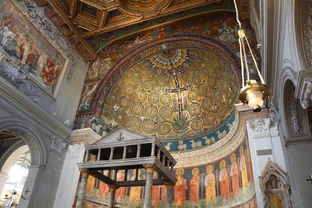
ArtClassical: Etruscans & Romans (6th Century B.C. to 5th Century A.D.) The Etruscans, who became Rome's pre-Republican Tarquin kings, arrived from Asia Minor with their own styles. By the 6th century B.C., however, they were borrowing heavily from the Greeks in their sculpture and importing thousands of Attic vases, which displayed the most popular and widespread painting style of ancient Greece. Painting in ancient Rome was used primarily for decorative purposes. Bucolic frescoes (the technique of painting on wet plaster) adorned the walls of the wealthy. Rome's sculptures tended to glorify emperors and the perfect human form, copying ad nauseum from famous Greek originals. Examples of classical art include: Etruscan. Etruscan artistic remains are confined to the Villa Giulia and Vatican Museums; the best is the Villa Giulia's terra-cotta sarcophagi covers of reclining figures. Some tomb paintings also survive at Tarquinia in northern Lazio. Roman. Along with an army of also-ran statues and busts gracing most archaeological collections in Italy, you'll find a few standouts: the marble bas-reliefs (sculptures that project slightly from a flat surface) on the Arch of Constantine; the sculptures, mosaics, and remarkable fresco collections at the various branches of the Museo Nazionale Romano; and such sculptures as the gilded equestrian statue of Marcus Aurelius and The Dying Gaul at the Capitoline Museum. The reliefs on the Ara Pacis are a great example of 1st-century A.D. art as imperial propaganda. Byzantine & Romanesque (5th to 13th Centuries) Artistic expression in the Dark Ages and early medieval Rome was largely church related. Because Mass was recited in Latin, images were used to communicate the Bible's most important lessons to the illiterate masses. Bas-reliefs around the churches' main doors, along with wall paintings and altarpieces inside, told key tales to inspire faith in God and fear of sin (Last Judgments were favorites). Otherwise, decoration was spare, and what little existed was often destroyed, replaced, or covered over the centuries as tastes changed and cathedrals were remodeled. The Byzantine style of painting and mosaic was very stylized and static. The iconographic tradition was imported from the eastern half of the Roman Empire centered at Byzantium (the empire's major political outposts in Italy were Ravenna and Venice). Faces (and eyes) were almond-shaped with pointy little chins, noses were long with a spoonlike depression at the top, and folds in robes (always blue over red) were represented by stylized cross-hatching in gold leaf. Romanesque sculpture was somewhat more fluid but still far from naturalistic. Often wonderfully childlike in its narrative simplicity, the work frequently mixed biblical scenes with the myths and motifs of local pagan traditions that were being slowly incorporated into early medieval Christianity. Romanesque art was seen as crude in most later periods and, as such, was usually replaced or destroyed over the centuries; it survives mostly in scraps. Good examples of this era include: Byzantine mosaics. The oldest paleo-Christian mosaics (5th-7th centuries) are in Santa Maria Maggiore, Santa Sabina (which also preserves remarkable 5th-century wood doors carved with biblical reliefs), and San Giovanni in Laterano's San Venanzio and Santa Rufina chapels (the main church's apse mosaic is 13th c.). Later Byzantine and Romanesque mosaics decorate Santa Maria d'Aracoeli, San Clemente Basilica, and San Paolo Fuori le Mura. Romanesque painting. San Clemente Basilica's lower church has some of the few remaining early medieval paintings in Rome. National Museum of Palazzo Venezia. Here you'll find Rome's best collection of medieval art, including the oldest painted wood statue (13th c.), numerous Byzantine crosses, ivories, and an unusual enameled metal Christ (13th c.). International Gothic (Late 13th to Early 15th Centuries) Late medieval Italian art continued to be largely ecclesiastical. In both Gothic painting and sculpture, figures tended to be more natural than in the Romanesque (and the colors in paintings more varied and rich) but remained highly stylized. The figures' features and gestures are exaggerated for symbolic or emotional emphasis. In painting especially, late-Gothic artists such as Giotto started introducing greater realism, a sense of depth, and more realistic emotion into their art -- characteristics that would later define the Renaissance. However, when the pope fled Rome for Avignon, France, in 1308, the Eternal City became a provincial town, and art languished. The best Gothic artists with work in Rome include: Giotto (1266-1337). The greatest Gothic artist, Giotto lifted painting from its Byzantine funk and set it on the road to the realism and perspective of the Renaissance. His best works are fresco cycles in Assisi, Padua, and Florence, but in Rome you can see the Stefaneschi Triptych (1315) in the Vatican Pinacoteca. Pietro Cavallini (1250-1330). He designed the Life of the Virgin apse mosaics in Santa Maria in Trastevere, but his only painting to survive is the top half of a Last Judgment (1295-1300) on the entrance wall of Santa Cecilia in Trastevere (you have to make an appointment to see it). Arnolfo di Cambio (1245-1302). This Tuscan sculptor and architect left a venerated bronze St. Peter in St. Peter's Basilica. Renaissance (Early 15th to Mid-17th Centuries) From the 14th to 16th centuries, the popularity of the Humanist movement in philosophy prompted princes and powerful prelates to patronize a generation of innovative young artists. These painters, sculptors, and architects experimented with new modes in art and broke with static medieval traditions to pursue a greater degree of expressiveness and naturalism, using such techniques as linear perspective. The term Renaissance, or "rebirth," was only later applied to this period in Italy (from where it spread to the rest of Europe). This list of Renaissance giants merely scratches the surface of the masters Italy gave rise to in the 15th and 16th centuries: Fra Angelico (1400-55). This Tuscan monk and early master was invited to Rome by the pope to paint the Vatican's Nicholas V chapel (1448-50). Leonardo da Vinci (1452-1519). A true "Renaissance man," Leonardo used his genius to experiment in a range of disciplines, from art to philosophy to science (on paper, he even designed machine guns and rudimentary helicopters). Little of his remarkable painting survives, however, because he often used new pigment mixes that proved to lack the staying power of traditional materials. Leonardo invented such painterly effects as the fine haze of sfumato, which softens outlines and progressively blurs background landscapes and objects to create a sense of realism and vast distance within the painting. Unfortunately, nothing in Rome shows this; the only major Leonardo here is an unfinished St. Jerome in the Vatican Pinacoteca. Raphael (1483-1520). Rightfully considered one of Western art's greatest draftsmen, Raphael produced a body of work in his short lifetime (he died at 37) that influenced European painters for generations to come. You'll find his ethereal Transfiguration (1520), almost finished when he died, in the Vatican Museums. Also in the Vatican are perhaps his greatest works, a series of frescoed rooms (1508-20) including the School of Athens, at once a celebration of Renaissance artistic precepts, the classical philosophers whose rediscovery spurred on the Renaissance, and Raphael's contemporaries (the various "philosophers" are actually portraits of Leonardo, Michelangelo, Raphael himself, and Bramante, an architect). Michelangelo (1475-1564). The heavyweight contender for the title of world's greatest artist, Michelangelo was a genius in sculpture, painting, architecture, and poetry. His work marked the apogee of the Renaissance. A complex, difficult man -- intensely jealous, probably manic-depressive, and certainly homosexual -- Michelangelo enjoyed great fame in a life plagued by a series of never-ending projects commissioned by the Medici in Florence and Pope Julius II in Rome -- the Sistine Chapel frescoes (ceiling 1508-12;) Last Judgment (1535-41), and the tomb of Julius II, of which he finished only the powerful Moses (1513-15) in San Pietro in Vincoli and some Slaves in Florence. He sculpted the Pietà (1500) in St. Peter's at age 25. Michelangelo worshiped the male nude as the ultimate form and twisted the bodies of his figures (art historians call this torsion) in different, often contradictory directions (a positioning called contraposto) to bring out their musculature. When forced against his will to paint the Sistine Chapel, he broke almost all the rules and sent painting headlong in an entirely new direction -- called mannerism -- marked by nonprimary colors, impressionistic shapes of light, and twisting muscular figures. Baroque & Rococo (Late 16th to 18th Centuries) The baroque, a more theatrical and decorative take on the Renaissance, mixes a kind of super-realism based on using peasants as models and an exaggerated use of light and dark, called chiaroscuro, with compositional complexity and explosions of dynamic fury, movement, color, and figures. Rococo is this later baroque art gone awry, frothy and chaotic. The baroque period produced many fine artists but only a few true geniuses, including: Caravaggio (1571-1610). Caravaggio started as a street urchin, rose to fame through the graces of a Borghese cardinal, became an honorary Knight of Malta, and ended his life on the run from murder charges in Rome. In between, he reinvented baroque painting, using peasants and commoners as models and including their earthy realism (dirty bare feet were a favorite) in his works. He added his chiaroscuro technique of playing areas of harsh light off deep, black shadows (which helps explain the deeply wrinkled faces he loved to paint). Among his masterpieces are the St. Matthew (1599) cycle in San Luigi dei Francesi, a series of paintings in the Galleria Borghese and Palazzo Corsini, and the Deposition (1604) in the Vatican Museums. Pietro da Cortona (1596-1669). This Tuscan painter moved to Rome and became the progenitor of a fluffy, pastel baroque style, which he used to decorate the ceilings of Palazzo Barberini with an allegorical Glorification of the Reign of Urban VIII (1635). Bernini (1598-1680). Bernini was the greatest baroque sculptor, a fantastic architect, and no mean painter. Among his finest sculptures are several in the Galleria Borghese: his youthful Aeneas and Anchises (1613), Apollo and Daphne (1624), The Rape of Persephone (1621), and David (1623-24) -- the last a resounding baroque man of action rather than a Renaissance man of contemplation like Michelangelo's famous David in Florence. His other masterpiece is the Fountain of the Four Rivers (1651) in Piazza Navona. Late 18th to Early 20th Centuries After carrying the banner of artistic innovation for more than a millennium, Italy ran out of steam with the baroque. Nevertheless, the country did produce a few fine neoclassical sculptures in the late 18th century. Italy did not play an important role in late-19th- or 20th-century art, although a few great artists did emerge. In 1909 Italian artists living in Paris made a spirited attempt to take the artistic initiative back into Italian hands, but what the Futurist movement's Umberto Boccioni (1882-1916) came up with was largely cubism -- the "fractured" style, made famous by Picasso, in which objects are depicted from several perspectives at once -- with an element of movement added in. Gino Severini (1883-1966) contributed a sophisticated take on color that rubbed off on the core cubists. You can see work by both artists in the National Gallery of Modern Art. The greatest Italian artists of the modern era include: Antonio Canova (1757-1822). Italy's top neoclassical sculptor, Canova was popular for his mythological figures and Bonaparte portraits (he even sculpted both Napoleon and his sister Pauline as nudes). You'll find his work in the Galleria Borghese. Amadeo Modigliani (1884-1920). A sickly boy, and only moderately successful in his short lifetime, Modigliani helped reinvent the portrait in painting and sculpture after he moved to Paris in 1906. He's known for his mysterious, elongated heads and rapidly painted nudes. Check them out at the National Gallery of Modern Art. Giorgio de Chirico (1888-1978). De Chirico founded freaky pittura metafisica (metaphysical painting), a forerunner of surrealism wherein figures and objects are stripped of their usual meaning though odd juxtapositions, warped perspective, unnatural shadows and other bizarre effects, and a general spatial emptiness. Look for them in the National Gallery of Modern Art and the Collection of Modern Religious Art in the Vatican Museums. Giorgio Morandi (1890-1964). In the painting of his eerily minimalist, highly modeled, quasi-monochrome still lifes, Morandi was influenced by pittura metafisica. His paintings decorate the National Gallery of Modern Art and the Collection of Modern Religious Art in the Vatican Museums.
Note: This information was accurate when it was published, but can change without notice. Please be sure to confirm all rates and details directly with the companies in question before planning your trip.
|
|||||||||||||||||||||||||||||||||||||||||||||||||||||||||||||||||||||||||||||||||||||||||||||||||||||||||||||||||||||||||||||||||||||||||||||||||||||||||||||||||||||||||||||||
| Home | Destinations | Hotels | Trip Ideas | Deals & News | Book a Trip | Tips & Tools | Travel Talk | Bookstore | ||||||||||||||||||||||||
| About Frommer's | FAQ | Contact Us | Help | Site Map | Privacy Policy | Advertise With Us | ||||||||||||||||||||||||
|
||||||||||||||||||||||||
| © 2000-2008 by Wiley Publishing, Inc. All rights reserved. | ||||||||||||||||||||||||
| Home > Destinations > Europe > Italy > Rome > Traveler's Guide to Art & Architecture > Art |