| Home > Destinations > Europe > Italy > Rome > Traveler's Guide to Art & Architecture > Architecture |
|
|
||||||
![]() |
||||||
FREE Newsletters! |
Win a FREE Trip! |
|||||
|
|
||||||
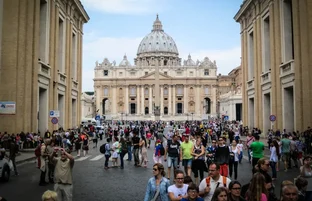
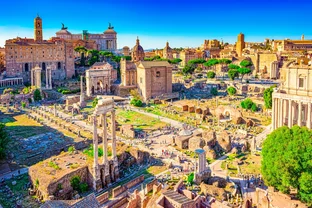
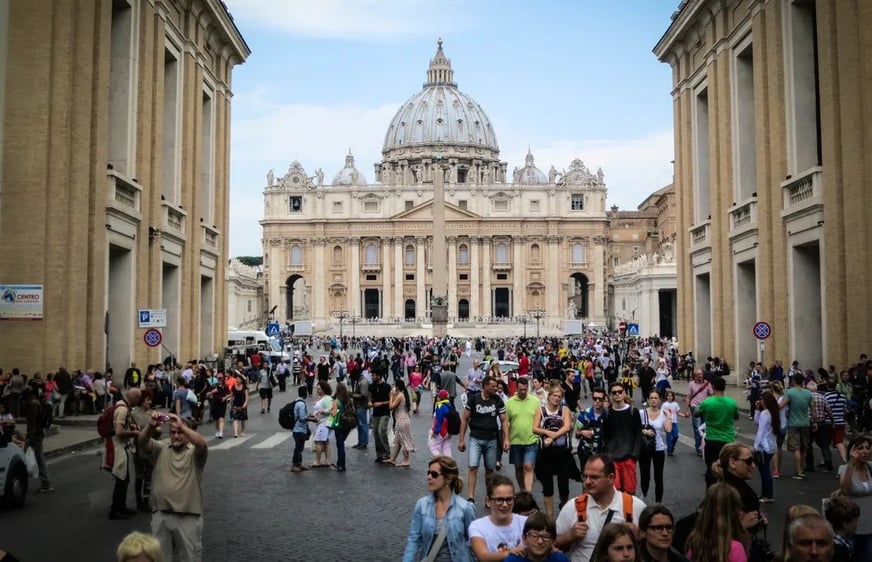
ArchitectureKeep a couple of points in mind when considering a building's style, particularly for structures built before the 20th century. First, very few buildings (especially churches) were actually built in only one style. Massive, expensive structures often took centuries to complete, during which time tastes changed and plans were altered. Second, while each architectural era has its own distinctive features, some elements, general floor plans, and terms are common to many; features might appear near the end of one era and continue through several later ones. From the Romanesque period on, most churches consist of either a single wide aisle or a wide central nave flanked by two narrow aisles. The aisles are separated from the nave by a row of columns or by square stacks of masonry called piers, usually connected by arches. This main nave/aisle assemblage is usually crossed by a perpendicular corridor called a transept near the far east end of the church so that the floor plan looks like a Latin cross (shaped like a crucifix). The shorter, east arm of the nave is the holiest area, called the chancel; it often houses the stalls of the choir and the altar. If the far end of the chancel is rounded off, it's called an apse. An ambulatory is a curving corridor outside the altar and choir area, separating it from the ring of smaller chapels radiating off the chancel and apse. Some churches, especially after the Renaissance, when mathematical proportion became important, were built on a Greek cross plan, with each axis the same length, like a giant +. By the baroque, funky shapes became popular, with churches built in the round or as ellipses, for example. Classical (6th Century B.C. to 4th Century A.D.) The Romans made use of certain Greek innovations, particularly architectural ideas. The first to be adopted was post-and-lintel construction (essentially, a weight-bearing frame, like a door). Inventive engineers, the Romans then added the load-bearing arch and also developed hoisting mechanisms and a specially trained workforce. Identifiable features of classical architecture include: Classical orders. The orders are most easily recognized by their column capitals, with the least ornate capital used on a building's ground level and the most ornate used on the top: Doric (a plain capital), Ionic (a capital with a scroll), and Corinthian (a capital with flowering acanthus leaves). Brick and concrete. Although marble is traditionally associated with Roman architecture, Roman engineers could also do wonders with bricks or even simple concrete -- concrete seating made possible such enormous theaters as Rome's 6-acre, 45,000-seat Colosseum. Roman architecture includes the sports stadium of the Colosseum (1st century A.D.; see illustration), which perfectly displays the use of the classical orders; Hadrian's marvel of engineering, the temple of the Pantheon (1st century A.D.); and the public brick Baths of Caracalla (3rd century A.D.). Another good example is the Basilica of Constantine and Maxentius in the Roman Forum (4th century A.D.). Roman basilica served as law courts. They were rectangular in shape and contained a wide nave, two rows of columns supporting arches, and an apse at one or both ends; the style was adopted by early Christians for their first grand churches. Rome's ancient seaport, Ostia Antica, has been preserved with its street plan and even some virtually intact buildings. Romanesque & Gothic (7th to 15th Centuries) The Romanesque took its inspiration and rounded arches from ancient Rome (hence the name). The first major churches in Rome were built on the basilica plan of Roman law courts. Architects constructed large churches with wide aisles to accommodate the masses who came to hear the priests say Mass but who were largely there to worship at the altars of various saints. To support the weight of all that masonry, the walls had to be thick and solid (meaning they could be pierced by few and rather small windows) and supported by huge piers, giving Romanesque churches a dark, somber, mysterious, and often oppressive feeling. By the late 12th century, the development of the pointed arch and exterior flying buttress freed architecture from the heavy, thick walls of Romanesque structures and allowed ceilings to soar, walls to thin, and windows to proliferate in the Gothic style, of which there's only one surviving example in Rome. Identifiable Romanesque features include: Rounded arches. These load-bearing architectural devices allowed architects to open up wide naves and spaces, channeling all the weight of the stone walls and ceiling across the curve of the arch and down into the ground via the columns or pilasters. Thick walls. Infrequent and small windows. Huge piers. The great early basilicas, each at least partly altered in decor over the ages, include Santa Maria Maggiore, San Giovanni in Laterano, and San Paolo Fuori le Mure. Other less grand Romanesque churches include Santa Maria in Cosmedin and Santa Sabina. Santa Maria Sopra Minerva is Rome's only Gothic church, all pointy arches and soaring ceilings. (However, because it is hemmed in by other buildings, its interior is atypically dark.) Renaissance (15th to 17th Centuries) As in painting, Renaissance architectural rules stressed proportion, order, classical inspiration, and mathematical precision to create unified, balanced structures. Some identifiable Renaissance features include: A sense of proportion A reliance on symmetry The use of classical orders Bramante (1444-1514) was perhaps the most mathematical and classically precise of the early High Renaissance architects. This is evident in his (much altered) plans for St. Peter's Basilica (his spiral staircase in the Vatican has survived untouched) and his jewel of perfect Renaissance architecture, the textbook Tempietto (1502; see illustration) at San Pietro in Montorio on the slopes of Rome's Gianicolo Hill, where Christians once believed St. Peter had been crucified (as a plus, the little crypt inside is a riotous rococo grotto). Renaissance man Michelangelo took up architecture later in life, designing the dome atop St. Peter's Basilica; the sloping approach, 12-pointed star courtyard, and trio of palace facades that together make up Piazza del Campidoglio, atop the Capitoline Hill; and the facade of the Palazzo Farnese (1566), which was otherwise built by Antonio da Sangallo (1483-1546). Baldassare Peruzzi (1481-1537) designed the lovely Villa Farnesina (1508-11; he also painted a tromp l'oeil fresco in an upstairs room). Vignola's (1507-73) monumental barrel-vaulted Chiesa del Gesù (1568-75), with its graceful facade by Giacomo della Porta (1533-1602), became a Catholic Counter-Reformation model for churches throughout Europe. Baroque & Rococo (17th to 18th Centuries) More than any other movement, the baroque aimed toward a seamless meshing of architecture and art. The stuccoes, sculptures, and paintings were all carefully designed to complement one another -- and the space itself -- to create a unified whole. This effect was both aesthetic and narrative, with the various art forms all working together to tell a single biblical story (or often to subtly relate the deeds of the commissioning patron to great historic or biblical events). Excessively complex and dripping with decorative tidbits, rococo is baroque gone awry. Some identifiable baroque features include: Classical architecture rewritten with curves. The baroque is similar to the Renaissance, but many of the right angles and ruler-straight lines are exchanged for curves of complex geometry and an interplay of concave and convex surfaces. The overall effect is to lighten the appearance of structures and to add movement of line and vibrancy to the static look of the classical Renaissance. Complex decoration. Unlike the sometimes severe and austere designs of the Renaissance, the baroque was playful. Architects festooned structures and encrusted interiors with an excess of decorations intended to liven things up -- lots of ornate stuccowork, pouty cherubs, airy frescoes, heavy gilding, twisting columns, multicolored marbles, and general frippery. Multiplying forms. The baroque asked, "Why make do with one column when you can stack a half-dozen partial columns on top of each other, slightly offset?" The baroque loved to pile up its forms and elements to create a rich, busy effect, breaking a pediment curve into segments so that each would protrude farther out than the last, or building up an architectural feature by stacking short sections of concave walls, each one curving to a different arc. The baroque flourished across Italy, but some of the best examples include Sant'Ivo alla Sapienza (1640s) by Borromini (1599-1667), with its interplay of concave and convex ovals, interlocking truncated triangles, and an elliptical ramplike dome that looks like soft-serve ice cream (as scooped by a mathematician). Though relatively sedate, St. Peter's facade by Carlo Maderno (ca. 1556-1629) and sweeping elliptical colonnade by Bernini make for one of Italy's most famous baroque assemblages. The two also collaborated (along with Borromini) on the Palazzo Barberini (1620-30s). The painter Pietro da Cortona designed the distinctive semicircular portico on Santa Maria della Pace (1656-57). For the rococo -- more a decorative than architectural movement -- look no farther than the Spanish Steps (1726), by architect Francesco de Sanctis (1693-1740), or the Trevi Fountain (1762; see illustration), by Nicola Salvi (1697-1751). Neoclassical to Modern (18th to 20th Centuries) As a backlash against the excesses of the baroque and rococo, by the middle of the 18th century, Italian architects began turning to the austere simplicity and grandeur of the Classical Age and inaugurated the neoclassical style. Their work was inspired by the rediscovery of Pompeii and other ancient sites. From the 19th century through the 20th century, Italian architects constructed buildings in a variety of styles. Italy's take on the early-20th-century Art Nouveau movement was called Liberty style. Mussolini made a spirited attempt to bring back ancient Rome in what can only be called fascist architecture. Since then, Italy, like the rest of the world, has mostly erected concrete and glass skyscrapers. Some identifiable features for each of these movements include: Neoclassical. The classical ideals of mathematical proportion and symmetry, first rediscovered during the Renaissance, are the hallmark of every classically styled era. Neoclassicists reinterpreted ancient temples as buildings with massive colonnaded porticos. Liberty. Like Art Nouveau practitioners in other countries, Italian artists rebelled against the era of mass production and stressed the uniqueness of craft. They created asymmetrical, curvaceous designs based on organic inspiration (plants and flowers) and used such materials as wrought iron, stained glass, tile, and hand-painted wallpaper. Fascist. Deco meets Caesar. This period produced monumentally imposing and chillingly stark white marble structures surrounded by classical statuary. Of the neoclassical, the Vittorio Emanuele Monument, which has been compared to a wedding cake and a Victorian typewriter, was Italy's main monument to reaching its Risorgimento goal of a unified Italy. Liberty style never produced any surpassingly important buildings, although you can glimpse it occasionally in period storefronts. Fascist architecture still infests all corners of Rome (although most of the Right Wing reliefs and the repeated engravings of "DVCE" -- Mussolini's nickname for himself -- have long since been chipped out). You can see it at its, er, best in Rome's planned satellite community called EUR (including a multistory "square Colosseum" so funky it has been featured in many films and music videos) and the Stadio Olimpico complex. The mid-20th century was dominated by Pier Luigi Nervi (1891-1979) and his reinforced concrete buildings, including the Palazzeto dello Sport stadium (1960).
Note: This information was accurate when it was published, but can change without notice. Please be sure to confirm all rates and details directly with the companies in question before planning your trip.
|
|||||||||||||||||||||||||||||||||||||||||||||||||||||||||||||||||||||||||||||||||||||||||||||||||||||||||||||||||||||||||||||||||||||||||||||||||||||||||||||||||||||||||||||||
| Home | Destinations | Hotels | Trip Ideas | Deals & News | Book a Trip | Tips & Tools | Travel Talk | Bookstore | ||||||||||||||||||||||||
| About Frommer's | FAQ | Contact Us | Help | Site Map | Privacy Policy | Advertise With Us | ||||||||||||||||||||||||
|
||||||||||||||||||||||||
| © 2000-2008 by Wiley Publishing, Inc. All rights reserved. | ||||||||||||||||||||||||
| Home > Destinations > Europe > Italy > Rome > Traveler's Guide to Art & Architecture > Architecture |