Frommers.com Frommers.com
Most Recent Rotorua Forum Posts
Most Recommended Articles
Most Commented Articles

Maori Cultural Experiences

It's easy to be completely confused by the number of Maori cultural experiences available in Rotorua. Basically, they all offer a hangi (earth oven feast) and a song-and-dance performance, and they're all similarly priced. The hangi is the traditional Maori method of cooking. A large pit is filled with a wood fire topped by stones; when the stones are heated through, baskets of food are placed on top and covered with damp cloths. Earth is then shoveled over to create a natural oven. After about 3 hours, dinner is unveiled, with intermingling flavors of various foods lightly touched by wood smoke. Not all hangi are this authentic -- many hotel hangi are now steamed for health and safety requirements.

The prize for the best concert and hangi is a tossup between three leading players, Tamaki Maori Village, Te Puia, or at Mitai Village, 196 Fairy Springs Rd., Rotorua (tel. 07/343-9132; www.mitai.co.nz), which is open daily with a concert and hangi performance from 6:30 to 9:45pm (NZ$99 per person). The Tamaki evening has become more commercial and has lost a little of its shine, but it gives a good rundown of Maori history and is in a re-created village out of town. Mitai scores big with its stunning arrival by waka (war canoe) and guests get taken into the bush to see glowworms afterward. It's a more authentic performance and the food is better. Both will get you home around 10:30 or 11pm. A singalong in the homeward bound Tamaki bus may better suit a younger crowd.

Te Po at Te Puia is also a terrific performance with smaller numbers and it will have you home by around 8:30pm. If you choose to do their combo, you are picked up at 4:30pm and do the last guided walk of the Whakarewarewa Thermal Valley before the cultural event and hangi. Their hangi food -- which includes mussels, shrimps, and their famous steam pudding -- wins hands down.

All the major hotels have nightly hangi and concerts. Of these, the Royal Lakeside Novotel, Tutanekai Street (tel. 0508/446-244 or 07/346-3888; www.novotel.co.nz), is one of the best and cheapest. The show presents a good balance between old and new. The steamed hangi (not as smoky or tasty as the earth-cooked version) is beautifully presented and has lots of extras. While you eat, a contemporary Maori guitarist performs and traces the development of Maori tourism. Although you don't get the feel of a marae here, a strong and consistently good performance group sings in several languages. It runs from 6:30 to 9pm. Most of the hotel hangi and performance experiences are priced from NZ$75 to NZ$100 per person.

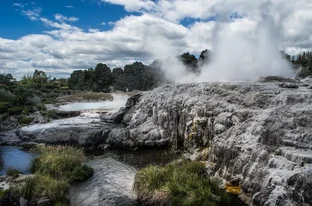
A visit to Whakarewarewa Thermal Village, 17 Tyron St., Rotorua (tel. 07/349-3463; www.whakarewarewa.com), will give you insight into the workings of a modern, real-life Maori village set among geothermal activity. It may be a little overrated in terms of actual geothermal activity, but this is the only place in New Zealand -- perhaps in the world -- where people continue the 300-year-old tradition of using natural geothermal energy as part of their everyday cooking and washing practices. You can also see Pohutu Geyser from here for half the price you pay to see it at Te Puia; and in the summer it's fun to watch the kids diving for coins in the river below the bridge. It's open daily from 8:30am to 5pm, with guided tours between 9am and 4pm and cultural performances with hangi (NZ$60) daily at 11:15am and 2pm. Admission is NZ$28 adults, NZ$13 children, NZ$69 family.

Keep in mind that Maori land claims currently under negotiation may see the adjacent government-owned Te Puia land returned to the Ngati Wahiao people of Whakarewarewa in coming years. This is unlikely to impact on your visitor experience, but we'll keep you posted.

You can make your own way to Ohinemutu Maori Village, on Rotorua's lakefront. Follow the lake road past the Royal Lakeside Novotel, and just by the first little group of shops, turn onto Houkotuku Street. Turn right onto Ariariterangi Street and drive to the historic Tamatekapua meetinghouse, cemetery, and the very beautiful St. Faith's Church. (Always ask permission before entering, and please respect the fact that photographs are not allowed inside the church.) You'll see tons of natural thermal activity in the area, much of it steaming up in people's gardens. Be warned that the streets are extremely narrow -- drive slowly because kids often play in the streets here. Also look out for Ohinemutu Maori Handcrafts, just past the church on Mataiawhea Street (tel. 07/350-3378). It's open daily 8am to 6:30pm in summer and from 9am to 5pm in winter. If you'd like a deeper insight into the village, take a 1 1/2-hour tour with Mitere (tel. 0508/648-373; miteretours@gmail.com). They host tours every 2 hours from 9am to 3pm, and bookings are essential.

If learning the traditional Maori haka (war dance) appeals, visit Haka World, Kiwi Paka, 60 Tarewa Rd. (tel. 07/347-1717; www.hakaworld.com), and let Tiki Edwards put you through the paces for NZ$30. He runs two sessions -- 9 to 11am and 1 to 3pm.


Back to Top


Note: This information was accurate when it was published, but can change without notice. Please be sure to confirm all rates and details directly with the companies in question before planning your trip.


Destination Guide
Destination Guide Destination Guide Destination Guide
Destination Guide Destination Guide Frommer's New Zealand, 6th Edition Destination Guide Frommer's New Zealand, 6th Edition

Author: Adrienne Rewi
Pub Date: February 15, 2010

Learn More
Destination Guide Destination Guide Destination Guide Related Titles:
Adelaide and South Australia (Including the Barossa Valley): Frommer's ShortCuts
Destination Guide
Auckland, New Zealand: Frommer's ShortCuts
Destination Guide
Brisbane, Australia: Frommer's ShortCuts
Destination Guide
Destination Guide Destination Guide
Destination Guide Destination Guide Destination Guide
Destination Guide
Destinations
Destinations