Home > Destinations > North America > USA > California > San Francisco > Attractions > Neighborhoods Worth a Visit
Bookstore Travel Talk - Our Message Boards Tips and Tools Book a Trip Deals and News Trip Ideas, Activities, Lifestyles Hotels Destinations Frommers.com Home
Frommer's - The best trips start here. Frommer's - The best trips start here.
Sign up for our FREE Newsletters! Win a FREE Trip
  Email This Article Email Print This Article Print Get Frommer's RSS Feed RSS

Neighborhoods Worth a Visit

To really get to know San Francisco, break out of the downtown and Fisherman's Wharf areas to explore the ethnically and culturally diverse neighborhoods. Walk the streets, browse the shops, grab a bite at a local restaurant -- you'll find that San Francisco's beauty and charm are around every corner, not just at the popular tourist destinations.

Nob Hill

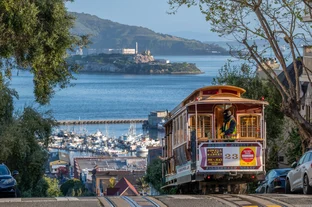
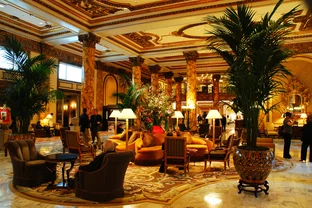
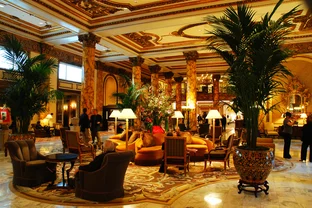
When the cable car started operating in 1873, this hill became the city's exclusive residential area. Newly wealthy residents who had struck it rich in the gold rush (and were known by names such as the "Big Four" and the "Comstock Bonanza kings") built their mansions here, but they were almost all destroyed by the 1906 earthquake and fire. The only two surviving buildings are the Flood Mansion, which serves today as the Pacific Union Club, and The Fairmont Hotel, which was under construction when the earthquake struck and was damaged but not destroyed. Today, the burned-out sites of former mansions hold the city's luxury hotels -- the InterContinental Mark Hopkins, the Stanford Court, The Huntington Hotel, and spectacular Grace Cathedral, which stands on the Crocker mansion site. Nob Hill is worth a visit if only to stroll around Huntington Park, attend a Sunday service at the cathedral, or ooh and aah your way around The Fairmont's spectacular lobby.

South of Market (SoMa)

From Market Street to Townsend Street and The Embarcadero to Division Street, SoMa has become the city's newest cultural and multimedia center. The process started when alternative clubs began opening in the old warehouses in the area nearly a decade ago. A wave of entrepreneurs followed, seeking to start new businesses in what was once an extremely low-rent area compared to the neighboring Financial District. Today, gentrification and high rents hold sway, spurred by a building boom that started with the Moscone Convention Center and continued with the Yerba Buena Center for the Arts and Yerba Buena Gardens, the San Francisco Museum of Modern Art, Four Seasons Hotel, W Hotel, St. Regis Hotel, and the Metreon Entertainment Center. Other institutions, businesses, and museums move into the area on an ongoing basis. A substantial portion of the city's nightlife takes place in warehouse spaces throughout the district.

North Beach

In the late 1800s, an enormous influx of Italian immigrants to North Beach firmly established this aromatic area as San Francisco's "Little Italy." Dozens of Italian restaurants and coffeehouses continue to flourish in what is still the center of the city's Italian community. Walk down Columbus Avenue on any given morning and you're bound to be bombarded by the wonderful aromas of roasting coffee and savory pasta sauces. Although there are some interesting shops and bookstores in the area, it's the dozens of eclectic little cafes, delis, bakeries, and coffee shops that give North Beach its Italian-bohemian character.

Chinatown

The first of the Chinese immigrants came to San Francisco in the early 1800s to work as servants. By 1851, 25,000 Chinese people were working in California, and most had settled in San Francisco's Chinatown. Fleeing famine and the Opium Wars, they had come seeking the good fortune promised by the "Gold Mountain" of California, and hoped to return with wealth to their families in China. For the majority, the reality of life in California did not live up to the promise. First employed as workers in the gold mines during the gold rush, they later built the railroads, working as little more than slaves and facing constant prejudice. Yet the community, segregated in the Chinatown ghetto, thrived. Growing prejudice led to the Chinese Exclusion Act of 1882, which halted all Chinese immigration for 10 years and severely limited it thereafter (the Chinese Exclusion Act was not repealed until 1943). Chinese people were also denied the opportunity to buy homes outside the Chinatown ghetto until the 1950s.

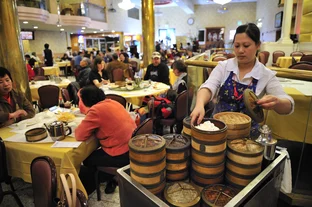
Today, San Francisco has one of the largest communities of Chinese people in the United States. More than 80,000 people live in Chinatown, but the majority of Chinese people have moved out into newer areas like the Richmond and Sunset districts. Although frequented by tourists, the area continues to cater to Chinese shoppers, who crowd the vegetable and herb markets, restaurants, and shops. Tradition runs deep here, and if you're lucky, through an open window you might hear women mixing mah-jongg tiles as they play the centuries-old game. (Be warned: You're likely to hear lots of spitting around here, too -- it's part of local tradition.)

The gateway at Grant Avenue and Bush Street marks the entry to Chinatown. The heart of the neighborhood is Portsmouth Square, where you'll find locals playing board games or just sitting quietly.

On the newly beautified and renovated Waverly Place, a street where the Chinese celebratory colors of red, yellow, and green are much in evidence, you'll find three Chinese temples: Jeng Sen (Buddhist and Taoist) at no. 146, Tien Hou (Buddhist) at no. 125, and Norras (Buddhist) at no. 109. If you enter, do so quietly so that you do not disturb those in prayer.

A block west of Grant Avenue, Stockton Street, from 1000 to 1200, is the community's main shopping street, lined with grocers, fishmongers, tea sellers, herbalists, noodle parlors, and restaurants. Here, too, is the Buddhist Kong Chow Temple, at no. 855, above the Chinatown post office. Explore at your leisure.

Fortune Cookie Factory -- At 56 Ross Alley is the Golden Gate Fortune Cookie Factory, a tiny Chinatown storefront where, since 1962, three women sit at a conveyer belt, folding messages into thousands of fortune cookies as the manager invariably calls out to tourists, beckoning them to stroll in, watch the cookies being made, and buy a bag of 40 for about $3. Sure, there are other fortune cookie bakeries in the city, but this is the only one left where the cookies are still made by hand the old-fashioned way. You can purchase regular fortunes, unfolded flat cookies without fortunes, or, if you bring your own fortunes, they can create custom cookies (great for dinner parties) at around $6 for 50 cookies -- a very cheap way to impress your friends. The factory is open daily 9am to 8:30pm. Admission is free; tel. 415/781-3956.

Japantown

More than 12,000 citizens of Japanese descent (1.4% of the city's population) live in San Francisco, or Soko, as the Japanese who first emigrated here often called it. Initially, they settled in Chinatown and south of Market along Stevenson and Jessie streets from Fourth to Seventh streets. After the earthquake in 1906, SoMa became a light industrial and warehouse area, and the largest Japanese concentration took root in the Western Addition between Van Ness Avenue and Fillmore Street, the site of today's Japantown, now 100 years old. By 1940, it covered 30 blocks.

In 1913, the Alien Land Law was passed, depriving Japanese Americans of the right to buy land. From 1924 to 1952, the United States banned Japanese immigration. During World War II, the U.S. government froze Japanese bank accounts, interned community leaders, and removed 112,000 Japanese Americans -- two-thirds of them citizens -- to camps in California, Utah, and Idaho. Japantown was emptied of Japanese people, and war workers took their place. Upon their release in 1945, the Japanese found their old neighborhood occupied. Most of them resettled in the Richmond and Sunset districts; some returned to Japantown, but it had shrunk to a mere 6 or so blocks. Today, the community's notable sights include the Buddhist Church of San Francisco, 1881 Pine St. (at Octavia St.), www.bcsfweb.org; the Konko Church of San Francisco, 1909 Bush St. (at Laguna St.); the Sokoji-Soto Zen Buddhist Temple, 1691 Laguna St. (at Sutter St.); Nihonmachi Mall, 1700 block of Buchanan Street between Sutter and Post streets, which contains two steel fountains by Ruth Asawa; and the Japan Center, an Asian-oriented shopping mall occupying 3 square blocks bounded by Post, Geary, Laguna, and Fillmore streets. At its center stands the five-tiered Peace Pagoda, designed by world-famous Japanese architect Yoshiro Taniguchi "to convey the friendship and goodwill of the Japanese to the people of the United States." Surrounding the pagoda, through a network of arcades, squares, and bridges, you can explore dozens of shops and showrooms featuring everything from TVs and tansu chests to pearls, bonsai, and kimonos. Kabuki Springs & Spa is the center's most famous tenant. But locals also head to its numerous restaurants, teahouses, shops, and multiplex movie theater.

There is often live entertainment in this neighborhood on summer weekends, including Japanese music and dance performances, tea ceremonies, flower-arranging demonstrations, martial-arts presentations, and other cultural events. The Japan Center (tel. 415/922-6776) is open daily from 10am to midnight, although most shops close much earlier. To get there, take bus nos. 2, 3, or 4 (exit at Buchanan and Sutter sts.) or nos. 22 or 38 (exit at the northeast corner of Geary Blvd. and Fillmore St.).

Haight-Ashbury

Few of San Francisco's neighborhoods are as varied -- or as famous -- as Haight-Ashbury. Walk along Haight Street, and you'll encounter everything from drug-dazed drifters begging for change to an armada of the city's funky-trendy shops, clubs, and cafes. Turn anywhere off Haight, and instantly you're among the clean-cut, young urban professionals who can afford the steep rents in this hip 'hood. The result is an interesting mix of well-to-do and well-screw-you aging flower children, former Dead-heads, homeless people, and throngs of tourists who try not to stare as they wander through this most human of zoos. Some find it depressing, others find it fascinating, but everyone agrees that it ain't what it was in the free-lovin' psychedelic Summer of Love. Is it still worth a visit? Not if you are here for a day or two, but it's certainly worth an excursion on longer trips, if only to enjoy a cone of Cherry Garcia at the now-famous Ben & Jerry's Ice Cream Store on the corner of Haight and Ashbury streets, and then to wander and gawk at the area's intentional freaks.

The Castro

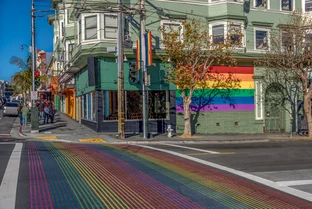
Castro Street, between Market and 18th streets, is the center of the city's gay community as well as a lovely neighborhood teeming with shops, restaurants, bars, and other institutions that cater to the area's colorful residents. Among the landmarks are Harvey Milk Plaza and the Castro Theatre (www.castrotheatre.com), a 1930s movie palace with a Wurlitzer. The gay community began to move here in the late 1960s and early 1970s from a neighborhood called Polk Gulch, which still has a number of gay-oriented bars and stores. Castro is one of the liveliest streets in the city and the perfect place to shop for gifts and revel in free-spiritedness. Check www.castroonline.com for more info.

The Mission District

Once inhabited almost entirely by Irish immigrants, The Mission District is now the center of the city's Latino community as well as a mecca for young, hip residents. It's an oblong area stretching roughly from 14th to 30th streets between Potrero Avenue on the east and Dolores on the west. In the outer areas, many of the city's finest Victorians still stand, although they seem strangely out of place in the mostly lower-income neighborhoods. The heart of the community lies along 24th Street between Van Ness and Potrero, where dozens of excellent ethnic restaurants, bakeries, bars, and specialty stores attract people from all over the city. The area surrounding 16th Street and Valencia is a hotbed for impressive -- and often impressively cheap -- restaurants and bars catering to the city's hip crowd. The Mission District at night doesn't feel like the safest place (although in terms of creepiness, the Tenderloin, a few blocks off Union Sq., beats The Mission by far), and walking around the area should be done with caution, but it's usually quite safe during the day and is highly recommended.

For an even better insight into the community, go to the Precita Eyes Mural Arts Center, 2981 24th St., between Harrison and Alabama streets (tel. 415/285-2287; www.precitaeyes.org), and take one of the 1 1/2- to 2-hour tours conducted on Saturdays and Sundays at 11am and 1:30pm, where you'll see 60 murals in an 8-block walk. Group tours are available during the week by appointment. The 11am tour costs $10 for adults, $8 for students with ID, $5 for seniors, and $2 for children under 18; the 1:30pm tour, which is half an hour longer and includes a slide show, costs $12 for adults, $8 for students with ID, and $5 for seniors and children under 18. All but the Saturday-morning tour (which leaves from 3325 24th St. at the Café Venice) leave from the center's 24th Street location.

Other signs of cultural life in the neighborhood are progressive theaters such as Theatre Rhinoceros (www.therhino.org) and Theater Artaud (www.artaud.org). At 16th Street and Dolores is the Mission San Francisco de Asís, better known as Mission Dolores. It's the city's oldest surviving building and the district's namesake.

This City's for the Birds!

If you're walking around San Francisco -- especially Telegraph Hill or Russian Hill -- and you suddenly hear lots of loud squawking and screeching overhead, look up. You're most likely witnessing a fly-by of the city's famous green flock of wild parrots. These are the scions of a colony that started out as a few wayward house pets -- mostly cherry-headed conures, which are indigenous to South America -- who found each other, and bred. Years later they've become hundreds strong, traveling in chatty packs through the city (with a few parakeets along for the ride), and stopping to rest on tree branches and delight residents who have come to consider them part of the family. To learn just how special these birds are to the city, check out the book The Wild Parrots of Telegraph Hill, see the heart-warming movie of the same name, or log onto www.markbittner.net.


Back to Top


Click the names below for more detailed information.

Note: This information was accurate when it was published, but can change without notice. Please be sure to confirm all rates and details directly with the companies in question before planning your trip.


  Email This Article Email Print This Article Print Get Frommer's RSS Feed RSS
Frommer's San Francisco 2008 Frommer's San Francisco 2008

Author: Erika Lenkert
Pub Date: October 01, 2007
Price: $16.99

Buy Now!
Related Titles:
A Moveable Thirst: Tales and Tastes from a Season in Napa Wine Country
California For Dummies, 4th Edition
Frommer's California 2008
Add Frommers.com RSS Feed  Add Frommers.com RSS Feed (What's This?)
Add Frommers.com Deals & News to Your Web Site
Add to My Yahoo!     Add to My MSN     More RSS Readers
Add Frommers.com Podcast Add Frommers.com Podcast (What's This?)
Home > Destinations > North America > USA > California > San Francisco > Attractions > Neighborhoods Worth a Visit