Home > Destinations > North America > USA > California > San Francisco > In Depth > History > The 1970's & 1980's: Gay Rights
Bookstore Community Tips and Tools Book a Trip Deals and News Trip Ideas, Activities, Lifestyles Hotels Destinations Frommers.com Home
Frommer's - The best trips start here. Frommer's - The best trips start here.
Sign up for our FREE Newsletters! Win a FREE Trip
Most Active San Francisco Discussions
Most Recommended Articles
Most Commented Articles
  Print This Article Print Get Frommer's RSS Feed RSS

History

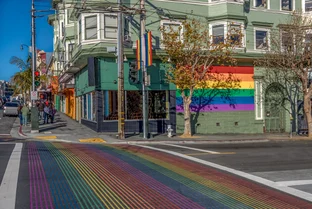
The homosexual community in San Francisco developed at the end of World War II, when thousands of military personnel returned to the United States via San Francisco. A substantial number of those men were homosexual and decided to stay in the city. A gay community grew up along Polk Street between Sutter and California. Later, the larger community moved into the Castro District, where it remains today.

The gay political-protest movement is usually dated from the 1969 Stonewall raid in Greenwich Village. Although the political movement started in New York, California had already given birth to two major organizations for gay rights: the Mattachine Society, founded in 1951 by Henry Hay in Los Angeles; and the Daughters of Bilitis, a lesbian organization founded in 1955 in San Francisco.

After Stonewall, the Committee for Homosexual Freedom was created in the spring of 1969 in San Francisco and a Gay Liberation Front chapter was organized at Berkeley. In the fall of 1969, Robert Patterson, a columnist for the San Francisco Examiner, referred to homosexuals as "semi males," "drag darlings," and "women who aren't exactly women." On October 31 at noon, a group began a peaceful picket of the Examiner. Peace reigned until someone threw a bag of printer's ink from an Examiner window. Things got violent and, eventually, the police moved in to clear the crowd, clubbing people as they went. The remaining picketers retreated to Glide Methodist Church, then marched on city hall. Unfortunately, the mayor was away. Unable to air their grievances, the picketers started a sit-in that lasted until 5pm, when they were ordered to leave. Most did, but three remained and were arrested.

Later that year, at an anti-Thanksgiving rally, gays protested against several national and local businesses: Western and Delta airlines (the former for firing lesbian stewardesses, the latter for refusing to sell a ticket to a young man wearing a Gay Power button); radio station KFOG, for its antihomosexual broadcasting; and some local gay bars for exploitation. On May 14, 1970, a group of gay and women's liberationists invaded the convention of the American Psychiatric Association in San Francisco to protest the reading of a paper on aversion therapy for homosexuals, forcing the meeting to adjourn.

The rage against intolerance was appearing on all fronts. At the National Gay Liberation conference in August 1970 in the city, Charles Thorp, chairman of the San Francisco State Liberation Front, called for militancy and issued a challenge to come out with a rallying cry of "Blatant is beautiful." He also argued for the use of what he felt was the more positive, celebratory term gay instead of homosexual, and decried the fact that homosexuals were kept in their place at the three Bs: the bars, the beaches, and the baths. As the movement grew in size and power, debates on strategy and tactics occurred, most dramatically between those gays who wanted to withdraw into separate ghettos, and those who wanted to enter mainstream society. The most extreme proposal was made in California by Don Jackson, who suggested establishing a gay territory in California's Alpine County, about 10 miles south of Lake Tahoe. It would have had a totally gay administration, civil service, university, museum -- everything. The residents of Alpine County were not pleased with the proposal. But before the situation turned really ugly, Jackson's idea was abandoned because of lack of support in the gay community. In the end, the movement concentrated on integration and civil rights, not separatism. Gays elected politicians who were sympathetic to their cause and celebrated their new identity by establishing National Gay Celebration Day and Gay Pride Week, the first of which was celebrated in June 1970, when 1,000 to 2,000 marched in New York, 1,000 in Los Angeles, and a few hundred in San Francisco.

By the mid-1970s, the gay community craved a more central role in city politics. Harvey Milk, owner of a camera store in the Castro, decided to run for the board of supervisors. He won, becoming the first openly gay person to hold a major public office. He and liberal mayor George Moscone developed a gay rights agenda, but in 1978 they were both shot and killed by former supervisor Dan White, after Moscone refused White's request for reinstatement. White, a former police officer, had consistently opposed Milk's and Moscone's more liberal policies. At his trial, White successfully pleaded temporary insanity caused by additives in his fast-food diet. The media dubbed it the "Twinkie defense," but the murder charges against White were reduced to manslaughter. On that day, angry and grieving, the gay community rioted, overturning and burning police cars in a night of rage. To this day, a candlelight memorial parade is held on November 27. Milk's martyrdom was both a political and a practical inspiration for gay candidates across the country.

The emphasis in the gay movement shifted abruptly in the 1980s, when the AIDS epidemic struck the community. AIDS has had a dramatic impact on the Castro: While it's still a thriving and lively community, it's no longer the constant party it once was. The hedonistic lifestyle that had played out in the discos, bars, baths, and streets changed as the seriousness of the epidemic sank in and the number of deaths increased. Political efforts by gays have shifted away from enfranchisement and toward demands for social services and research money to deal with the AIDS crisis. Despite its difficulties, the gay community in San Francisco is still thriving. And let's not forget the hullabaloo around gay marriage, which Mayor Gavin Newsome legalized for a moment in early 2004 until higher-ranking governmental officials put a stop to them.


Back to Top


Click the names below for more detailed information.

Note: This information was accurate when it was published, but can change without notice. Please be sure to confirm all rates and details directly with the companies in question before planning your trip.


  Print This Article Print Get Frommer's RSS Feed RSS
Frommer's San Francisco 2009 Frommer's San Francisco 2009

Author: Matthew Richard Poole
Pub Date: October 06, 2008
Price: $17.99

Buy Now!
Related Titles:
A Moveable Thirst: Tales and Tastes from a Season in Napa Wine Country
California For Dummies, 4th Edition
Frommer's 24 Great Walks in San Francisco
Sponsored Links: What's This?
Museums on Us (r) , free admission from Bank of America
Add Frommers.com RSS Feed  Add Frommers.com RSS Feed (What's This?)
Add Frommers.com Deals & News to Your Web Site
Add to My Yahoo!     Add to My MSN     More RSS Readers
Add Frommers.com Podcast Add Frommers.com Podcast (What's This?)
Home > Destinations > North America > USA > California > San Francisco > In Depth > History > The 1970's & 1980's: Gay Rights