Frommer's Review
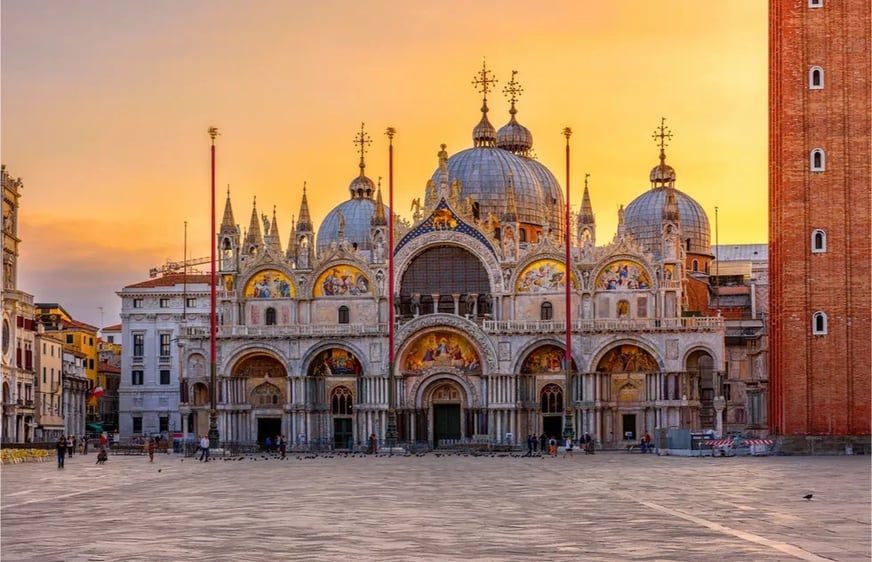
The pink-and-white marble Gothic-Renaissance Palazzo Ducale, residence and government center of the doges ("dukes," elected for life) who ruled Venice for more than 1,000 years, stands between the Basilica di San Marco and St. Mark's Basin. A symbol of prosperity and power, it was destroyed by a succession of fires and was built and rebuilt in 1340 and 1424 in its present form, escaping the Renaissance fever that was in the air at the time. Forever being expanded, it slowly grew to be one of Italy's greatest civic structures. A 15th-century Porta della Carta (Paper Gate; the entrance adjacent to the basilica where the doges' official proclamations and decrees were posted) opens onto a splendid inner courtyard with a double row of Renaissance arches.
Ahead you'll see Jacopo Sansovino's enormous Scala dei Giganti staircase (Stairway of the Giants; scene of the doges' lavish inaugurations and never used by mere mortals), which leads to the wood-paneled courts and elaborate meeting rooms of the interior. The walls and ceilings of the principal rooms were richly decorated by the Venetian masters, including Veronese, Titian, Carpaccio, and Tintoretto, to illustrate the history of the puissant Venetian Republic while at the same time impressing visiting diplomats and emissaries from the far-flung corners of the maritime republic with the uncontested prosperity and power it had attained.
If you want to understand something of this magnificent palace, the fascinating history of the 1,000-year-old maritime republic and the intrigue of the government that ruled it, take the Secret Itineraries tour. Failing that, at least shell out for the infrared audio-guide tour (at entrance: 5.50€/$6.90) to help make sense of it all. Unless you can tag along with an English-speaking tour group, you may otherwise miss out on the importance of much of what you're seeing.
The first room you'll come to is the spacious Sala delle Quattro Porte (Hall of the Four Doors), whose ceiling is by Tintoretto. The Sala del Anti-Collegio (adjacent to the College Chamber, whose ceiling is decorated by Tintoretto), the next main room, is where foreign ambassadors waited to be received by this committee of 25 members: It is decorated with works by Tintoretto, and Veronese's Rape of Europe, considered one of the palazzo's finest. It steals some of the thunder of Tintoretto's Three Graces and Bacchus and Ariadne -- the latter considered one of his best by some critics. A right turn from this room leads into one of the most impressive of the spectacular interior rooms, the richly adorned Sala del Senato (Senate Chamber), with Tintoretto's ceiling painting, The Triumph of Venice. Here laws were passed by the Senate, a select group of 200 chosen from the Great Council. The latter was originally an elected body, but from the 13th century onward, it was an aristocratic stronghold that could number as many as 1,700. After passing again through the Sala delle Quattro Porte, you'll come to the Veronese-decorated Stanza del Consiglio dei Dieci (Room of the Council of Ten, the republic's dreaded security police), of particular historical interest. It was in this room that justice was dispensed and decapitations ordered. Formed in the 14th century to deal with emergency situations, the Ten were considered more powerful than the Senate, and feared by all. Just outside the adjacent chamber, in the Sala della Bussola (The Compass Chamber), notice the Bocca dei Leoni ("lion's mouth"), a slit in the wall into which secret denunciations and accusations of enemies of the state were placed for quick action by the much-feared Council.
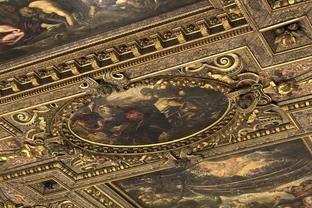
The main sight on the next level down -- indeed in the entire palace -- is the Sala del Maggior Consiglio (Great Council Hall). This enormous space is made special by Tintoretto's huge Paradiso at the far end of the hall above the doge's seat (the painter was in his 70s when he undertook the project with the help of his son; he died 6 years later). Measuring 7m by 23m (23 ft.*75 ft.), it is said to be the world's largest oil painting; together with Veronese's gorgeous Il Trionfo di Venezia (The Triumph of Venice) in the oval panel on the ceiling, it affirms the power emanating from the council sessions held here. Tintoretto also did the portraits of the 76 doges encircling the top of this chamber; note that the picture of the Doge Marin Falier, who was convicted of treason and beheaded in 1355, has been blacked out -- Venice has never forgiven him. Although elected for life since sometime in the 7th century, over time il doge became nothing but a figurehead (they were never allowed to meet with foreign ambassadors alone); the power rested in the Great Council. Exit the Great Council Hall via the tiny doorway on the opposite side of Tintoretto's Paradiso to find the enclosed Ponte dei Sospiri (Bridge of Sighs), which connects the Ducal Palace with the grim Palazzo delle Prigioni (Prisons). The bridge took its current name only in the 19th century, when visiting northern European poets romantically envisioned the prisoners' final breath of resignation upon viewing the outside world one last time before being locked in their fetid cells awaiting the quick justice of the Terrible Ten. Some attribute the name to Casanova, who, following his arrest in 1755 (he was accused of being a Freemason and spreading antireligious propaganda), crossed this very bridge. He was one of the rare few to escape 15 months after his imprisonment, returning to Venice 20 years later. Some of the stone cells still have the original graffiti of past prisoners, many of them locked up interminably for petty crimes.
An Insider's Look at the Palazzo Ducale--I cannot recommend the Itinerari Segreti (Secret Itineraries) guided tours highly enough. The tours offer an unparalleled look into the world of Venetian politics over the centuries and are the only way to access the otherwise restricted quarters and hidden passageways of this enormous palace, such as the doges' private chambers and the torture chambers where prisoners were interrogated. The story of Giacomo Casanova's imprisonment in, and famous escape from, the palace's prisons is the tour highlight (though a few of the less-inspired guides harp on this aspect a bit too much). I strongly recommend you reserve in advance, by phone if possible -- tours are often sold out at least a few days ahead, especially from spring through fall -- or in person at the ticket desk. Tours are at 10:30am Thursday through Tuesday (by reservation only), and cost 13€ ($16) for adults, 7€ ($8.75) for students, and 4€ ($5) for children 6 to 14.
Note: This information was accurate when it was published, but can change without
notice. Please be sure to confirm all rates and details directly with the companies in question before
planning your trip.