Home > Destinations > Europe > Austria > Vienna > In Depth > History > The Postwar Years
Bookstore Community Tips and Tools Book a Trip Deals and News Trip Ideas, Activities, Lifestyles Hotels Destinations Frommers.com Home
Frommer's - The best trips start here. Frommer's - The best trips start here.
Sign up for our FREE Newsletters! Win a FREE Trip
Most Active Vienna Discussions
Most Recommended Articles
Most Commented Articles
  Print This Article Print Get Frommer's RSS Feed RSS

History

Der Dritte Mann & Postwar Vienna

The 1949 film The Third Man, starring Joseph Cotten, Orson Welles, and Alida Valli, remains one of the best records of a postwar Vienna in ruins. Graham Greene, who wrote the screenplay (published by Penguin Books), found a "city of undignified ruins, which turned February into great glaciers of snow and ice." The Danube was a "gray, flat muddy river," and the Russian zone, where the Prater lay, was "smashed and desolate and full of weeds."

In the closing weeks of World War II, the city suffered major aerial bombardment. In the summer of 1944, Vienna tried to save itself, closing all theaters and public areas. The workweek was extended to 60 hours. A dreaded mass recruitment, the Volksturm, rounded up all males between the ages of 16 and 60 for a final defense. Hitler was in his Berlin bunker when he learned that the city of his youth, Vienna, had fallen to the Allies.

The victors found a wasted city on the verge of starvation. By 1945, Vienna had the highest death rate in Europe. Bombings had destroyed 20% of its buildings, and some 270,000 Viennese were left homeless.

The Third Man immortalized the "four men in a jeep" -- that is, four military policemen from the quartet of occupying powers -- patrolling the beleaguered city. The black market, on which the events in the film turn, became the way of life in Vienna.

Even today, the Viennese have bitter memories of the occupation, especially by the Soviet Union. A reminder of those dreaded years survives at Schwarzenbergplatz (reached from Karlsplatz by walking along Friedrichstrasse/Lothringerstrasse). Under the Nazis, this square was called Hitlerplatz. Today, a patch of landscaped greenery surrounds a fountain and a statue left by the Russians. The city has been none too happy with this "gift" from its former conquerors. Three times officials have tried to demolish the memorial, but so far Soviet engineering has proven indestructible. Viennese have nicknamed an anonymous Soviet soldier's grave "the Tomb of the Unknown Plunderer."

In May 1955, the Austria State Treaty, signed by the four Allied powers and Austria, reestablished full Austrian sovereignty. Why did it take so long? One reason is that the Soviets were seeking heavy reparations from Austria. But as dust settles over history, another possibility arises. Stalin might have planned to stick around in Vienna, as he did in Berlin. After all, a toehold in Vienna would have given the Soviets deep penetration into the West at the peak of the Cold War. As it was, Vienna became a center of Cold War espionage and spying -- real James Bond country.

Postwar Times -- On May 15, 1955, Austria regained its sovereignty as an independent, perpetually neutral nation. As a neutral capital, Vienna became the obvious choice for meetings between John Kennedy and Nikita Khrushchev (in 1961) and Leonid Brezhnev and Jimmy Carter (in 1979). Many international organizations (including OPEC and the Atomic Energy Authority) established branches or headquarters there.

Once again part of a republic, the Viennese aggressively sought to restore their self-image as cultural barons. Restoring the State Opera House and other grand monuments became a top priority.

However, Vienna's self-image suffered a blow when scandal surrounded Austria's president, Kurt Waldheim, elected in 1986. Waldheim had been an officer in the Nazi army and had countenanced the deportation of Jews to extermination camps. The United States declared him persona non grata. Many Austrians stood by Waldheim; others were deeply embarrassed. Waldheim did not seek reelection, and in May 1992, Thomas Klestil, a career diplomat, was elected president, supported by the centrist Austrian People's Party.

In 1989, the last heiress to the Habsburg dynasty, Empress Zita of Bourbon-Parma, in exile since 1919, was buried in one of the most lavish and emotional funerals ever held in Vienna. At age 96, the last empress of Austria and queen of Hungary had always been held in some degree of reverence, a symbol of the glorious days of the Austrian empire.

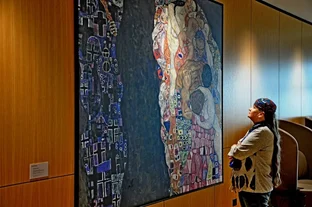
In the spring of 1998, the Austrian government stunned the art world by agreeing to return artworks confiscated from Jews by the Nazis. Many Jewish families, including the Austrian branch of the Rothschilds, had fled into exile in 1938. Although they tried to regain their possessions after the war, they were not successful. Austrian journalist Hubertus Czernin wrote, "The art was stolen by the Nazis and stolen a second time by the Austrian government." One museum director claimed Austria had "a specific moral debt," which it was now repaying.

In 1999 elections, the Freedom Party won notoriety -- and 27% of the vote -- by denouncing the presence of foreigners in Austria. Echoing Nazi rhetoric, the party blames foreigners for drugs, crime, welfare abuse, and the spread of tuberculosis. The party remains racist and Nazi-admiring in spite of the resignation of its leader, Jörg Haider, its most controversial member.

After first announcing punishing sanctions against Austria for its tilt to the far right, the European Union in September of 2000 lifted those sanctions while vowing to keep a special eye on Austria's song and dance into right-wing politics. E.U. officials concluded that in spite of earlier defiance, the Austrian government in Vienna had taken "concrete steps to fight racism, xenophobia, and anti-Semitism."

News of an expat Austrian, a citizen of Graz, made the biggest headlines in both Vienna and the country itself in 2004. Their homegrown son, muscleman/movie star Arnold Schwarzenegger, swept into the governor's office in California in a recall vote. Even though he's married to a Kennedy, Maria Shriver, Schwarzenegger is a Republican, and lent the prestige of his name in the campaign of George W. Bush for reelection. For his efforts, he told a stunned nation, he was denied sex for 2 weeks.

In October of 2006, Austria's opposition Social Democrats won nationwide elections, swinging the country to the center-left after more than six years of influence by the extreme right. Immigration was a central theme in the campaign (sound familiar?), and the far right wants to reduce the number of foreigners in Austria by 30 percent. The Social Democrats on the other hand promised to lower the number of unemployed and reduce salary differences between men and women.


Back to Top


Click the names below for more detailed information.

Note: This information was accurate when it was published, but can change without notice. Please be sure to confirm all rates and details directly with the companies in question before planning your trip.


  Print This Article Print Get Frommer's RSS Feed RSS
Frommer's Vienna and Danube Valley, 6th Edition Frommer's Vienna and Danube Valley, 6th Edition

Author: Darwin Porter
Pub Date: April 23, 2007
Price: $16.99

Buy Now!
Related Titles:
Europe For Dummies, 4th Edition
Europe For Dummies, 5th Edition
Frommer's 24 Great Walks in Amsterdam
Add Frommers.com RSS Feed  Add Frommers.com RSS Feed (What's This?)
Add Frommers.com Deals & News to Your Web Site
Add to My Yahoo!     Add to My MSN     More RSS Readers
Add Frommers.com Podcast Add Frommers.com Podcast (What's This?)
Home > Destinations > Europe > Austria > Vienna > In Depth > History > The Postwar Years