

International Cat Day is August 8. The following is a transcript of an interview featured on the Frommer’s Travel Show Podcast. Our guest was Jeff Bogle, author of Street Cats & Where to Find Them: The Most Feline Friendly Cities and Attractions Around the World. The Q&A has been edited for length and clarity; click here to listen to the entire interview.
Pauline Frommer: When I think of street cats, I think of a sobering talk I had many years ago with a veterinarian in Jerusalem. She told me that street cats were a huge problem in the city. Cats were brought to Jerusalem by the British to kill mice and [because] they had no natural predators the population exploded. Today, there are thousands of street cats there, and [the veterinarian told me] they lead very difficult lives.
I don’t think they take care of the cats [in Jerusalem]. But in certain cities they do. And you've highlighted those cities.
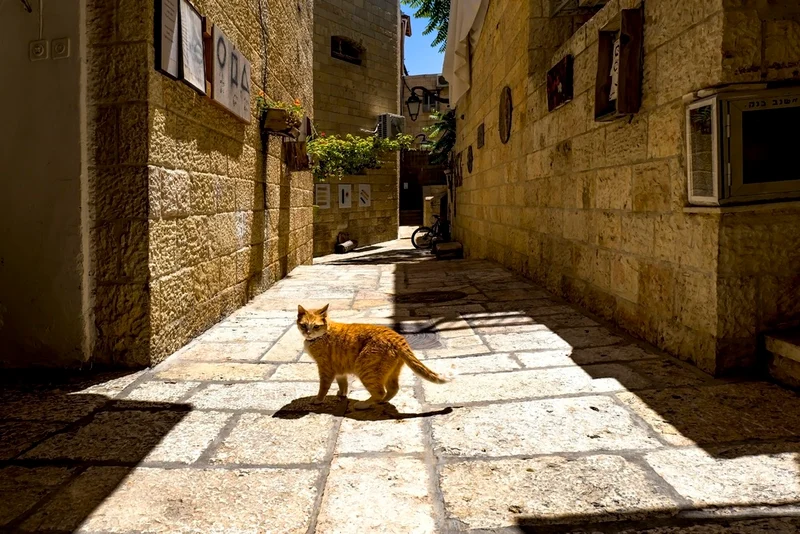
Jeff Bogle: I have. But I’ve also highlighted some of the ones where cats have it rougher. I wanted to paint as full a picture as I could… within 224 pages. This is not War and Peace.
Jerusalem's not in the book. [But you’ll find street cats in] Bergen, Norway. They're in Maui, Hawaii. They're everywhere.
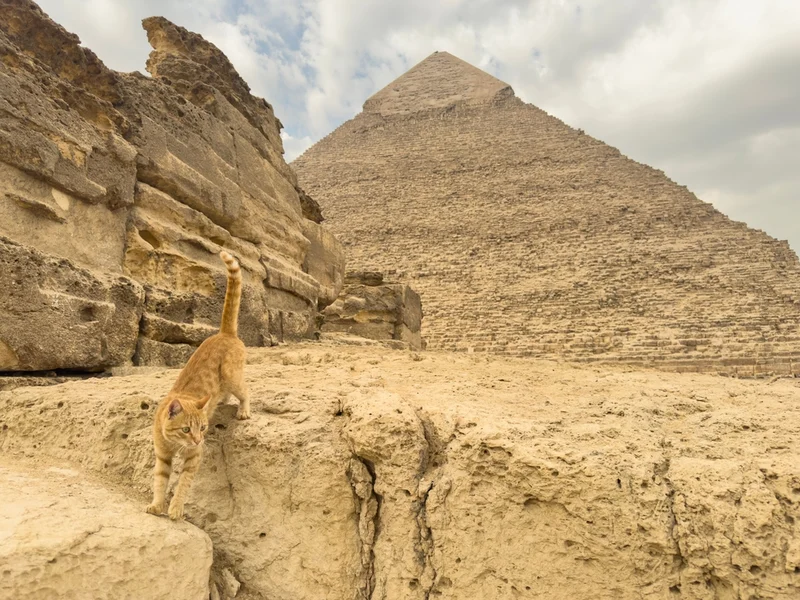
I focused on 20 specific locations, and it’s not all cupcakes and rainbows. For example: Cairo, Egypt. That’s a place we associate with cats because they were once worshipped there. Egyptians loved cats. Not so much anymore.
But in a lot of cities around the world, people have made little cardboard huts with blankets inside, really cute shapes and designs, and placed them in parks and on streets. It’s a real joy to see because they are an active representation of people caring, and trying to look out for their vulnerable, yet extremely resilient, feline neighbors.
I wanted to give people a full picture of what it's like [city by city] so that you when you see [street cats], you can help them.
They're not all going to be super cuddly. They're not all going to be pristine. Some of them are going to have been in some scrapes.
But I wanted to kind of show the full world, literally and figuratively, of street cats.
Approaching street cats: safety and protocols
Frommer: You go around and you do cuddle these street cats. I've always wanted to, but I've worried that they'd be feral or that they would have fleas or ringworm or other communicable diseases. So let's talk about the safety aspects of interacting with street cats. What's the difference between a street cat and a feral cat?
Bogle: A feral cat is a wild cat. It has never been domesticated. It has no interest in being petted. It is a truly wild animal. All feral cats are street cats, but the same is not true in reverse.
Street cats are cats that may have lived in a home and were dumped. That happens way too often and that’s the way a lot of street cats get on the street. And they are used to being loved, many of them. They are used to jumping up and curling up on a stranger's lap, which happened to me in so many places. They are comfortable with people in parks, in markets, and on busy streets. So they're not truly wild—they live outside, but they're not truly feral in that sense.
Frommer: So I guess you're saying the difference between a feral cat and a street cat is [the latter] will approach you.
Bogle. Exactly. I have a section in the book called "Staying Safe with Street Cats." I wanted to share ways to interact safely, for humans and for the cats.
When you see a street cat, you go up and you put your hand out and you crouch down on their level. They’ll come near you and they might rub up against your hand, they might circle, or do figure eights around your legs. If you sit down, there's a very good chance they're going to climb up on your lap and promptly fall asleep. The key thing is crouching, getting on their level. I mean, heck, we are imposing to even the largest [cats].
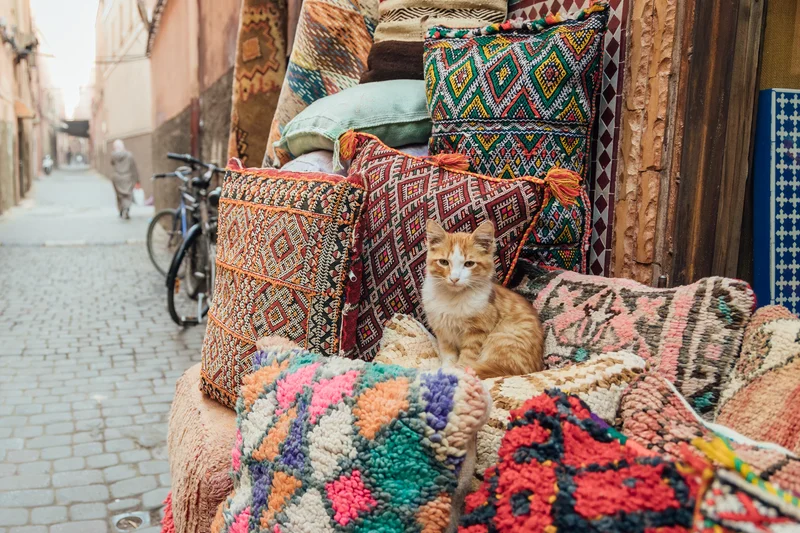
You also want to try to be as quiet as possible now, which sounds funny because some of these places that these cats live are so loud, like the Medina in Marrakech, [where] there are motorbikes zooming past constantly. But you still want to be quiet. Use hush tones, put your hand out and let them decide. Let them make the first move. Cats have an amazing ability, that I wish humans had, to vet people very quickly. I feel like cats can tell who's a good person and who's a dodgy person within one sniff. Boy, wouldn't that be helpful if we could do that? We would avoid a lot of bad relationships.
So, yeah, they will say, I trust you, I want to be pet by you. I want to sit on your lap, I want to rub up against your leg incessantly.

Now, obviously if they have rabies and you get bit or scratched, there could be an issue. But if they have ringworm and sit on your lap that’s not going to infect you. I'd like to think I'm living proof of that because I can't even count the number of cats that I've [petted around the world].
Frommer: What if you see an open sore or if it’s clear the cat is sick. What do you do?
Bogle: You probably want to avoid having that cat on your lap because they might be tender [around the sore and if] you pet them it could trigger something in them—a fight or flight type situation where you don't want that.
Even better, search on your phone to see if there’s an animal rescue organization with the city and give them a ring. Tell them where you saw that cat, maybe take a picture, and then they can provide the support that that cat would need.
Top places to photograph street cats
Bogle: My wife and I are crazy cat people. I take photos of cats wherever we go. And sometimes they’re in the most beautiful places, like Kotor, Montenegro.
Kotor is a medieval walled city right on what looks a fjord, although I can't imagine fjords being in Montenegro. But if you've ever been to Norway, it's a little arm of a body of water that looks a lot like a glacial fjord.
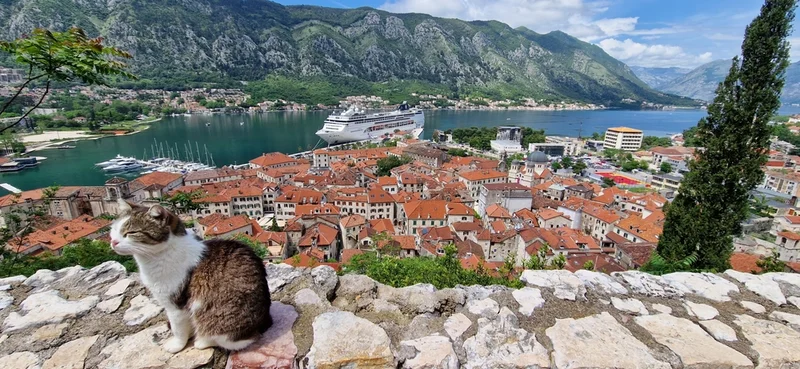
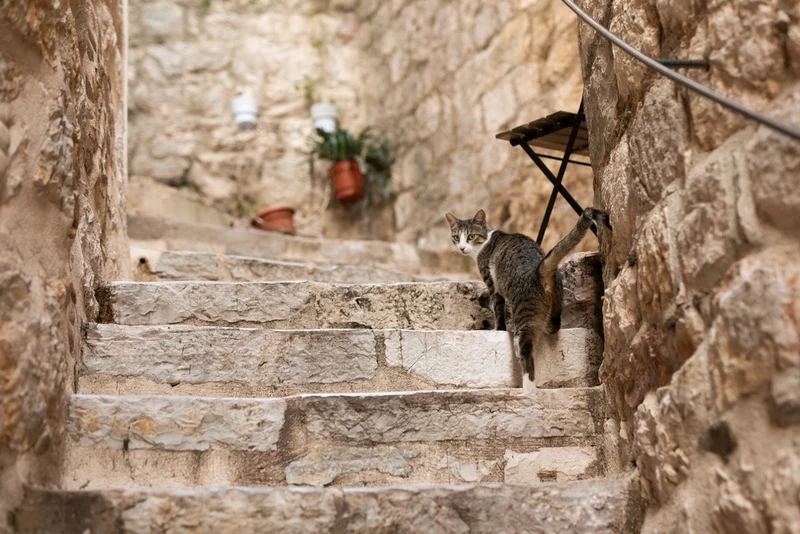
I took my oldest daughter on that portion of my book making research. We went to Croatia and drove down to Kotor [and] Dubrovnik, and it is a wonderland of a place. It is small and compact, extremely walkable, except if you're staying at an accommodation in the Old Town of Kotor—all of those are up massive flights of stone steps.
There are cats everywhere in Kotor, but specifically there's one park with little boxes, little homes for the cats, and a vending machine. You put in your old plastic non reusable bottles into the machine and out the bottom of the machine comes dry cat food. So you recycle, cats get food. It's quite genius. I’ve also seen [this type of vending machine] in Cyprus.
And right from that cat park, there's steps up to go to the walls, where you look out over the water, look out over a cruise ship if it's there in port. A stunning, stunning location.
Frommer: Closer to home, you write about a place I’d never heard of: Tangier Island, Virginia.
Bogle: Yeah, not many people in Virginia have heard of it either.
Frommer: You say it’s like New Orleans, but no alcohol.
Bogle: Exactly. They have their own dialect in Tangier that doesn't exist anywhere else in the country or the world for that matter. You feel like you're not quite in the 18th century, but a lot of the history of the island goes back to Revolutionary War times.
If you were going to describe it negatively, you could say it's like a backwater place. I won't do that though. It's right in the Chesapeake Bay, not far from Smith Island. Ferries run there, but only in season. They bring tourists there to bike or kayak or take golf cart tours. It's a 3-kilometer island, so you could walk it.
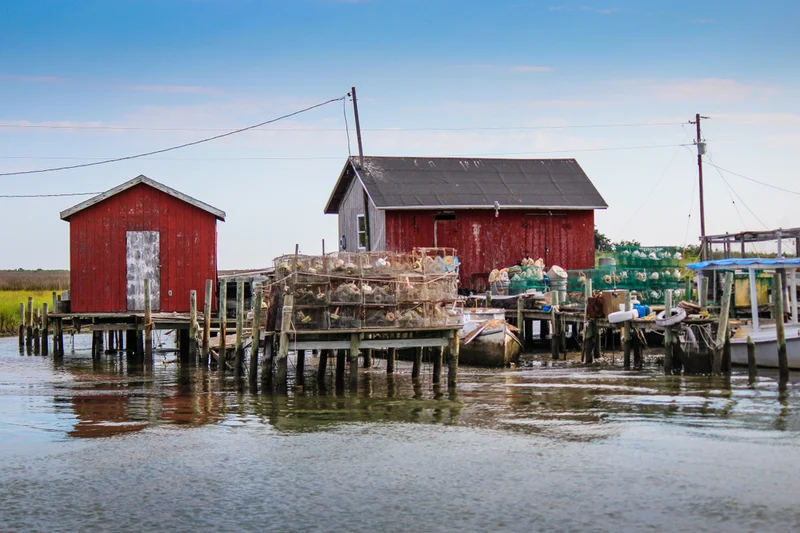
The cats there are community cats. So these cats belong to people, but since there are no real predators on the island, they wander around. They hang out by the docks; this is the soft shell crab capital of the world. And so the cats know when the fishing boats come in and [they] all go down to the dock and wait. [As the fishermen are] cleaning them and deshelling them, they throw the cats scraps. They’re no dummies!
Frommer: Interesting. Let’s talk about another cat island: Tashirojima.
Bogle: Japan has a few cat islands. And by that I mean islands where cats far outnumber human inhabitants. [On this island] there are about 50 to 75 people that live there, with upwards of 300 cats. The residents take care of them.
For fans of anime or manga artwork, modern manga artists designed a number of cabins [on the island]. They are shaped like cats and you can rent and stay in them. They're fantastic. And there's original manga art drawn on the wooden walls on the inside of these cabins, covered in glass.
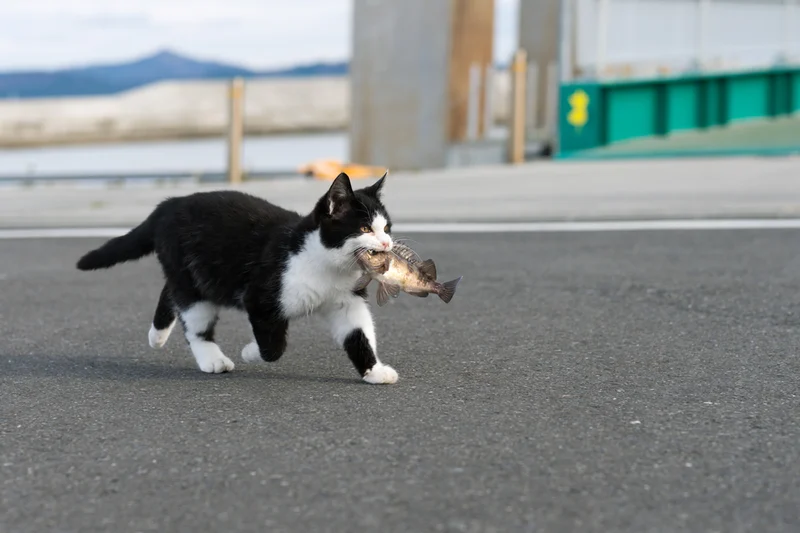
[The island also has] gift shops, there's a restaurant with a bit of a shelter where a lot of the cats hang out (because they get food there), and every dollar you spend on the island is indirectly helping the cat.
Frommer: When you go to Japan, one of the things you see everywhere is this cat statue with a little waving arm and you explain what that came from.
Bogle: In Japanese folklore, a lord was returning home from a day of falconry, during the Edu period in the early 1600s. It was pouring rain and a friendly little cat came by and beckoned him into the temple to stay dry. The lord left so impressed he decided to financially back a rebuilding of the temple.

That is why this welcoming kitty has become part of the lore: The cat protected a lord from horrendous weather and a temple was built in its honor.
Frommer: And before we leave Japan, you talk about your favorite cat cafe there, one that was created for for abandoned cats who are up for adoption but only if the adoption is done right.
Bogle: [The owner's] name is Massimo. It's a full fledged restaurant that blends his Italian heritage (his grandmother's recipes) with his wife who's Japanese. They met in Australia—it is a true global story.

There's no fee to adopt. You come in, and over time, he feels you out, and matches you to a cat. You take the cat home for a couple of weeks to try see how the cat adjusts to you, how you adjust to the cat. And then if it's a fit, the cat is yours.
He's a lovely human being who runs such a socially conscious place that just wants to do good for his community and for the cats who live there.
Frommer: Before I let you go, I have to ask you about some of the historic sites associated with cats. And this was mind blowing: The National Palace in Mexico is swarming with cats.
Bogle: It is, it is. And they're protected forever by a presidential decree. Two Mexican presidents ago, it was decreed that the cats there are [protected] for as long as they live. No matter what political party or who's in office, [street cats] have access to the grounds. They are to be cared for and fed.
Frommer: And when you go to Key West, one of the top sights is Hemingway's house. He was a famous lover of cats.
Bogle: Not only that, he had an unusual cat with extra fingers on his paws.
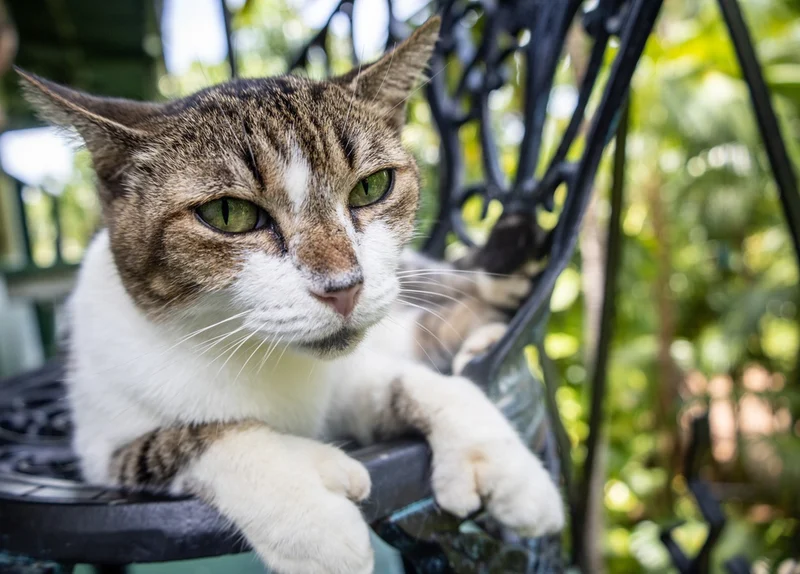
Frommer: Right! Descendants of that cat still live there. So when you go to Hemingway House, you will see cats that truly don't look like any other cats you've ever seen, which is neat. When we travel, we want to see things we can't see at home.
Bogle: Cats help you pause and see things in a new way, on their level. I'm 6 foot 5, but when I'm sitting crisscross applesauce on the ground, the world looks different. It helps me as a travel writer and just as a human, to see things differently and photograph differently.