

The chances are strong that you won't personally witness the total solar eclipse of Aug. 12, 2026.
The path of totality—the area under which the sun will be completely obscured by the moon—only passes over parts of Spain and Portugal, Greenland, and a lot of uninhabited Arctic areas where the main witnesses will be polar bears. Parts of northern Canada and northern Europe will have incomplete side views.
But so what if you miss this one?
As long as the world keeps spinning, there will be more opportunities.
Some solar eclipses are annular, during which a ring of the sun is visible around the edges of the moon as it obstructs light. But the pinnacle of eclipse types, the one avid sky-gazers get into planes to chase, is the total solar eclipse, when the sun is fully blocked by the moon for a period of time.
Here are some future total solar eclipses on the books that pass over places you might be willing to travel to see.
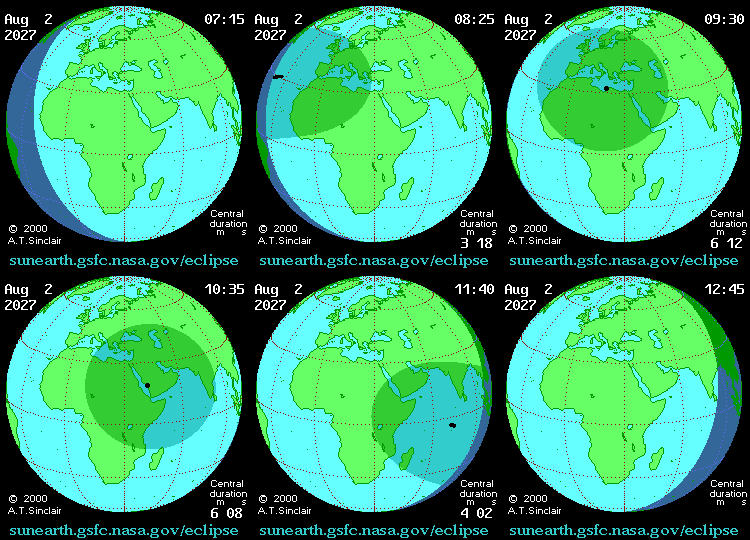
Total solar eclipse of Aug. 2, 2027
The path: The path of totality starts in the mid-Atlantic Ocean and skims across southern Spain and the northern and eastern coasts of Africa, heading into the Indian Ocean and crossing over the Red Sea and the tip of Somalia.
A partial eclipse will be visible from Northern Africa and Southern Europe.
Where most travelers will go: Spain (Cádiz, Marbella, Málaga, Gibraltar), Morocco (Tangier), Italy (Lampedusa), Egypt (Luxor)
Travel ideas: Luxor will witness the best of this eclipse: an unusually long 6 minutes and 39 seconds of totality. Luxury river cruise packages are planning to bring pilgrims up the Nile to Luxor's Ancient Egyptian ruins for the main event at a cost that matches the once-in-a-lifetime spectacle: about $15,000 (airfare not included) for a 12-day vacation (from City and Sea Travel or Smithsonian Journeys) or $8,000 for a 10-day trip (Memphis Tours).
Many of the guided tours are already sold out, including the 4-night trip for $5,200 from Eclipse Traveler. But if you're interested, it may pay to add your name to a waiting list for cancellations.
The Australian travel agency Eclipse Travel is also selling a few more options, such as vacations at vantage points in Morocco for about $4,000.
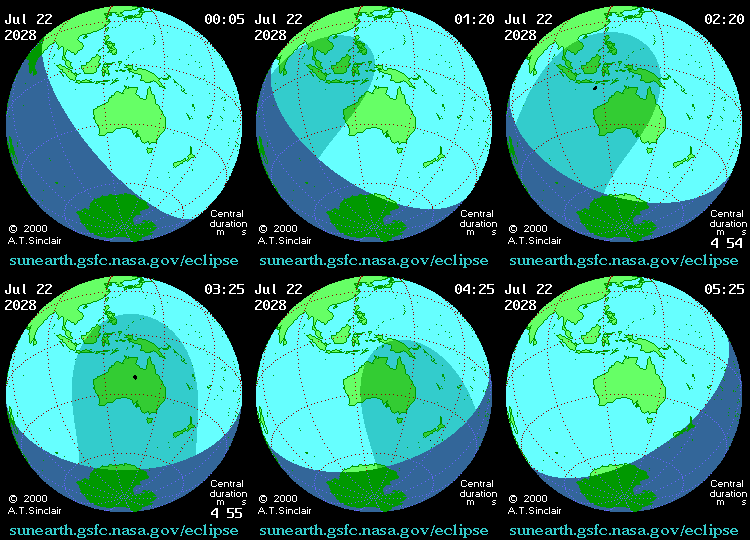
Total solar eclipse of July 22, 2028
The path: This path of totality cuts between the northern Australian cities of Broome and Darwin, passing over the settlement of Tennant Creek on the Stuart Highway, a paved road that travels up the middle of Australia. Then the city of Sydney on the country's east coast will experience the eclipse. New Zealand's Dunedin and the national adventure sports capital, Queenstown, also get a prime view.
Partial views will prevail on the Indonesian island of Bali, in the cities of Melbourne and Brisbane in Australia, and in Christchurch, New Zealand.
Where most travelers will go: Sydney and Queenstown, although the best chances for cloudless skies are in the dry heart of Australia.
Travel ideas: Since both Australia and New Zealand are easy to visit under your own steam without specialized guides or transportation, you won't need to buy a package unless you like the hand-holding and stress-free planning.
Ten-day, land-only itineraries are being sold for US$6,400–$7,900 by Australia-based Eclipse Travel. The specialized astronomy tourists who run Sirius Travel are offering a 4-night trip to Sydney in a 5-star hotel just for the nearly 4-minute eclipse there (land-only, $5,900).
The publication New Scientist also runs branded eclipse vacations through its Discovery Tours that bring professional astronomers along. One of those trips, a 7-day New Zealand itinerary, is selling for £5,149 (US$6,925).
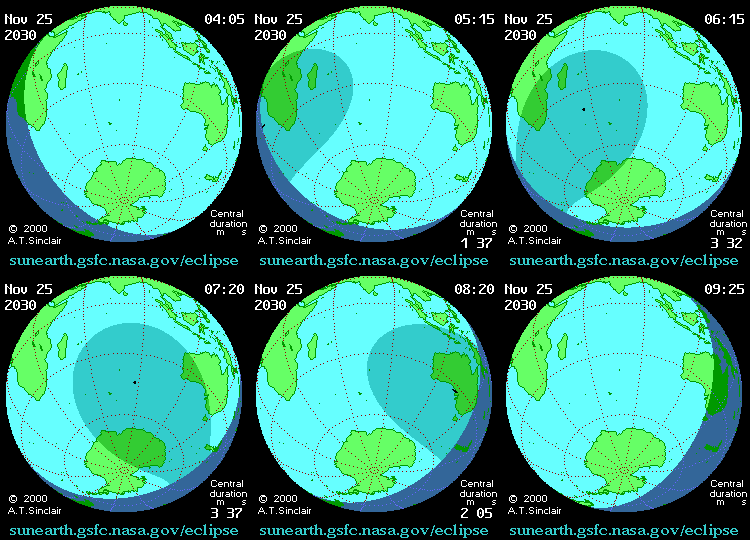
Total solar eclipse of Nov. 25, 2030
The path: Some areas of Africa of interest to adventurous tourists will have their moments of totality, including Namibia's capital city, Windhoek, and the coastal area around Durban, South Africa's third-largest city.
Sydney, Melbourne, and Brisbane will get a second crack at a solar eclipse in 16 months, but all three cities will experience partial coverage, and for less than 2 minutes this time. Of the three, Brisbane's view of the sun will be covered the most—nearly 95%.
The culturally rich Indian Ocean islands of Réunion and Mauritius will also see partial eclipses.
Where most travelers will go: Durban has a large population and plenty of hotels.
Travel ideas: Experienced science tour operator Astro Trails is planning a trip, but details aren't yet set for this one. Most cruise lines have not set their itineraries for 2030, but given that this date falls during Australia's summer, chances are good that some lines will be in the region at the time.