Pergamon Museum

The Pergamon is one of the world's greatest museums, so do try to allot several hours for a visit. If that's not possible, go directly to the Department of Greek and Roman Antiquities, housed in the north and east wings of the museum, and enter the central hall to see the Pergamon Altar (180-160 B.C.), which is so large that it has a huge room all to itself. Most fascinating is the frieze around the base. It shows the struggle of the Olympian gods against the Titans and is strikingly alive, with figures that project as much as a foot from the background. If you explore further, you'll find a statue of a goddess holding a pomegranate (575 B.C.), found in southern Attica, where it had been buried for 2,000 years. It was so well preserved that flecks of the original paint are still visible on her garments. Also extraordinary: the fabled Market Gate of Miletus, a Roman gate built around A.D. 120 in the Aegean coastal city of Miletus (now part of Turkey).
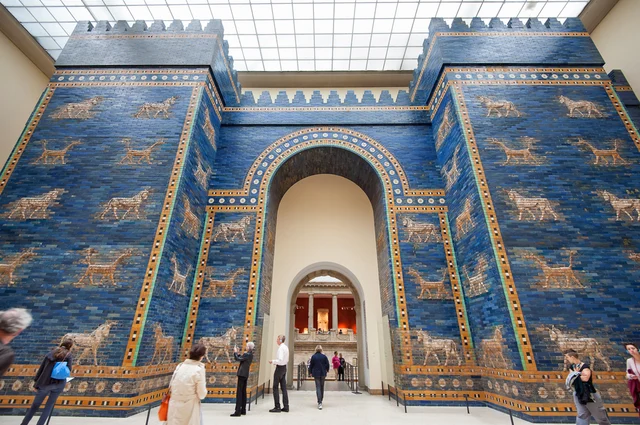
The Near East Department, in the south wing, contains one of the largest collections anywhere of antiquities from ancient Babylonia, Persia, and Assyria. Among the exhibits is the Processional Way of Babylon with the Ishtar Gate, dating from 575 B.C. You can also visit the throne room of Nebuchadnezzar. Cuneiform clay tablets document a civilization that created ceramics, glass, and metal objects while Europe was still overrun with primitive tribes. The museum's upper level is devoted to Islamic Art. Of special interest are the miniatures, carpets, and woodcarvings.
The Pergamon is one of the world's greatest museums, so do try to allot several hours for a visit. If that's not possible, go directly to the Department of Greek and Roman Antiquities, housed in the north and east wings of the museum, and enter the central hall to see the Pergamon Altar (180-160 B.C.), which is so large that it has a huge room all to itself. Most fascinating is the frieze around the base. It shows the struggle of the Olympian gods against the Titans and is strikingly alive, with figures that project as much as a foot from the background. If you explore further, you'll find a statue of a goddess holding a pomegranate (575 B.C.), found in southern Attica, where it had been buried for 2,000 years. It was so well preserved that flecks of the original paint are still visible on her garments. Also extraordinary: the fabled Market Gate of Miletus, a Roman gate built around A.D. 120 in the Aegean coastal city of Miletus (now part of Turkey).
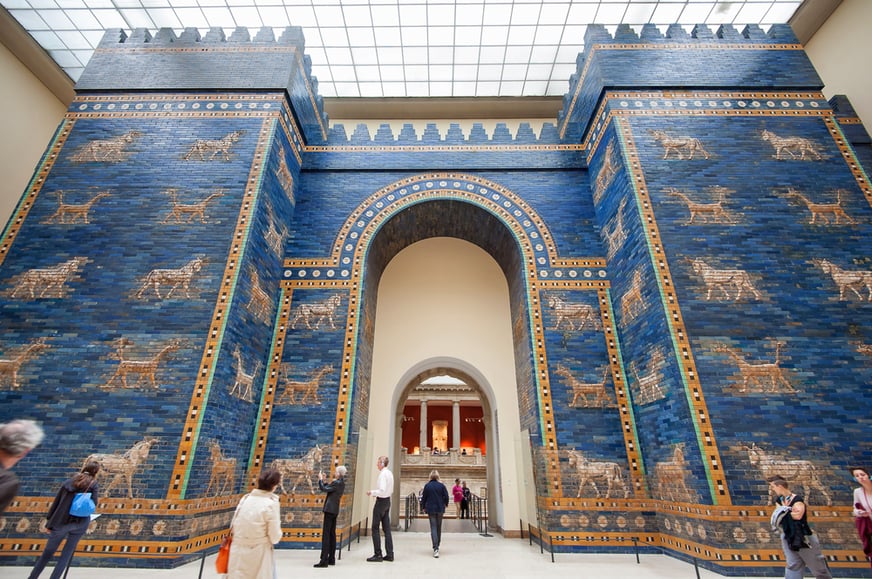
The Near East Department, in the south wing, contains one of the largest collections anywhere of antiquities from ancient Babylonia, Persia, and Assyria. Among the exhibits is the Processional Way of Babylon with the Ishtar Gate, dating from 575 B.C. You can also visit the throne room of Nebuchadnezzar. Cuneiform clay tablets document a civilization that created ceramics, glass, and metal objects while Europe was still overrun with primitive tribes. The museum's upper level is devoted to Islamic Art. Of special interest are the miniatures, carpets, and woodcarvings.
Details
Bookstore

Available as paperback
and as e-book.