Guggenheim Museum

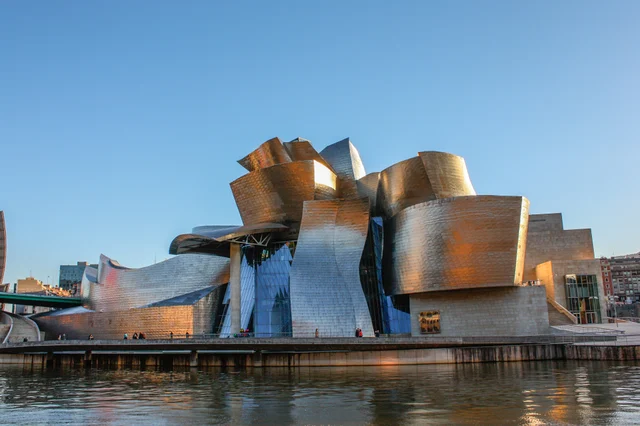
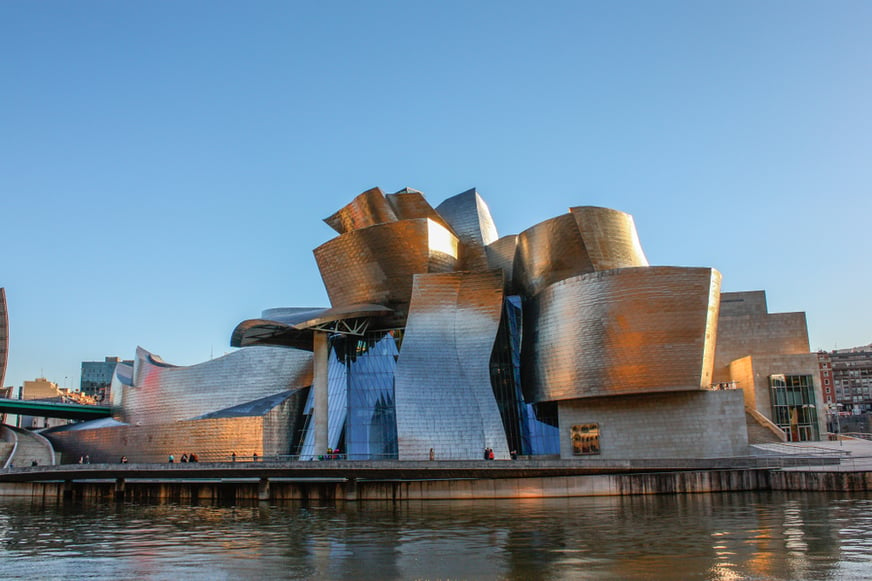
Skeptics said Bilbao would get a temporary bump in tourism as curious people came to see what Frank O. Gehry had wrought on the once-industrial waterfront. Nearly 3 decades later, some 1.3 million people now visit the museum each year, and the flow shows no sign of abating. Truly, this is the engine that drove Bilbao onto the tourist map and kept it there. The strange building, seemingly assembled of gargantuan parts from a titanium-clad fish, no longer seems so alien—in fact, it’s become as iconic as Eiffel’s tower in Paris. There’s something appealingly primitive about the squat beast, best viewed from across the river so you can take it all in.
The interior is radical as well. With a disorienting lack of right angles, the building is essentially a soaring 50m-high (164-ft.) atrium with exhibition floors cantilevered off a central support. Unless you’ve visited often, take the free audio guide when you enter, as it helps navigation.
The permanent collection focuses on major post-1950 artists, including Robert Motherwell, Robert Rauschenberg, and Antoni Tàpies. Do linger a while among the eight massive metal sculptures of Richard Serra’s The Matter of Time. Walk and talk through all of them, testing the incredible acoustics. The Bilbao branch also shows contemporary Basque art, favoring sculptors, painters, and video artists who are still living and working. In addition, there’s a vigorous temporary exhibition schedule, often featuring avant-garde work from places as distant as China, Korea, and Japan. Signage is trilingual—in Basque, Castilian, and English. For extra information, you can download an app on entry.
Skeptics said Bilbao would get a temporary bump in tourism as curious people came to see what Frank O. Gehry had wrought on the once-industrial waterfront. Nearly 3 decades later, some 1.3 million people now visit the museum each year, and the flow shows no sign of abating. Truly, this is the engine that drove Bilbao onto the tourist map and kept it there. The strange building, seemingly assembled of gargantuan parts from a titanium-clad fish, no longer seems so alien—in fact, it’s become as iconic as Eiffel’s tower in Paris. There’s something appealingly primitive about the squat beast, best viewed from across the river so you can take it all in.
The interior is radical as well. With a disorienting lack of right angles, the building is essentially a soaring 50m-high (164-ft.) atrium with exhibition floors cantilevered off a central support. Unless you’ve visited often, take the free audio guide when you enter, as it helps navigation.
The permanent collection focuses on major post-1950 artists, including Robert Motherwell, Robert Rauschenberg, and Antoni Tàpies. Do linger a while among the eight massive metal sculptures of Richard Serra’s The Matter of Time. Walk and talk through all of them, testing the incredible acoustics. The Bilbao branch also shows contemporary Basque art, favoring sculptors, painters, and video artists who are still living and working. In addition, there’s a vigorous temporary exhibition schedule, often featuring avant-garde work from places as distant as China, Korea, and Japan. Signage is trilingual—in Basque, Castilian, and English. For extra information, you can download an app on entry.
Details
Bookstore

Available as paperback
and as e-book.