Château de Langeais

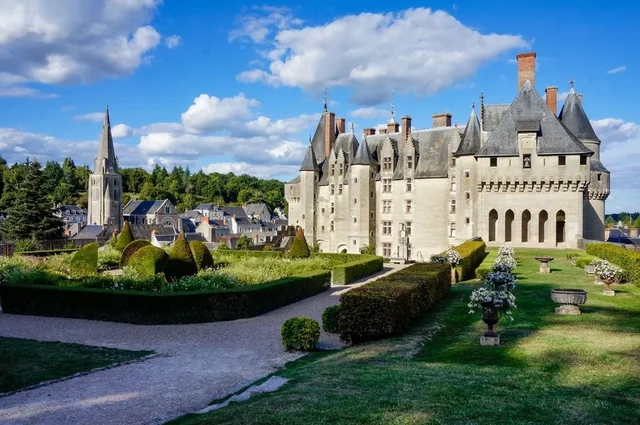
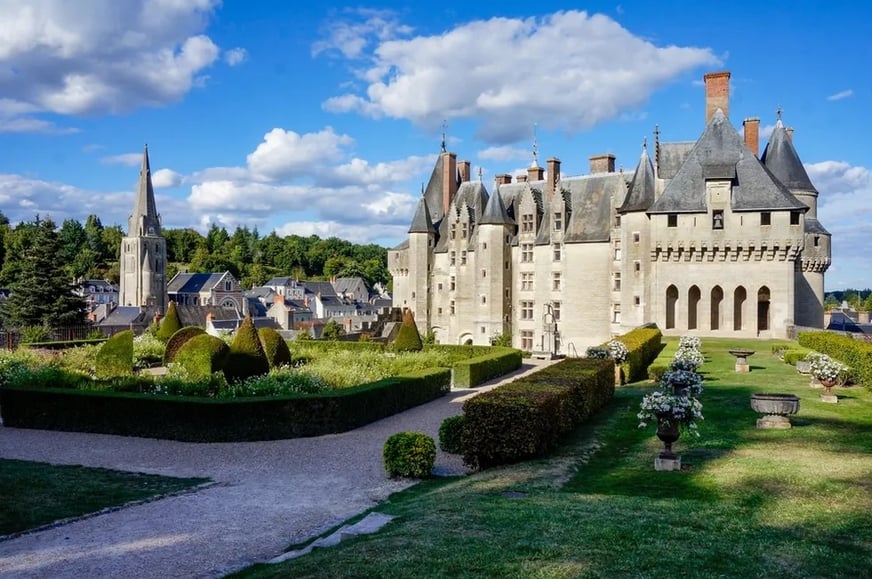
On December 6, 1491, 15-year-old Anne de Bretagne was wed to Charles VIII at Langeais, permanently attaching Brittany to France. The original castle was built in the 10th century when Fulk III (972–1040), Count of Anjou, sometimes called the “Black Falcon,” seized Langeais from the Count of Blois. He erected the first keep, the ruins of which can still be seen. The present structure was built in 1465 in the late medieval style. The interior is well preserved and furnished, thanks to Jacques Siegfried, who not only restored it over 20 years, but also bequeathed it to the Institut de France in 1904.
The rooms recreate the ambience of a regal residence of the late Middle Ages, rich with ornamental fireplaces and tapestries. A remarkable 15th-century millefleurs tapestry decorates the Chambre de la Dame, and seven superb tapestries known as the “Valiant Knights” cover the walls of the Salle des Preux.
The Banquet Hall features a mantelpiece carved to resemble a fortress, complete with crenellated towers. The Wedding Hall includes a re-creation of the marriage of Anne de Bretagne and Charles VIII with lavishly costumed wax figures. In the Luini Room is a large 1522 fresco by that artist, removed from a chapel on Lake Maggiore, Italy. It depicts Saint Francis of Assisi and Saint Elizabeth of Hungary with Mary and Joseph. Kids can learn medieval castle construction with interactive displays, or have some fun exploring the tree house and the two playgrounds.
On December 6, 1491, 15-year-old Anne de Bretagne was wed to Charles VIII at Langeais, permanently attaching Brittany to France. The original castle was built in the 10th century when Fulk III (972–1040), Count of Anjou, sometimes called the “Black Falcon,” seized Langeais from the Count of Blois. He erected the first keep, the ruins of which can still be seen. The present structure was built in 1465 in the late medieval style. The interior is well preserved and furnished, thanks to Jacques Siegfried, who not only restored it over 20 years, but also bequeathed it to the Institut de France in 1904.
The rooms recreate the ambience of a regal residence of the late Middle Ages, rich with ornamental fireplaces and tapestries. A remarkable 15th-century millefleurs tapestry decorates the Chambre de la Dame, and seven superb tapestries known as the “Valiant Knights” cover the walls of the Salle des Preux.
The Banquet Hall features a mantelpiece carved to resemble a fortress, complete with crenellated towers. The Wedding Hall includes a re-creation of the marriage of Anne de Bretagne and Charles VIII with lavishly costumed wax figures. In the Luini Room is a large 1522 fresco by that artist, removed from a chapel on Lake Maggiore, Italy. It depicts Saint Francis of Assisi and Saint Elizabeth of Hungary with Mary and Joseph. Kids can learn medieval castle construction with interactive displays, or have some fun exploring the tree house and the two playgrounds.
Details
Bookstore

Available as paperback
and as e-book.