Planning a trip to Maine
There are more details in other parts of this section. But in terms of road trips, it's important to remember that from Memorial Day through Labor Day, sometimes longer, I-95 from Boston to Maine becomes sluggish (even stopped-to-a-standstill) on Friday afternoons and evenings as weekend traffic backs up at the toll gates for miles. Sunday nights bring a reverse-repeat of this scene. It might sound comical that you could be stuck in gridlock in a tidal flat in the middle of nowhere; trust me, it's not nearly so funny once you're ensnared in it. U.S. Route 1 along the coast seems like an escape route—but it's not.
Instead, it bottlenecks at the same times of day and week, especially in spots where two-lane bridges span the local tidal rivers. There's really no cure for this condition; you can, however, do a few things to prevent getting stuck. Try to stay put on weekends and during the big summer holidays—travel midweek or midday instead, if at all possible. Or simply take an extra day off work and head back after the holiday crush. It'll pay handsome dividends in lowered blood pressure—and you'll save a few hours you would have wasted idling your engine going nowhere.
Jump to:
- Tips on Accommodations
- Tips for Travelers with Disabilities
- Insurance
- Health & Safety
- Entry Requirements
- Money
- Tips for Black Travelers
- Tips for Gay and Lesbian Travelers
- Staying Connected
- Getting Around
- Special-Interest Vacations
- Fast Facts
- Calendar of Events
- Tips for Student Travelers
- Escorted Tours & Independent Package Tours
- Tips for Families
- Getting There
- Tips for Senior Travelers
- Sustainable Travel & Ecotourism
- Tips for Travelers with Pets
- When to Go
Tips on Accommodations
Tips for Travelers with Disabilities
Most disabilities shouldn't stop anyone from traveling to northern New England. There are more options and resources out there than ever before.
The American the Beautiful -- National Park and Federal Recreational Lands Pass -- Access Pass (formerly the Golden Access Passport) gives visually impaired or permanently disabled persons (regardless of age) free lifetime entrance to federal recreation sites administered by the National Park Service, including the Fish and Wildlife Service, the Forest Service, the Bureau of Land Management, and the Bureau of Reclamation.
It's especially useful here in northern New England, because it gains the bearer entry into Acadia National Park, the White Mountain National Forest, and the Green Mountain National Forest. Other monuments, historic sites, recreation areas, and national wildlife refuges are also covered by the pass.
The pass can only be obtained in person at any NPS facility that charges an entrance fee. You need to show proof of medically determined disability. Besides free entry, the pass also offers a 50% discount on some federal-use fees charged for such facilities as camping, swimming, parking, boat launching, and tours. For more information, go to www.nps.gov/zion/planyourvisit/annual-passes.htm.
Organizations that offer a vast range of resources and assistance to travelers with disabilities include MossRehab (tel. 800/CALL-MOSS); and the American Foundation for the Blind (AFB) (tel. 800/232-5463).
Avis Rent a Car (tel. 888/879-4273) has an "Avis Access" program that offers services for customers with special travel needs. These include specially outfitted vehicles with swivel seats, spinner knobs, and hand controls; mobility scooter rentals; and accessible bus service. Be sure to reserve well in advance.Insurance
The cost of travel insurance varies widely, depending on the cost and length of your trip, your age and health, and the type of trip you're taking, but expect to pay between 5% and 8% of the vacation itself. And since no one company is always the best, we like to steer our readers to such marketplace sites as SquareMouth.com, TravelInsurance.com and InsureMyTrip.com. With each, you enter your trip cost and dates, your age, and other information, to get policy options from more than a dozen companies. When looking at your options don't assume that the most expensive policy is always the best. Instead, concentrate on what each policy is promising to cover. The more coverage, the better the policy.
That being said, you don't necessarily need travel insurance for every trip. In general, you'll be able to get your money back if a flight is delayed, or if you have to cancel a night at a hotel (so long as you cancel long enough in advance). So look at the parameters of your trip before ponying up. Insurance is a smart purchase for cruises and home rentals, less so for simple road trips.Health & Safety
Staying Healthy
New Englanders, by and large, consider themselves a healthy bunch, which they ascribe to clean living, brisk northern air, vigorous exercise (leaf raking, snow shoveling, and so on), and few excesses other than the stresses and strains of being a Red Sox fan (now greatly alleviated, thank goodness). The region also has one of the highest vaccination rates in the U.S.A. Other than picking up a stray cold or flu, you shouldn't face any serious health risks when traveling in the region.
Exceptions? Well, yes -- you may find yourself at higher risk when exploring the outdoors, particularly in the backcountry. A few things to watch for when venturing off the beaten track:
- Poison ivy: This shiny, three-leafed plant is common throughout the region. If you touch it, you could develop a nasty, itchy rash that might seriously erode further enjoyment of your vacation. Some people experience a dangerously bad reaction, while others are barely affected at all; it's best to simply just avoid it. If you're unfamiliar with what poison ivy looks like, ask at a ranger station or visitor information booth. Many have posters or books to help you with identification.
- Giardia: That crystal-clear stream coursing down a backcountry peak might look pure, but it could be contaminated with animal feces. Disgusting, yes, and also dangerous. When ingested by humans, Giardia cysts can cause serious diarrhea and loss of weight. The symptoms might not surface until well after you've left the backcountry and returned home. Carry your own water for day trips, or bring a small filter (available at any camping or sporting-goods store) to treat backcountry water. Failing that, at least boil your water or treat it with iodine pills before using it -- even for cooking, drinking, or washing. If you feel diarrhea coming on, see a doctor immediately.
- Lyme disease: Lyme disease has been a growing problem in New England since 1975, when the disease was identified in the town of Lyme, Connecticut; thousands of cases are reported nationwide annually, and they're no trifling matter: Left untreated, Lyme disease can damage the heart. The disease is transmitted by tiny deer ticks, which are difficult to see -- but check your socks and body daily anyway with a partner. If you spot a bull's-eye-shaped rash, 3 to 8 inches in diameter (the rash may feel warm but usually doesn't itch), see a doctor right away. Lyme disease is more easily treated in early phases. Other symptoms may include muscle and joint pain, fever, or fatigue.
- Rabies: Since 1989, rabies has increasingly been spreading northward into New England. The disease is spread by animal saliva and is especially prevalent in skunks, raccoons, bats, and foxes. It is always fatal if left untreated in humans. Infected animals tend to display erratic and aggressive behavior; the best advice is to keep a safe distance between yourself and any wild animal you might encounter. If you're bitten, wash the wound as soon as you can and immediately seek medical attention. Treatment is no longer as painful as it used to be, but still involves a series of shots.
Those planning longer excursions into the backcountry of northern New England might find a compact first-aid kit with basic salves and medicines very handy to have along. Towns and villages in the three states are reliably stocked with pharmacies, chain grocery stores, and Wal-Mart-type big-box stores where you can stock up on common medicines (such as calamine lotion and aspirin) to cope with minor ailments along the way.
What to Do If You Get Sick Away From Home
Hospitals are easy to find in the cities of northern New England; rurally, however, you might need to depend on regional health centers or walk-in clinics.
If you suffer from a chronic illness, consult your doctor before your departure. Pack prescription medications in your carry-on luggage, and carry them in their original containers, with pharmacy labels -- otherwise they won't make it through airport security.
Visitors from outside the U.S. should carry the generic names of their prescription drugs. Foreign visitors may also need to pay all medical costs upfront in an emergency and seek reimbursement later. For U.S. travelers, most health-care plans provide coverage if you get sick away from home.
Safety
New England -- with the notable exception of parts of Boston -- boasts some of the lowest crime rates in the country. Northern New England is even more so; the odds of anything really bad happening during your visit here are extremely slim. But travelers should always take all the usual precautions against theft, robbery, and assault anyway.
Avoid any unnecessary public displays of wealth, for instance. Don't bring out fat wads of cash from your pocket, and save your best jewelry for private occasions. If you are approached by someone who demands money, jewelry, or anything else, hand it over. Don't argue or negotiate. Just comply. Afterward, contact police right away by dialing tel. 911.
The crime you're statistically most likely to encounter here (as with anywhere in the U.S.) is the theft of items from your car. Don't leave anything of value in plain view, and lock valuables out of sight in your trunk. If you have an electronic security system, use it.
Also take the usual precautions against leaving cash, laptops, or valuables in your hotel room (or at least lying around in the open) whenever you're out of your room. Many hotels have safe-deposit boxes; use them. Smaller inns and hotels often do not offer any kind of safe, but it can't hurt to check.
Finally, when traveling late at night, look for a well-lighted area if you need to gas up or step out of your car for any reason.
Entry Requirements
Every traveler entering the U.S. must show a passport.
The U.S. Department of State has a Visa Waiver Program (VWP) allowing citizens of the following countries (at publishing) to enter the United States without a visa for stays of up to 90 days: Andorra, Australia, Austria, Belgium, Brunei, Canada, Denmark, Finland, France, Germany, Iceland, Ireland, Italy, Japan, Liechtenstein, Luxembourg, Monaco, the Netherlands, New Zealand, Norway, Portugal, San Marino, Singapore, Slovenia, Spain, Sweden, Switzerland, and the United Kingdom.
Citizens of all other countries must have (1) a valid passport that expires at least 6 months later than the scheduled end of their visit to the United States, and (2) a tourist visa, which may be obtained without charge from any U.S. consulate.
Medical Requirements
Unless you're arriving from an area known to be suffering from an epidemic (particularly Covid19, cholera or yellow fever), inoculations or vaccinations are not required for entry into the United States. If you have a medical condition that requires syringe-administered medications, carry a valid signed prescription from your physician; syringes in carry-on baggage will be inspected. Insulin in any form should have the proper pharmaceutical documentation. If you have a disease that requires treatment with narcotics, you should also carry documented proof with you -- smuggling narcotics aboard a plane carries severe penalties in the U.S.
Money
Travelers are in for a little sticker shock on the coast of Maine, at least during peak travel seasons. In midsummer, there's simply no such thing as a cheap motel room in places such as Portland, Camden, or Bar Harbor. Even no-frills mom-and-pop motels can and do sometimes happily charge $200 a night or more for a bed that could fairly be described as a notch above car-camping. Blander-than-bland chain hotels demand even more.To be fair, innkeepers in some of these tourist areas must reap nearly all their annual profits in what amounts to just a 2- or 3-month season each year, so that's one reason for the approaching-bank-stickup rates. It's not like they enjoy your misery (I don't think).
Anyhow, take heart. Outside of peak foliage season and holidays, the cost of rooms, meals, and day-to-day expenses is generally a lot less here than you'd pay in a major non-New England city. You can find excellent entrees at upscale, creative restaurants for around $30, comparing favorably with similar dishes at big-city restaurants that would top $40.
Still, lodging here is more expensive than in almost any other rural part of the United States, and planning can prove tricky for budget travelers.
It's highly recommended that you travel with at least one major credit card. You must have one to rent a car, and hotels and airlines usually require a credit card imprint as a deposit against expenses.
Tips for Black Travelers
Black Travel Online (www.blacktravelonline.com) posts news on upcoming events and includes links to articles and travel-booking sites. Soul of America (www.soulofamerica.com) is a comprehensive website, with travel tips, event and family-reunion postings, and sections on historically black beach resorts and active vacations.
Agencies and organizations that provide resources for black travelers include: Rodgers Travel (tel. 800/825-1775; www.rodgerstravel.com); the African American Association of Innkeepers International (tel. 877/422-5777; www.africanamericaninns.com); and Henderson Travel & Tours (tel. 800/327-2309 or 301/650-5700; www.hendersontravel.com).
Go Girl: The Black Woman's Guide to Travel & Adventure (Eighth Mountain Press) is a compilation of travel essays by writers including Jill Nelson and Audre Lorde. The African-American Travel Guide by Wayne C. Robinson (Hunter Publishing; www.hunterpublishing.com) was published in 1997, so it may be somewhat dated. Travel and Enjoy Magazine (tel. 866/266-6211) is a travel magazine and guide. The well-done Pathfinders Magazine (tel. 877/977-PATH; www.pathfinderstravel.com) includes articles on everything from Rio de Janeiro to Ghana to upcoming ski, diving, golf, and tennis trips.
Tips for Gay and Lesbian Travelers
Northern New England isn't yet the hotbed of gay culture that, say, Provincetown, Massachusetts, has become. But plenty of LGBTQ folk live and travel here, and find this state accepting of their culture.
Ogunquit, on the southern Maine coast, is a hugely popular destination among gay travelers and features a lively beach and bar scene in the summer. In winter, it's still active but mellower. One good place to learn more is from the Facebook group www.facebook.com/GayOgunquitME, with information on gay-owned inns, restaurants, and nightclubs in the town.
Staying Connected
Telephones
Generally, hotel surcharges on long-distance and local calls are astronomical, so you're better off using your cellphone or a public pay phone. Most convenience stores in northern New England sell prepaid calling cards in denominations of up to $50; for international visitors these can be the least expensive way to call home.
Many public pay phones at airports now accept American Express, MasterCard, and Visa credit cards directly. Local calls made from a pay phones in most of northern New England costs from 25¢ to 50¢ each; pennies aren't accepted.
Most long-distance and international calls can be dialed directly from any phone. For calls within the United States and to Canada, dial 1 followed by the area code and the seven-digit number. For other international calls, dial 011 followed by the country code, city code, and the number you are calling.
Calls to area codes 800, 888, 877, and 866 are toll-free.
For reversed-charge or collect calls, and for person-to-person calls, dial the number 0 then the area code and number; an operator will come on the line, and you should specify whether you are calling collect, person-to-person, or both. If your operator-assisted call is international, ask for the overseas operator.
For local directory assistance ("information") in most towns in northern New England, dial tel. 411; for long-distance information, dial 1, plus the appropriate area code, plus tel. 555-1212.
Cellphones
Just because your cellphone works at home doesn't mean it'll work deep in the woods of northern Maine -- or even at that rustic country B&B, thanks to our nation's (and the region's) fragmented and competing cellphone coverage systems. You may or may not be within your roaming area, even if you have a national calling plan.
It's a good bet that your phone will work in the region's major cities, so look over your wireless company's coverage map on its website before heading out to be sure; T-Mobile, Sprint, and Nextel are particularly weak at covering rural areas.
If you need to stay in touch at a destination where you know your phone won't work, rent a phone that will from InTouch USA (tel. 800/872-7626; www.intouchglobal.com) or from some rental car desks; just be aware that you'll pay $1 a minute or more for airtime anytime you use the phone.
If you're not from the U.S., you'll be appalled at the poor reach of the GSM wireless network (which is used by much of the rest of the world) here. Your phone will probably work in most cities and interstate corridors in northern New England, and along much of the southern Maine coast; but it definitely won't work in most of the rural areas, which means nearly all the rest of the region. You also may or may not be able to use SMS (in other words, send text messages) home.
Hey, Google, did you get my text message? -- It's bound to happen: The day you leave this guidebook back at the hotel for an unencumbered stroll through Burlington, you'll forget the address of the lunch spot you had earmarked. If you're traveling with a mobile device, send a text message to tel. 466453 (GOOGLE) for a lightning-fast response. For instance, type "carnegie deli new york" and within 10 seconds you'll receive a text message with the address and phone number.
This nifty trick works in a range of search categories: Look up weather ("weather philadelphia"), language translations ("translate goodbye in spanish"), currency conversions ("10 usd in pounds"), movie times ("harry potter 60605"), and more. If your search results are off, be more specific ("the abbey gay bar west hollywood"). For more tips and search options, see www.google.com/intl/en_us/mobile/sms. Regular text message charges apply.
Voice-Over Internet Protocol (VOIP)
If you have Web access while traveling, you might consider a broadband-based telephone service (in technical terms, Voice over Internet Protocol, or VoIP) such as Skype (www.skype.com) or Vonage (www.vonage.com), which allows you to make free international calls if you use their services from your laptop or in a cybercafe. The people you're calling must also use the service for it to work; check the sites for details.
Internet/E-mail
Without Your Own Computer -- Although there's no definitive directory for cybercafes -- these are independent businesses, after all -- start with the websites www.cybercaptive.com and www.cybercafe.com. Larger cities in northern New England, such as Portland and Burlington, always have a couple of cybercafes; in small towns, though, it's often hit-or-miss (usually miss).
Most airports have Internet kiosks that provide basic Web access for a per-minute fee that's usually higher than cybercafe prices. Check out copy shops like Kinko's (now called FedEx Kinkos), which offer computer stations with fully loaded software plus Wi-Fi access. Starbucks coffee shops have a partnership with T-Mobile allowing public Wi-Fi access, for a fee; you need to subscribe to the service through T-Mobile's web site (www.t-mobile.com).
New England's public libraries are great at offering Internet access, nearly always for free; you may need to submit a driver's license or library card or other piece of identification as a deposit. Finally, although youth hostels are thin on the ground in northern New England, they normally offer at least one computer from which you can access the Internet. (Avoid hotel business centers, which often charge exorbitant rates.)
With Your Own Computer -- More and more hotels, resorts, airports, cafes, and retailers are going Wi-Fi (wireless fidelity), becoming "hotspots" that offer free high-speed Wi-Fi access or charge a small fee for usage. Wi-Fi is even found in campgrounds, RV parks, and even entire towns. Most laptops sold today have built-in wireless capability. To find public Wi-Fi hotspots at your destination, go to www.jiwire.com; its Hotspot Finder holds the world's largest directory of public wireless hotspots.
For dial-up access, most business-class hotels in the U.S. offer dataports for laptop modems, and a few thousand hotels in the U.S. and Europe now offer free high-speed Internet access.
Wherever you go, bring a connection kit of the right power and phone adapters, a spare phone cord, and a spare Ethernet network cable -- or find out whether your hotel supplies them to guests.
Getting Around
Maine is like much of the rest of America: A set of small cities and suburbs, strung together by transportation corridors, with a whole bunch of small towns and rural areas filling in the rest of the map. Bus, train, and regional plane services are sporadic at best. This all means you will almost certainly need to travel by car (yours, or one you have rented) if you really want to see the coast of Maine in any detail.
BY CAR
Mark my words: You'll need a car. Portland's airport has plenty of rental options, from all the multi-national rental agencies.
Traffic in Maine is generally light compared with that in urban and suburban areas of the East Coast, but the Maine Turnpike and U.S. Route 1 can get heavily congested, especially when entering Maine on a summer Friday evening or departing it on a Sunday night. Expect delays at peak times, and try to travel off-peak if possible.
North-south travel is fairly straightforward in Maine, thanks to I-95 and Route 1. Don't underestimate the length of the Maine coast, though—from Kittery to Eastport (the easternmost city in the United States) is 293 miles, much of it winding slowly through coastal villages or sitting at stoplights. Driving times can be longer than you'd expect due to narrow roads and zigzagging peninsulas.
Moose Crossings: Driving across the northern tier of Maine, you’ll often see MOOSE CROSSING signs, complete with silhouettes of the gangly herbivores. These are not placed here to amuse the tourists. In Maine, the state with the most moose (an estimated 30,000, at last count), crashes between moose and cars are increasingly common.
These encounters are usually more dramatic than deer-car collisions. For starters, the large eyes of moose don’t reflect in headlights like those of deer, so you often come upon them with less warning when driving late at night. Also, moose can weigh up to 1,000 pounds, with almost all of that weight placed high atop spindly legs—when a car strikes a moose broadside in the road, it usually knocks the legs out and sends a half-ton of hapless beast right through the windshield. Need we dwell on the results of such an encounter? I thought not. When in moose country, drive slowly and carefully.
BY BUS
As I have already mentioned, express bus service into the region is pretty good, but there is really no non-car means of traveling within. Quirky schedules and routes may send you well out of your way, and what may seem like a simple trip could take hours. Traveling north-south between towns along a single bus route (for example, Portland to Bangor) is feasible, but east-west travel across Maine is, by and large, impractical. For information on bus travel within Maine, contact either Greyhound or Concord Coach Lines.
BY PLANE
Service between airports in Maine is sketchy at best. You can find limited direct flights between some cities (such as Portland to Bangor), but for the most part, you'll have to backtrack to Boston and fly out again to your final destination. Convenient, it's not.
BY TRAIN
Amtrak (tel. 800/872-7245) provides limited rail travel on the southernmost coast of Maine. There is talk here and there of expanding passenger rail lines west to Lewiston and beyond, to Montreal, but I wouldn’t start planning a trip around it anytime soon.
Special-Interest Vacations
One rewarding way to spend a vacation is to learn a new outdoor skill or add to your knowledge. Maine especially lends itself to outdoorsy adventures that combine fresh air and exercise with Mother Nature as your instructor in Maine's vast, beautiful classroom. You can find plenty of options in Maine, ranging from formal weeklong classes to 1-day workshops. Here are a couple of the most popular:
Fly-fishing and other skills classes. The world-famous L.L.Bean educational offerings are growing by leaps and bounds, and are highly recommended by travelers of all ages. Among the many options, the intriguing fly-fishing outings are worth a look. L.L.Bean also offers a number of shorter workshops on various outdoor skills through its Outdoor Discovery Program (tel. 888/552-3261).
All About Birds. Budding and experienced naturalists can expand their understanding of marine wildlife while residing on 333-acre Hog Island in Maine's wild and scenic Muscongus Bay through the Maine Audubon Society. You're brought by boat, then stay on the island for 5 nights; see the web site hogisland.audubon.org for more details. (Famed birder Roger Tory Peterson once taught birding classes here.) I can personally vouch for Maine Audubon's other outdoors and educational programs, too.
Historic New England is a nonprofit foundation that owns and operates 36 historic properties around New England, ranging from places built in the 17th century to the present, including a number of properties profiled on this website. For more information on Historic New England and its properties, visit the group’s website at www.historicnewengland.org.
Fast Facts
Area Codes: Maine’s area code is 207 throughout.
Business Hours: Shops in Maine are usually open weekdays from 9am to 6pm, Saturdays from 10am until 5 to 7pm, and Sundays from noon until 5 or 6pm. In bigger cities like Portland, and in shopping-mall and outlet-shop areas, shops stay open as late as 9pm during peak shopping days and/or seasons.
Drinking Laws: The legal age for purchase and consumption of alcoholic beverages is 21; proof of age is required and often requested at bars, nightclubs, and restaurants, so it’s always a good idea to bring ID when you go out. Do not carry open containers of alcohol in your car or any public area that isn’t zoned for alcohol consumption. The police can fine you on the spot. Don’t even think about driving while intoxicated.
Liquor of some sort is sold at special, state-operated stores; some supermarkets; and many convenience stores in Maine. Restaurants without liquor licenses sometimes allow patrons to bring in their own—this is particularly common at lobster shacks, but ask first. Bars sell liquor until 1am in Maine.
Emergencies: For fire, police, and ambulance, find any phone and dial tel. 911. If this somehow fails, dial 0 (zero) and report an emergency.
Gasoline(Petrol): Gas in Maine is a bit more expensive than it is in some other parts of the U.S., but still much cheaper than it is in Canada, Europe, Asia, and Australia. There are next to no full-service gas stations in Maine, meaning you can expect to pump the gas yourself.
Internet Access: Every hotel, B&B, inn and resort recommended on this website will have free Wi-Fi (and pretty much every other lodging in the state will have it, too). If you're out and about, public libraries maintain computer terminals with free public Internet access and also will have free Wi-Fi. Plus any reasonably hip coffee shop on the coast is also likely to have free Wi-Fi.
LGBTQ Travelers: In 2012, Maine became one of the first three states to legalize same-sex marriage by popular vote. Portland hosts a sizable pride festival early each summer that includes a riotous parade and a dance on the city pier. South of Portland, Ogunquit is hugely popular among gay travelers, a longtime (even historic) gay resort area that features a lively beach-and-bar scene in the summer.
Mail: Every town and city in Maine has a post office—in the smallest towns, it may double as a grocer or other business.
Police: Dial tel. 911. You can also find the direct phone numbers for many of Maine’s small-town police stations in the local phone book.
Senior Travel: Maine is well suited to older travelers, with a wide array of activities for seniors and discounts commonly available (though sometimes they're not as good as the regular discounts travelers can access; check before booking).
The U.S. National Park Service’s America the Beautiful Senior Pass gives seniors 62 years or older lifetime entrance to all properties administered by the National Park Service—national parks, monuments, historic sites, recreation areas, and national wildlife refuges—for a one-time processing fee of $10. The pass must be purchased in person at any NPS facility that charges an entrance fee.
Besides free entry, the America the Beautiful Senior Pass also offers a 50% discount on some fees for camping, swimming, parking, boat launching, and tours. For more information, go to www.nps.gov.
Smoking: Smoking is banned in all workplaces and public places (restaurants, bars, offices, hotel lobbies) in Maine.
Taxes: The United States has no value-added tax (VAT) or other indirect tax at the national level. Every state, county, and city may levy its own local tax on all purchases, including hotel and restaurant checks and airline tickets. Maine has a 5.5% sales tax on most consumer goods and a 9% tax on lodging. These taxes will not appear on price tags.
Time: The entire Maine coast lies within the Eastern Standard Time zone (EST). When it’s noon in Bar Harbor and Portland, it’s also noon in New York City, and it’s 11am in Chicago (CST), 10am in Denver (MST), 9am in Los Angeles (PST), and 5pm in London (GMT).
Daylight saving time is in effect from 1am on the second Sunday in March to 1am on the first Sunday in November, except in Arizona, Hawaii, the U.S. Virgin Islands, and Puerto Rico. Daylight saving time moves the clock 1 hour ahead of standard time.
Tipping: Tips are a very important part of certain workers’ income, and gratuities are the standard way of showing appreciation for services provided. However, tipping is certainly not compulsory if service is poor. In hotels, tip bellhops $2 or more per bag ($3–$5 if you have a lot of luggage) and tip housekeeping staff a few dollars per day (more if you have a large suite). Tip the doorman or concierge if some specific service was provided (for example, calling a cab or obtaining difficult-to-get theater tickets). Tip valet-parking attendants $3 to $5 each time you get your car.
In restaurants, bars, and nightclubs, tip service staff 15% to 20% of the check, tip bartenders 10% to 15%, tip checkroom attendants $1 per garment.
Tip cabdrivers 15% of your fare; tip skycaps at airports at least $1 per bag ($2–$3 if you have a lot of luggage).
Toilets: In coastal Maine, they’re called bathrooms or restrooms. Find them in hotel lobbies, bars, coffee shops, restaurants, fast-food places, museums, department stores, train stations, and some gas stations. (Sometimes, you will need to ask the cashier for a key, or make a purchase first.)
Travelers With Disabilities: If you plan to visit Acadia National Park, consider obtaining the America The Beautiful National Park Access Pass, which gives visually impaired or permanently disabled persons free lifetime entrance to sites administered by the National Park Service. This may include national parks, monuments, historic sites, recreation areas, and national wildlife refuges.
The pass can only be obtained in person at any NPS facility that charges an entrance fee. You need to show proof of a medically determined disability. Besides free entry, the pass also offers a 50% discount on some fees for camping, swimming, parking, boat launching, and tours. For more information, go to www.nps.gov.
Traveling With Children: Families will have little trouble finding fun, low-key things to do with kids in Maine. Some recommended destinations include York Beach and Acadia National Park. Be sure to ask about family discounts when visiting attractions. Many places offer a flat family rate that costs less than paying for each ticket individually. Note that some parks and beaches charge by the carload rather than the head count.
Calendar of Events
Civic festivals are a mainstay of Maine’s little towns, each one clamoring to stake its claim to some obscure aspect of Maine life and culture, and its hard to keep up with all the Whoopie Pie festivals (in Dover-Foxcroft in June), Potato Blossom festivals (in Fort Fairfield in July), and Moxie festivals (also July, in Lisbon).
Maine Office of Tourism maintains a pretty comprehensive and searchable calendar at www.visitmaine.com/events. In the late summer and early fall, various small-town and county agricultural fairs present a classic slice of rural Americana—midways, tractor pulls, livestock exhibits, and so on. The Blue Hill Fair in early August and the Fryeburg Fair in early October are the best of these. Check www.mainefairs.org for a list.
JANUARY
New Year's Portland. Ring in the New Year with a smorgasbord of events and entertainment throughout downtown Portland. Events for families are scheduled in the afternoon; adult entertainment, including loads of live music, kicks off later in the evening. One admission price buys entrance to all events. December 31 and January 1.
FEBRUARY
U.S. National Toboggan Championships, Camden. A raucous and lively athletic event where being overweight is an advantage. Held at the Camden Snow Bowl's toboggan chute ( tel. 207/236-3438). Early February.
MARCH
Maine Maple Sunday. Maple sugarhouses throughout the state open their doors to visitors ( tel. 207/287-3491). Fourth Sunday in March.
APRIL
Splash Into Spring, Ogunquit. A spring fest occasioned by Patriot Day, celebrated nowhere but New England and commemorating the 1775 Battle of Lexington and Concord. Expect fife and drum bands and , colonial-themed games and races, along with a craft fair, kite-flying contest, and more. Call tel. 207/646-2939. Late April.
MAY
All Roads Music Festival, Belfast. Maine’s answer to South by Southwest has dozens of Maine bands and performers converging on every available venue in Belfast for a day of concerts, panels, and special collaborations (tel. 207/370-9197). Late May.
JUNE
Annual Windjammer Days, Boothbay Harbor. For nearly 4 decades, windjammers have gathered in Boothbay Harbor to kick off the summer sailing season. Expect music, food, and a parade of magnificent sailboats (tel. 207/633-2353). Late June.
JULY
Independence Day, region-wide. Communities all along the coast celebrate with parades, greased-pole climbs, cakewalks, cookouts, road races, and fireworks. The bigger the town, the bigger the fireworks. But many small coastal towns feature seafood and/or lobster-boat racing, an unusual and fun way to celebrate the occasion. Eastport's 4-day-long celebration is particularly impressive. Check local newspapers or contact chambers of commerce for details. July 4.
Maine Boatbuilders' Show, Portland. More than 200 exhibitors and 9,000 boat aficionados gather as winter fades to make plans for the coming summer. A great place to meet boat builders and get ideas for your dream craft (tel. 207/774-1067). Late July.
Portland Summer Concerts. They run all summer, but July’s the peak month for big outdoor concerts at Portland’s Maine State Pier and Thompson’s Point, featuring everything from country acts to jam bands to Bob Dylan. Check www.waterfrontconcerts.com and www.thompsonspointmaine.com for summer schedules. June, July, and August.
York Days, York Village. Enjoy a quintessential coastal Maine celebration complete with crafts, road races, parades, dances, concerts, fireworks, and much more. Call tel. 207/363-1040. Late July to early August.
AUGUST
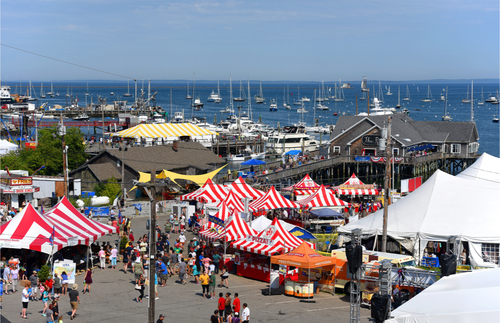
Maine Lobster Festival, Rockland (pictured above). Enjoy a boiled lobster or two, and take in ample entertainment during this informal waterfront gala celebrating Maine's favorite crustacean (tel. 800/576-7512). First week of August.
Wild Blueberry Festival, Machias. A festival marking the harvest of the region's wild blueberries. Eat to your heart's content (tel. 207/255-6665 or 207/633-2353). Mid-August.
SEPTEMBER
Camden Windjammer Festival. Come visit Maine's impressive fleet of old-time sailing ships, which host open houses throughout the weekend at this scenic harbor. Labor Day weekend.
Blue Hill Fair, Blue Hill. A classic country fair just outside one of Maine's most elegant villages. Call tel. 207/374-3701. Early September.
Common Ground Country Fair, Unity. A sprawling, old-time state fair with a twist: The emphasis is on organic foods, recycling, and wholesome living. Great music and demonstrations. This is a Maine classic (tel. 207/568-4142). Late September.
OCTOBER
Fall Foliage Festival, Boothbay. More than 100 exhibitors display their arts and crafts at the Railroad Village; plenty of festive foodstuffs and live music, too. Call tel. 207/633-2353. Early October.
Damariscotta Pumpkin Fest & Regatta. Many pumpkin-themed activities; huge painted pumpkin sculptures lining Main Street. But the highlight is when local crazies hop inside giant, hollowed-out pumpkins and race them across the harbor, either with paddles or outboard motors. You have to see it to believe it ( tel. 207/380-3160). Columbus Day weekend.
Mount Desert Island Marathon, Bar Harbor. A scenic 26.2-mile race through gorgeous island scenery (tel. 207/276-4226). Mid-October.
OgunquitFest, Ogunquit. A 3-day pre-Halloween bash, featuring arts, crafts, costumes, and a parade. Call tel. 207/646-2939. Late October.
NOVEMBER
Festival of Lights, Rockland. Horse-drawn carriages, singing, shopping, and open houses of local inns. Call tel. 207/596-0376. Late November.
Harvest on the Harbor, Portland. Tasting events, chef competitions, and special seated dinners all over Maine’s foodiest city. Early November.
DECEMBER
Christmas Prelude, Kennebunkport. Santa arrives in a lobster boat, followed by a blitz of street shows, pancake breakfasts, and tours of the town's splendid inns ( tel. 207/967-0857). Early December.
Vintage Christmas, Portsmouth, New Hampshire. The streets are decked, the tree is lit, and the historic Strawberry Banke Museum dazzles with old-time decorations and more than 1,000 candles lighting the 10-acre grounds ( tel. 603/433-1100). First 3 weekends in December.
York Village Festival of Lights. This beautiful festival displays an entire York Village and York Beach lit with Christmas lights, carolers, a parade, and much more. Call tel. 207/363-1040. Early December.
Tips for Student Travelers
The International Student Travel Confederation (ISTC) (www.istc.org) was formed in 1949 to make travel around the world more affordable for students. Check out its website for comprehensive travel services information and details on how to get an International Student Identity Card (ISIC), which qualifies students for substantial savings on rail passes, plane tickets, entrance fees, and more.
It also provides students with basic health and life insurance and a 24-hour helpline. The card is valid for a maximum of 18 months. You can apply for the card online or in person at STA Travel (tel. 800/781-4040 in North America; www.statravel.com), the biggest student travel agency in the world; check out the website to locate STA Travel offices worldwide.
If you're no longer a student but are still under 26, you can get an International Youth Travel Card (IYTC) from the same people, which entitles you to some discounts. Travel CUTS (tel. 800/592-2887; www.travelcuts.com) offers similar services for both Canadians and U.S. residents. Irish students may prefer to turn to USIT (tel. 01/602-1904; www.usit.ie), an Ireland-based specialist in student, youth, and independent travel.
Escorted Tours & Independent Package Tours
After a lot of research, we can say definitively that travel packages that bundle together airfare and hotels don't save money in Maine (though they can work well in the Caribbean).Escorted tours probably won't mean a savings either, but for those who enjoy the structure of a group tour, with a group leader, they can be a fine choice. The price usually includes everything from airfare to hotels, meals, tours, admission costs, and local transportation. They're not for everybody, but escorted tours -- whether they're navigated by bus, motor coach, train, or boat -- let travelers sit back and enjoy the trip without having to drive or worry about details. They're particularly convenient for people with limited mobility and they can be a great way to make new friends.
On the downside, you'll have little opportunity for serendipitous interactions with locals. The tours can be jam-packed with activities, leaving little room for individual sightseeing, whim, or adventure -- plus they often focus on the heavily touristed sites, so you miss out on many a lesser-known gem.
We think that the marketplace sites TourRadar and TravelStride. You'll be able to compare itineraries for dozens of companies, and read user reviews on those two websites.
Ask Before You Go
Before you invest in an escorted tour:
- Always ask about the cancellation policy. Can you get your money back? Is there a deposit required?
- Ask about the accommodations choices and prices for each. Then look up the hotels' reviews in this guide, and check rates online for your specific dates of travel. Also find out what types of rooms are offered.
- Request a complete schedule.
- Ask about the size and demographics of the group.
- Discuss what's included in the price (transportation, meals, tips, airport transfers, and so on).
- Finally, look for hidden expenses. Ask whether airport departure fees and taxes, for example, are included in the total cost -- they rarely are.
Tips for Families
Families have little trouble finding fun, low-key things to do with kids in northern New England. The natural world seems to hold tremendous wonder for the younger set -- an afternoon exploring mossy banks and rocky streambeds can be a huge adventure. Older kids may like the challenge of climbing a mountain peak or learning to paddle a canoe in a straight line, and the beach is always good for hours of afternoon diversion.
Be sure to ask about family discounts when visiting attractions. Many places offer a flat family rate that is less than paying for each ticket individually. Some parks and beaches charge by the car rather than the head.
Also, when planning your trip be aware that certain small inns cater only to couples and prefer that families not stay there, or at least prefer that children be over a certain minimum age. This website notes the recommended age for children where restrictions apply, but it's always best to ask first, just to be safe. At any rate, if you mention that you're traveling with kids when making reservations, often you'll get accommodations nearer the game room or the pool, making everyone's life a bit easier.
Recommended destinations in Maine for families include York Beach and Acadia National Park (for splashing around and kid-friendly attractions).
Getting There
BY PLANE
Several commercial carriers serve the coast of Maine, though airlines commonly connect to Maine's airports after stops in New York or Boston; direct connections from other cities, such as Chicago and Philadelphia, are available particularly between Memorial Day and Labor Day, when airlines cater to domestic tourists with direct flights to and from smaller cities like Milwaukee and Pittsburgh. Remember that some scheduled flights to Maine from Boston are aboard small propeller-driven ("prop") planes; ask the airline or your travel agent if this is an issue for you.
Portland International Jetport (airport code PWM), is the largest airport in Maine. It’s served by flights from American Airlines (tel. 800/433-7300), Cape Air (tel. 800/227-3247) Delta (tel. 800/221-1212), Frontier (tel. 801/401-9000), Elite Airways (tel. 800/393-2510), JetBlue (tel. 800/538-2583), Southwest Airlines ( tel. 800/435-9792), and United Express (tel. 800/864-8331). The airport had undergone significant expansion in recent years, but the terminal is still pretty easily navigated. For general airport information, see the airport's website, www.portlandjetport.org, or call tel. 207/874-8877.
Some savvy visitors to northern New England find cheaper fares and a wider choice of flight times by flying into Boston's Logan Airport (code: BOS), then renting a car to drive north (or taking a connecting bus or train). Boston is about 2 hours by car from Portland, and 5 hours from Bar Harbor. Almost every major airline in the U.S. (and many others worldwide) flies into Boston daily, so the fare competition can result in a better ticket price. Note that Boston's airport can become congested, especially at check-in and security; delayed flights are common; and traffic can snarl. But the fare savings can be large.
When researching fares, also check flights going into Manchester Airport (airport code: MHT) in New Hampshire, a regional hub for Southwest Airlines (see above). The airport is less than 2 hours from Portland by car (1 hour to York or Kittery), and you can sometimes find deep discounts on routes from Southwest hub cities such as Chicago, Dallas, Orlando, Los Angeles, or Houston that don’t already have direct flights to Portland.
Travelers to Downeast Maine might check on rates to the Saint John, New Brunswick (airport code: YSJ) airport, about 2 hours from Eastport by car—just remember to budget additional time for the border crossing.
Finally, if you need a quick connection directly to Midcoast Maine, check with the regional airline Cape Air, which operates three to six daily flights from Boston to the Knox County Regional Airport in the Camden-Rockland region, using small nine-seat twin-engine business jets. If you book well ahead, an off-peak round-trip fare from Boston can cost as little as $139 per person. Cape Air can also get you from Boston to the Hancock County-Bar Harbor airport in Trenton, just across the causeway from Mount Desert Island, as can PenAir (tel. 800/448-4226).
BY CAR
From Boston, New York, and points farther beyond, the interstate highway I-95 is by far the quickest way to get to the coast of Maine. Note that I-95 is a toll road for stretches through New Hampshire, as well as in stretches of Maine, where I-95 is called the Maine Turnpike. To reach Portland, exit the Turnpike at Exit 44 and follow I-295 (a free highway) into the city. To get to the Midcoast or Downeast Maine, continue north to Exit 52 and take the Falmouth Spur to connect with coastal U.S. Route 1 North.
Note: From New York City, I-95 can sometimes be congested for much of its length, particularly on summer weekends. It's often quicker to take I-91 north from New Haven, Connecticut, cut north on I-84 toward Boston, and circumvent Beantown via I-495 north, which joins I-95 near Portsmouth, New Hampshire.
Road maps can sometimes be deceptive—keep in mind that Maine is much bigger than it looks on a one-page road map. Budget accordingly for drive time. I have noted driving distances or driving times on this website wherever possible, but a good rule of thumb to follow is that 50 miles of rural driving takes about 1 hour if there's little traffic. In summer, passing through a string of busy towns, it might take up to twice that long.
BY TRAIN
Train service to coastal Maine is very limited, but it does exist. Amtrak's Downeaster service operates four to five times daily between Boston’s North Station and Portland. If you're coming from elsewhere on the East Coast, you will need to change train stations in Boston—a slightly frustrating exercise requiring either a taxi ride through congested streets or a ride and transfer on Boston's aging subway system. The train stops in Wells, Saco, and Old Orchard Beach before arriving in Portland, then on to Freeport and Brunswick.
Total travel time is about 2 1/2 hours from Boston to Portland. Bikes can be loaded or off-loaded at Boston, Portland, and Brunswick. The one-way fare from Boston to Portland is $25–$40 (with a discount for same-day round-trips). The line has its own website, located at www.amtrakdowneaster.com, with fares, schedules, and other useful information.
BY BUS
Express bus service is well run, but spotty, in coastal Maine. You'll be able to reach the major cities and tourist destinations, but only a few of the smaller towns or villages. Tickets from Boston to Portland usually cost between $15 and $30 per person, one-way, depending on such factors as day of week, time of day, and how far in advance you purchase the tickets. Taking the bus requires no advance planning or reservations, but in summer it's still a good idea to buy as early as possible; often you can also save money this way.
Two major bus lines serve coastal Maine from Boston and New York City. Greyhound ( tel. 800/231-2222) serves Portsmouth, New Hampshire; Portland; Bangor; and points in between with frequent departures from Boston's South Station or New York’s Port Authority. Concord Coach Lines (tel. 800/639-3317 or 603/228-3300) serves Portsmouth, New Hampshire; Portland; and Bangor from Boston, and it also connects a few key smaller towns such as Belfast, Camden, Rockport, Brunswick, and Damariscotta. Sadly, neither line goes anymore to Bar Harbor.
Tips for Senior Travelers
Northern New England is well suited to older travelers, with a wide array of activities for seniors and very low crime rates. Mention the fact that you're a senior whenever you make your travel reservations. Throughout the region, travelers over the age of 60 qualify for reduced or free admission to theaters, museums, ski resorts, and other attractions, as well as discounted fares on public transportation.
Members of AARP (tel. 888/687-2277), get discounts on hotels, and car rentals, though sometimes the discounts aren't as good as the ones one can get through such sites as Booking.com or Priceline.com. Check first.
The U.S. National Park Service offers an America the Beautiful -- National Park and Federal Recreational Lands Pass -- Senior Pass (formerly the Golden Age Passport), which gives seniors 62 years or older lifetime entrance to all properties administered by the National Park Service -- including Acadia National Park, the White Mountain and Green Mountain national forests, monuments, historic sites, recreation areas, and national wildlife refuges -- for a one-time processing fee of $10. The pass must be purchased in person at any NPS facility that charges an entrance fee. Besides free entry, the American the Beautiful Senior Pass also offers a 50% discount on some federal-use fees charged for such facilities as camping, swimming, parking, boat launching, and tours. For more information, go to www.nps.gov.
Many reliable tour operators target the 50-plus market. Road Scholar (tel. 800/454-5768) is a particularly good resource for those 60 and over.
Sustainable Travel & Ecotourism
Each time you take a flight or drive a car CO2 is released into the atmosphere. Al though one could argue that any vacation that includes an airplane flight or use of a car can't be truly called "green," you can still contribute positively to the environment while on vacation.
Choose forward-looking companies that embrace responsible development practices and help preserve destinations for the future. An increasing number of sustainable tourism initiatives can help you plan a family trip and leave as small a "footprint" as possible.
- Whenever possible, choose nonstop flights; they generally require less fuel than those that must stop and take-off again.
- If renting a car is necessary, ask the rental agent for the most fuel-efficient one available. Not only will you use less gas, you'll also save money at the tank.
- At hotels, request that your sheets and towels not be changed daily. You'll save water and energy by not washing them as often, and you'll prolong the life of the towels, too. (Many hotels already have programs like this in place.)
- Turn off the lights and air-conditioner or heater when you exit your hotel room.
Tips for Travelers with Pets
Some places allow pets, some don't. I've noted inns that allow pets, but even so I don't recommend showing up anywhere with a pet in tow unless you've cleared it over the phone with the innkeeper ahead of time.
Note that many establishments have only one or two rooms (often a cottage or room with exterior entrance) set aside for guests traveling with pets, and they won't be quite so happy to see Fido if the "pet room" is already occupied. Also, it's common for a surcharge (usually $10-$20 per pet, per night) to be added to your bill to cover the extra cleaning effort needed by housekeeping staff.
Several websites dispense tips and list animal-friendly lodgings and campgrounds: www.petswelcome.com, www.pettravel.com, and www.travelpets.com together contain thousands of property and campground listings. Also note that all Motel 6 hotel properties accept pets, though they are pretty rare in northern New England.
Keep in mind that dogs are prohibited on most hiking trails, and must be leashed at all times on federal lands administered by the National Park Service (which includes Acadia National Park in Maine). No pets are allowed at any time (leashed or unleashed) at Baxter State Park in Maine. Some other Maine state parks do allow pets on a leash.
Make sure your pet is wearing a name tag with the name and phone number of a contact person. And never, ever leave your pet for a long period in a car with the windows rolled up. Even in Maine, each year pets die from getting overheated in cars.
When to Go
The well-worn joke about the climate in coastal Maine is that it has just two seasons: winter and August. There's a kernel of truth in this, but it's also probably a ploy to keep outsiders from moving here. In fact, the ever-shifting seasons make Maine distinctive, and with one exception, the seasons are well defined.
SUMMER: The peak summer season runs from July 4th to Labor Day (although increasingly, businesses report that summer traffic lasts solidly until the end of September). Vast crowds surge up the Maine coast during and between the two holiday weekends, swelling traffic on the turnpike and Route 1, and causing countless motels and inns to hang “No Vacancy” signs. Expect to pay premium prices at hotels and restaurants along the coast in midseason. This should be no surprise: Summers are exquisite, in spite of the occasional stretches of fog or rain. (In Portland it tops 90°F/32°C only 4 or 5 days a year, on average.)
Maine's coastal weather is largely determined by whatever breezes are prevailing. Southerly winds bring haze, heat, humidity, fog (thick fogs occasionally linger for days), and even thunderstorms. Northwesterly winds bring cool weather and knife-sharp vistas. (Northeasters bring wind and storms, though these are rare in summer.) These systems tend to alternate during summer, with the heat arriving stealthily and slowly, then getting exiled by stiff, cool winds a few days later.
Along the immediate coast it's often warmest in the late morning; sea breezes typically kick up around lunchtime, pushing temperatures back down for the rest of the afternoons. Rain is rarely far away—some days it's an afternoon thunderstorm, sometimes it's a steady drizzle that brings a 4-day soaking. On average, about 1 day in 3 will bring at least a little rain. Travelers should come prepared for some.
Also be aware that early summer brings out black flies and mosquitoes in multitudes, a state of affairs that has ruined many a camping and hiking trip. While this is especially true inland, it applies along the coastline and on islands as well. Outdoors enthusiasts are best advised to wait until July 4 or later for long camping-out adventures unless they want to end up resembling human pincushions.
AUTUMN: Fall is to Maine what the Grand Canyon is to the Southwest: It's one of the great natural spectacles of the place. The rolling hills become saturated in brilliant reds and stunning oranges (every year's foliage is different); the season is almost garish. Even hardened locals still get dewy-eyed at the sight of the annual colors year after year.
Don't be surprised if you sense fall approaching as early as mid-August, when a first few leaves turn orange on the maples at the edges of wetlands. Fall comes early to Maine, puts its feet up on the couch, and hangs around for some time. The foliage season begins in earnest in the northern part of the region by the third week in September; in the south, it reaches its peak around mid-October.
Happily, thanks to Maine's low elevation and the moderating influences of ocean temperatures along the coast, foliage season tends to run longer along the coast than it does inland; sometimes the tart colors even linger into the first few days of November.
Keep in mind that this is also a hugely popular time of year for other travelers, however—bus tours flock like migrating geese to all parts of New England in early October. As a result, hotels are often booked solid, and advance reservations are essential. Don't be surprised if you're assessed a foliage surcharge of $10 to $50 per night at some inns. Pay it and be glad you're here.
Maine maintains a website to let you know where and when the leaves are at their brightest peaks (log onto www.mainefoliage.com).
WINTER: Maine winters are like wine; some years are good, some are lousy. During a good season, mounds of light, fluffy snow blanket the deep woods and fill the ski slopes. The muffling qualities of fresh snow bring a great silence to the region, and the hiss and pop of a wood fire at a country inn can sound like a heavenly symphony. During these winters, exploring the powdery forest floors on snowshoes or cross-country skis is an experience bordering on the magical.
During those other winters, though (the lousy ones), the weather gods bring a nasty melange of rain, freezing rain, and sleet. The woods become filled with dirty crusty snow; the sky seems perpetually cottony and bleak. In 1998, a destructive ice storm wreaked so much havoc on the woods that you can still see evidence (fallen trees) today. During times like this, even the stoutest residents wish they'd been born in the Caribbean.
Beach towns such as York Beach and Ogunquit and tourist destinations such as Boothbay Harbor shut down almost entirely and become almost depressing in winter. Skip those. Winter visitors are better off heading for places with more substantial year-round communities and a good selection of year-round lodging and cultural attractions, such as the Kennebunks, Portland, and Bar Harbor. (A foray inland to Baxter State Park is also a fine idea in a cold clear winter).
SPRING: Maine's spring seemingly lasts only a weekend or so, often around mid-May but sometimes as late as June. One day the ground is muddy, the trees barren, and gritty snow is still collected in shady hollows. The next day it's in the 70s or 80s, trees are blooming, and kids are jumping off docks into the ocean.
Travelers need to be alert if they want to experience spring in Maine; it's also known as "mud season" in these parts, and many innkeepers and restaurateurs actually close up shop for a few weeks for repairs or to venture someplace a lot more cheery. Yet April and May can offer superb days when a blue sky arches overhead and it's warm in the sun.
This might be the most peaceful time of year—a good time for taking solitary walks on the beach or sitting on rocky promontories with only seagulls for company. And here's another secret: Maine hotel rooms are never cheaper than they are in springtime. Just be aware that as soon as that sun slips behind a cloud, it'll feel like winter again; don't leave the parka or gloves far behind.