Things To Do in Nadi
Bookstore

Available as paperback
and as e-book.
Nadi Attractions
You can easily waste time driving around this area without seeing much of anything, so I recommend a half-day guided sightseeing tour with a reputable company. Round-trip bus transportation from Nadi area hotels is included in the price of the tours and outings; that is, a bus will pick you up within 30 minutes or so of the scheduled departure time for Nadi area trips, 1 hour or more for those on the Coral Coast. Children 11 and under years of age pay half fare on most activities. Most hotel and hostel activity desks, or the reception-desk staffs, will make reservations or arrangements for all activities.
Nadi Town
Along the banks of the muddy Nadi River, the actual town of Nadi earns its livelihood by selling supplies to sugar-cane farmers and souvenirs to tourists. The Queen's Road passes through town as Main Street, an 8-block-long commercial strip lined with stores of every description. The biggest and best are on the north end of town near the river. Many shop owners will beckon you to come into their stores and have a look. By contrast, the teeming Nadi Market, on Hospital Road inland, has a multitude of vendors purveying fresh local produce. It's not as large as the markets in Suva and Lautoka, but it's a fascinating glimpse into how Fijians -- and Third World people in general, for that matter -- buy their fruits and vegetables.
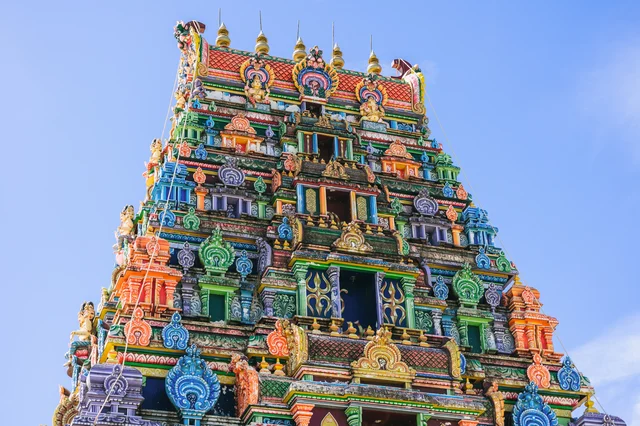
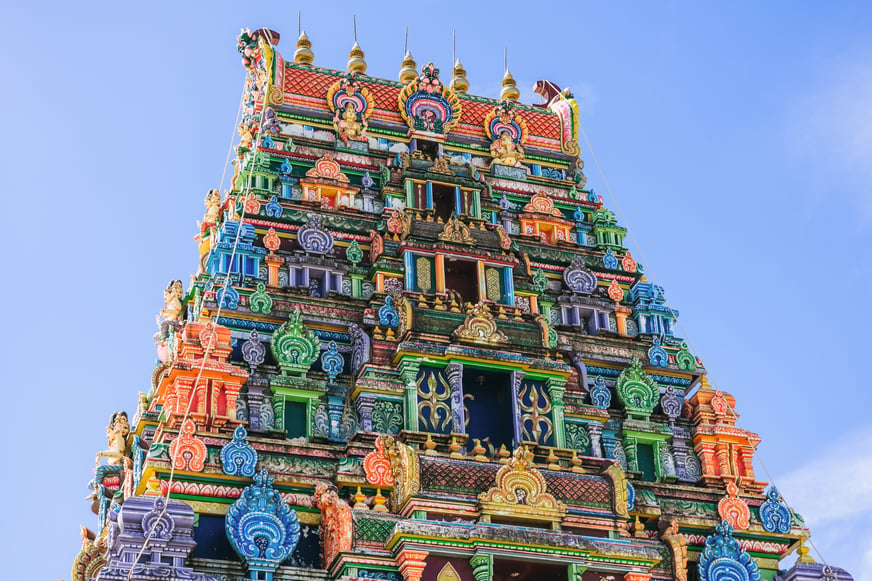
The town's other prime attraction is the Sri Siva Subrahmaniya Swami Temple (see above), on the south end of Main Street; the local Hindu community erected it in 1994. Artisans from India carved the images of the Hindu gods adorning the colorful building, itself dedicated to Lord Muruga, the mythical general said to have defeated evil. The temple is open daily from 8am to 5pm. Admission is charged. Note: You must wear modest dress and remove your shoes when entering the temple, and photography is not permitted inside.
Denarau Island
Only a muddy mangrove creek separates Denarau Island, about 7km (4 1/3 miles) west of Nadi Town, from the mainland. Denarau is home to one of Fiji's largest real estate developments, a huge project officially known in its entirety as Denarau Island Resort Fiji. To my mind -- and that of many local folks -- it's a generic tropical resort development bearing little resemblance to the rest of Fiji. It includes several resort hotels, a 150-unit timeshare complex, and numerous homes and condos.
As much as Denarau could be in Hawaii, Florida, or Australia's Gold Coast, it is still the place for play in Nadi. All the resorts have watersports and other activities, which both their guests and outsiders can use, and the Denarau Golf & Racquet Club has an 18-hole golf course as well as top-flight tennis courts.
Except for those paying extra to fly, everyone else heading out to the islands departs from Port Denarau, a modern shopping center and marina where most of the area's shuttle boats and cruises are based. The shopping center has a number of retail outlets, banks (with ATMs) and a money exchange, an ice-cream parlor, and several restaurants.
Anyone can ride the free Bula Bus, which runs around the island from 7am to 11pm daily.
Attractions North of Nadi
My favorite half-day tour goes north of Nadi Airport to the Garden of the Sleeping Giant [ST]. In 1977, the late Raymond Burr, star of TV's Perry Mason and Ironside, started this lovely, 20-hectare (50-acre) orchid range north of the airport to house his private collection of tropical orchids (he once also owned Naitoba, a small island in the Lau Group). It sits at the base of "Sleeping Giant Mountain," whose profile forms the outline of a man fast asleep. There's much more here than orchids, however, and the guides will describe a variety of local plants and their uses.
You can get here on your own by rental car or taxi. Look for the sign at Wailoko Road off the Queen's Road between Nadi and Lautoka. It's open Monday to Saturday from 9am to 5pm. Entrance fees are charged.
From there the tour stops at historic Viseisei Village, on the Queen's Road about halfway between Nadi and Lautoka. One legend says that the first Fijians settled here. Today it's a typical, fairly prosperous Fijian village, with some modern houses and some shacks of concrete block and tin, a small handicraft shop, and the usual road humps that bring traffic to a crawl.
An Attraction South of Nadi
Installed during World War II to protect the main pass through the Great Sea Reef, the concrete bunkers and naval guns in Momi Battery Historical Park are now under the care of the National Trust of Fiji, which operates the country's national parks and historical sites. The drive to the park is worth it just for the splendid view over the lagoon and western coast of Viti Levu. It's open daily from 9am to 5pm. Admission is charged. Turn west off the Queen's Road 16km (10 miles) south of Nadi Town toward Momi Bay. The road toward the coast is paved, since it leads to an on-again, off-again Marriott hotel project being developed on Momi Bay. Turn right at the signpost beside the school and follow a rough dirt track another 4km (2 1/2 miles) to the park. Note: The park does not have toilets or drinking water.
Nadi Shopping
Haggling is not considered to be polite when dealing with Fijians, and the better stores now have fixed prices. Bargaining is still acceptable, however, when dealing with Indo-Fijian merchants in many small shops. They will start high, you will start low, and somewhere in between you will find a mutually agreeable price. I usually knock 40% off the asking price as an initial counteroffer and then suffer the merchants' indignant snickers, secure in the knowledge that they aren't about to kick me out of the store when the fun has just begun.
In addition to being the shove-off point for cruises and transfers to the islands, Port Denarau is the shopping mecca on Denarau Island. This modern mall has a Jack's of Fiji branch, a surf shop, two banks and a FourEx currency exchange, a grocery and wine store, an ice-cream parlor, and several restaurants.
"Duty-Free" Shopping
Fiji has the most developed shopping industry in the South Pacific, as will be very obvious when you walk along the main thoroughfare in Nadi Town. The Fiji government charges an import tax on merchandise brought into the country; so, despite their claims to the contrary, the stores aren't "duty-free." I have found much better prices and selections on the Internet and at large-volume dealers such as Best Buy and Circuit City in the United States, so shop around at home first so that you can compare the prices in Fiji. Also the models offered in the duty-free shops here are seldom the latest editions.
You should have no problems buying watches, cameras, and electronic gear from large merchants such as Prouds and Tappoo, but get receipts that accurately describe your purchases from small stores. Make sure all guarantee and warranty cards are properly completed and stamped by the merchant. Examine all items before making payment. If you later find that the item is not what you expected, return to the shop immediately with the item and your receipt. As a general rule, purchases are not returnable and deposits are not refundable. Always pay for your duty-free purchases by credit card. That way, if something goes wrong after you're back home, you can solicit help from the financial institution that issued the card.
If you missed anything, you'll get one last chance at the huge shops in the departure lounge at Nadi Airport.
Handicrafts
Fijians produce a wide variety of handicrafts, such as carved tanoa (kava) bowls, war clubs, and cannibal forks; woven baskets and mats; pottery (which has seen a renaissance of late); and masi (tapa) cloth. Although generally not of the quality of those produced in Tonga, they are made in prolific quantities. Be careful when buying souvenirs and some woodcarvings, however, for many of today's items are machine-made, and many smaller items are imported from Asia. Only with masi can you be sure of getting a genuine Fijian handicraft.
The larger shops sell some very fine face masks and nguzunguzus (pronounced noo-zoo-noo-zoos), the inlaid canoe prows carved in the Solomon Islands, and some primitive art from Papua New Guinea. (Although you will see plenty hanging in the shops, the Fijians never carved masks in the old days.)
The largest and best-stocked shop on Queen's Road is Jack's of Fiji (tel. 670 0744). It has a wide selection of handicrafts, jewelry, T-shirts, clothing, and paintings by local artists. The prices are reasonable and the staff is helpful rather than pushy. The Chefs The Restaurant complex is on premises. Jack's of Fiji has other outlets including the shopping arcade of the Sheraton Fiji Resort (tel. 670 1777), at the Tokatoka Resort Hotel (tel. 672 0400), and in Sigatoka (tel. 650 0810).
Other places to look are Nadi Handicraft Center (tel. 670 2357) and Nad's Handicrafts (tel. 670 3588). Nadi Handicraft Center has an upstairs room carrying clothing, leather goods, jewelry, and black pearls. Nad's usually has a good selection of Fijian pottery. Nadi Handicraft Market (no phone) is a collection of stalls on the Queen's Road near the south end of Nadi Town. The best are operated by Fijian women who sell baskets and other goods woven of pandanus, a palm whose supple leaves are more durable than those of the coconut tree.
Tropical Clothing
You'll have innumerable choices of tropical clothing here, but for the most unusual items in the entire South Pacific, head out to Michoutouchkine Creations at the Sheraton Fiji (tel. 675 0518). This little shop carries the colorful creations of Nicolai Michoutouchkine and Aloi Pilioki, two noted Vanuatu artists whose unique squiggly swirls and swooshes distinguish each of their shirts, blouses, pant suits, and beach towels.
Beware of Men Wielding Swords -- Fijians are extremely friendly people, but beware of so-called sword sellers. These are Fijian men who carry bags under their arms and approach you on the street. "Where you from, 'Stralia? States?" will be their opening line, followed by, "What's your name?" If you respond, they will quickly inscribe your name on a sloppily carved wooden sword. They expect you to buy the sword, whether you want it or not. They are numerous in Nadi, and they may even come up to you in Suva, though government efforts to discourage the practice have been more successful there. The easiest way to avoid this scam is to not tell any stranger your name and walk away as soon as you see the bag.
Nadi Nightlife
The large hotels usually have something going on every night. This might be a special meal followed by a Fijian dance show, and the large hotels also frequently offer live entertainment in their bars during the cocktail hour. Check with the hotel activities desk to see what's happening.