Planning a trip to Nazareth and the Yizreel Valley
Getting There & Around
By Car-Nazareth is in the center of the lower Galilee, set in the largest and most fertile valley in Israel, the Yizreel Valley, often called simply Ha-Emek (“the valley”); it lies between the Galilee mountains to the north and the Samaria range to the south, midway between Haifa and Tiberias. From Tiberias, take Rte. 77, and turn south onto Rte. 754 near Kana, which will take you into Nazareth. From Haifa, take Rte. 75.
A warning: Nazareth has a “bypass,” a road that circles the town, which explains the confusing signs that point in opposite directions for the same destination. One of these destinations is Nazareth Elit (or Nazerat Illit—meaning Upper Nazareth), the new, modern, mostly Jewish area to the north, planned by the government to create a Jewish community beside the city of Nazareth. Its a separate municipality.
For Nazareth itself, you’ll want to go down Pope Paul VI Street and into the center of Nazareth, you follow the signs to the Basilica of the Annunciation, Nazareth’s principal religious monument off Pope Paul VI Street on Casa Nova Street (also known as Bishara or Annunciation St.).
By Bus-Major cities offer bus service to Nazareth, though there isn’t a central bus station: Intercity buses stop at Pope Paul VI Street near Bank Hapoalim. Egged Information is just across from the bank, open daily 6am-6pm, and is best to approach for the most convenient bus route for your destination. Buses to Haifa or Tiberias depart approximately every half hour. Nazareth Municipal Buses get you up the steep hill to the Salesian and Nazareth Illit neighborhoods. The website for the Jesus Trail organization provides the best information on travel to and from Nazareth. Abraham Hostels in Jerusalem and Tel Aviv also run minibus shuttles to Nazareth (a more private, direct option costing just a few dollars more each direction).
Orientation
City Layout-Use the basilica’s huge cupola, topped by a beacon, as your landmark—everything you’ll need is within sight of the basilica. There are very few street signs, and building numbers are often in Arabic. Remember that it’s downhill to the basilica and the center of town from most points in the city. The main roadway downhill into Nazareth (and uphill out of it) is separated into a right-hand roadway, clogged with cars parking, unloading, and waiting; and a central, less-gridlocked roadway for (we hope) moving traffic.
Casa Nova Street is the approach to the basilica, and on it you’ll find restaurants, cafes, hotels, hospices, and the Tourist Information Office.
To get a feel for old Nazareth, turn into the narrow alleys that wind up and back into the terraced limestone ridges, and wander through the narrow cobbled streets of the Arab Market. Keep in mind that Nazareth is completely closed on Sunday and in full swing on Saturday. Interesting eateries, venues for small concerts, readings, and theatrical performances are opening in the beautiful, freshly restored old mansions off the main streets of the town center.
Visitor Information-The Nazareth Tourism Association Information Office (tel. 04/657-0555) is on Casa Nova Street (also called El Bishara St. or Annunciation St.) near the intersection with Pope Paul VI Street, open Monday through Friday from 8:30am to 5pm, Saturday from 9am to 1pm. The Tourism Association’s website is filled with excellent information on places of interest, walks, shopping, and food. The Fauzi Azar Inn gives excellent and free walking tours of the Old City Mon-Fri at 9:30am and Sat at 12:30pm and is a helpful one-stop shop for maps and information about the area.
Regions in Brief
Nazareth
This ancient part of town clings to the inside of a vast bowl, its stone houses tiered like the seats of an amphitheater. Today, the city houses Israel's largest Arab community outside Jerusalem -- more than 80,000 -- approximately 35% to 40% Christian and 60% to 65% Muslim. With Jerusalem, it is also the headquarters of the Christian mission movement in Israel, with more than 40 churches, convents, monasteries, orphanages, and private parochial schools. Nazareth's very name is used by Arabs and Israelis to designate Christians, just as Jesus was also known as the Nazarene. In Arabic, Christians are called Nasara, and in Hebrew Notzrim. Because it has a more cosmopolitan population, Nazareth has become the cultural and political center for the more moderate Arabic-speaking community in northern Israel. Um al Fahm, the other major Arab Israeli city in the north, is more traditionally Muslim, and a center for Islamic religious and political movements.
To get a feel for old Nazareth, turn into the narrow alleys that wind up and back into the terraced limestone ridges, and wander through the narrow cobbled streets of the Arab Market. Keep in mind that Nazareth is completely closed on Sunday and in full swing on Saturday. Like every city in Israel, Nazareth faces its own special problems. In 2000, Christians and Muslims clashed over whether to build a church or an Islamic shrine on a plot of land near the Basilica of the Annunciation. There is both despair and anger over the continuing Intifada and the lack of prospects for peace. But the city is also undergoing a cultural renaissance -- interesting cafes, venues for small concerts, readings, and theatrical performances are opening in the beautiful, freshly restored old mansions off the main streets of the town center. The town is filled with poets, novelists, and playwrights; the works of Nazareth's preeminent modern poet, Tahar Mohammed Ali (who has a tourist shop in the old market), have been translated from Arabic into English and Hebrew to critical acclaim. There is also a community of innovative filmmakers, mostly working on a shoestring, but some, like the hometown favorite, Elias Suleiman, who chronicles the condition of Nazareth (and Israeli-Arab) society with a wry eye, have received international attention and awards.
The Yizreel Valley
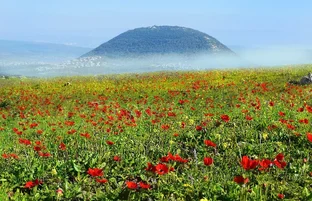
The Yizreel Valley houses some of Israel's oldest and best-known settlements -- Mishmar Ha-Emek, Hazorea, Givat Oz, Ginegar, and the giant moshav, Nahalal. The rich, dark soil is crisscrossed in checkerboard patterns of fruit trees, vineyards, and green vegetable fields. It is a breathtaking quilt of colors, some blocks golden with wheat, some black with heavy cultivation, others orange with brilliant flowers.
About 70 years ago, however, this lush area was a breeding swamp of malaria. In the early 1920s, the Keren Kayemet (Jewish National Fund) launched its biggest land reclamation project; over a period of time, the swampland was drained and every mosquito was killed. Russian, German, and Polish settlers filled the new settlements. The cultivation of the Emek became legendary, rhapsodized in dozens of romantic songs in which the tilling of soil and the smell of roses are common lyrics.
As you look at this splendid fertility, remember also that this has been one of the bloodiest fields of war in history. Here the Egyptians shed blood 4,000 years ago, as did the Canaanites, the Mongols, the Greeks, the Romans, and the Crusaders in later centuries. From Mount Tabor, overlooking the Emek's northeast corner, the Prophet Deborah launched her famous attack against the Canaanite armies. And several years later, Gideon's forces came from Mount Gilboa on the Midianites and slaughtered the plundering Bedouin tribe.
But it was also on this fertile plain that the ancient Israelite nation suffered one of its most calamitous national defeats -- when King Saul (the first king of Israel) and his sons, including Jonathan (the closest friend of David, second of Israel's kings), died during a clash with the Philistines. It is with regard to this battle that the Second Book of Samuel records David's immortal lament.
How the mighty are fallen!
Tell it not in Gath,
Publish it not in the streets of Ashkelon
Lest the daughters of the Philistines rejoice . . .
Saul and Jonathan were lovely and pleasant in their lives,
And in their deaths they were not divided . . .
Lo, how the mighty are fallen,
And the weapons of war perished.
Later, the Turks fought here, as did Napoleon. In 1918, General Allenby defeated the Turkish forces on the Emek, and Israel's armies in 1948 overwhelmed the Arabs. It is ironic that the Emek region, which has been so ravaged, today flourishes in such splendor.