New York City Self-Guided Walking Tour: Harlem

More than in any other place in the city, you need a strong imagination and social sense to really enjoy touring Harlem. The tragic fact is that much of what made this area unique, lively, and . . . well, Harlem, during the fabled Jazz Era (aka the Harlem Renaissance), crumbled beneath the wrecking ball decades ago. What you now see—wide avenues, rows of brownstones, elegant apartment buildings—are somewhat an accident of history, the physical face of an area that housed a people but wasn’t necessarily “of” that people (I’ll explain below). Despite all this, Harlem remains the African-American capital of the United States (sometimes called the “capital for Africans throughout the world”), a one-of-a-kind area with much to recommend it. Architect Zevilla Jackson Preston best sums up its appeal in the book HarlemWorld, in which she writes, “Ultimately it is the energy on the street, the beat on the street—all of the beautiful Black people on the streets—that make the experience unique.”
Harlem was settled by a number of different groups over the years—Dutch farmers first, followed by their British counterparts, then poor Irish and Italian immigrants. But development only took off in the years just prior to 1904, when the city’s first subway line opened, a 9 1/2-mile snaking tunnel connecting Lower Manhattan with points as far north as 145th Street. In anticipation of this event, an unprecedented housing boom hit the neighborhood, with developers slapping up Victorian row house after row house for the crowds of upwardly mobile immigrants—middle-class Jews and Germans, primarily—they were certain would soon flood this newly commutable neighborhood. What they didn’t anticipate were recessions and panics in 1893, 1907, and 1910, which deflated the housing market and badly affected the development of large numbers of homes on the Upper West Side.
Left with hundreds of unrentable homes, property owners soon began doing what nobody else had done in the history of the United States: renting or selling brand-new, often beautifully appointed buildings to the race that had, until that point, always made do with the tumble-down ghetto housing no other group would accept. In 1905, pioneering real estate agent Philip Payton persuaded a white landlord to rent him 31 W. 133rd St. so he could re-lease it to African Americans. The landlord accepted the offer because Payton promised to pay far more than the going rate, a substantial $5 more per tenant per month (a lot of money in those days). Several other white landlords panicked and bought the building in order to evict the Black tenants, but by then it was too late. Payton had the funding to buy several other buildings, and Black migration into the area began in earnest. What you see in Harlem today are homes and businesses that were not created by or for African Americans. These lovely buildings, however, did allow for an unprecedented standard of living and security, primarily in the 1920s, '30s, and '40s, for African Americans.
Another thing you won’t see in Harlem today are the Jazz Era nightclubs and theaters for which the area was famed. Tragically, those historic sites were torn down. But we will visit places where the great figures of Harlem, men and women such as Langston Hughes, Malcolm X, Mother Hale, and Adam Clayton Powell, Jr., lived, worked, and made history.
A note about this tour: Harlem is by far the largest neighborhood in Manhattan, stretching from approximately 116th Street all the way up to the river. There’s no way to see it all in one walk, but this tour gives you a taste of the area’s history from different eras. I’d urge you to go back and see such historic gems as Striver’s Row, Sugar Hill, and the home of Alexander Hamilton
GETTING TO THE START OF THIS TOUR: Take the 2 or 3 subway to 125th St.
START: Walk downtown to 120th St. and Malcolm X Blvd. (also known as Lenox Ave.).
FINISH: The Apollo Theater, 253 W. 125th St.
TIME: 1.5 hr.
BEST TIMES: Daylight hours
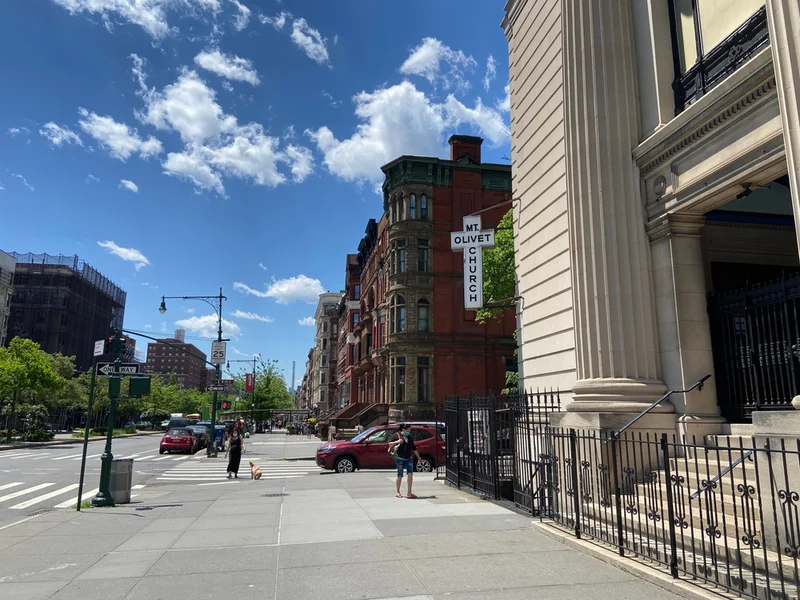
1 Mt. Olivet Baptist Church
Stand across the street (120th St. and Malcolm X Blvd., aka Lenox Ave.) so that you can get a better look at this prominent Harlem Church (over the years, presidential candidate Howard Dean and the late Venezuelan President Hugo Chavez have addressed the congregation). If you look closely, you’ll notice something that one doesn’t usually see on the facade of a church: several Stars of David. This church epitomizes the neighborhood’s transformation over the years; it was built (in 1907) to be the neighborhood’s first synagogue. The architect, the first Jewish architect licensed in New York State, based its design on that of the Second Temple in Jerusalem, which had just been excavated, making worldwide headlines. Remember the name Louis Blumstein, a prominent member of this congregation, as he’ll reappear later in this walking tour.
Walk uptown on Malcolm X Blvd., turn left on 122nd St., and walk to 152 W. 122nd St., which is:
2 Hale House
We jump forward now a century to 1969 when an act of kindness changed the lives of thousands of children. A young woman named Lorraine Hale was driving on 146th Street when she saw a drugged-out mother nodding off on the street, her 2-month-old baby almost slipping from her arms. Ms. Hale got out of the car and told the mother she needed to get treatment and that she could leave the baby with her own mother—Clara McBride Hale—while she got sober. The next day the drug-addicted mother did just that, and soon hundreds of babies were being left with “Mother Hale,” who pioneered methods of treating babies born with addictions (and also took in a lot of HIV-positive babies).
This all happened during the 1960s, '70s, and '80s, a period of steep decline for Harlem. Racist redlining policies made it impossible for Harlem residents to get housing loans and mortgages. A number of predatory landlords bought neighborhood buildings and rented them out, but stopped maintaining and even abandoned the buildings once they’d leached as much profit as they could get out of them (in 1960, a census showed only 50% of the housing in Harlem to be deemed sound, as opposed to 85% elsewhere in the city). Harlem became synonymous with urban decay, and Hale House, though a controversial institution later, was one of its few rays of hope. You can read more about the house and its mission on the plaque at the door.
Walk back to Malcolm X Blvd., cross the street, and walk east on 122nd St. until you get to:
3 Church of the Holy Trinity (230 Malcolm X Blvd)
Completed in 1885, this Romanesque Revival Church was designed by a very prominent New Yorker: William Appleton Potter, who later served as the architect for the federal Department of the Treasury. He commissioned Louis C. Tiffany to decorate the interior, and no expense was spared: the final bill came in at $210,500 or $5 million in today’s currency. It took the congregation until 1910 to pay off the debt, when an anonymous check for $35,498 hit the collection plate on Thanksgiving Day. Alas, two devastating fires destroyed the interior, the roof, and parts of the exterior in 1925 and 1939, so it doesn’t have its original majesty. Among the famous congregants was Civil War hero Major General Abram Duryee, who later became a villain when, as Police Commissioner of the city, he sent mounted policemen in to break up a labor protests in 1874, one of the city’s most violent episodes.
Look across the street to #242, the corner of an 1888 row of buildings with mansard roofs, that wouldn’t look out of place in France. In 1890, a dentist named William S. Hollingsworth moved here, and did pioneering work in the new field of orthodontia. He felt that piano wire was best for yanking recalcitrant teeth into place (ouch!), according to industry magazine The Dental Cosmos. He died a wealthy man in 1929, leaving $270,000 in his will (roughly $5 million in today’s dollars).
Continue walking east on 122nd St. until you get to:
4 4-16 W. 122nd St.
This is not a famous building, but a very beautiful one and another good example of the kind of talent that was enlisted to build Harlem’s brownstones when the neighborhood was first being developed. This one is by architect William Tuthill, who went on to design Carnegie Hall later in his career. As in many Gotham brownstones, the main entrance is on the second, not the ground, floor. Why? The streets were stinky places at the time of this construction, littered with horse poop and trash. So the kitchen and servants quarters were placed on the ground floor, and the owners lived above to escape the stench.
Look toward the park at the east end of the street. It used to be called:
5 Mount Morris Park
Named for General Roger Morris, this park was created in honor of the very first American victory in the Revolutionary War. It was in the vicinity of where you’re standing now, on September 16, 1776, that George Washington engaged in what he called a “brisk little skirmish” with the Redcoats. Just 1 month earlier, the largest British expeditionary fleet in history had sailed into New York Harbor, bringing with it 21,000 troops, a full 40% of all the men serving in the Royal Navy at that time. In quick order, these trained soldiers slaughtered approximately 2,800 American militiamen at the Battle of Brooklyn, forcing Washington to escape Brooklyn under cover of night and hightail it to the northern reaches of Manhattan. At the small battle on this site, called the Battle of Washington Heights, enemy buglers taunted the colonists by playing the call that traditionally ended a foxhunt. Enraged, Washington called for reinforcements and drove the Redcoats back to what is now the Upper West Side. It was the first time his soldiers had won an engagement and did much to boost morale. Many years later, in 1969, the park hosted the outdoor Harlem Cultural Festival—sometimes called “the Black Woodstock”—celebrated in the 2021 Oscar-winning documentary Summer of Soul. In 1973 the park was renamed Marcus Garvey Park, in honor of the founder of the Universal Negro Improvement Association.
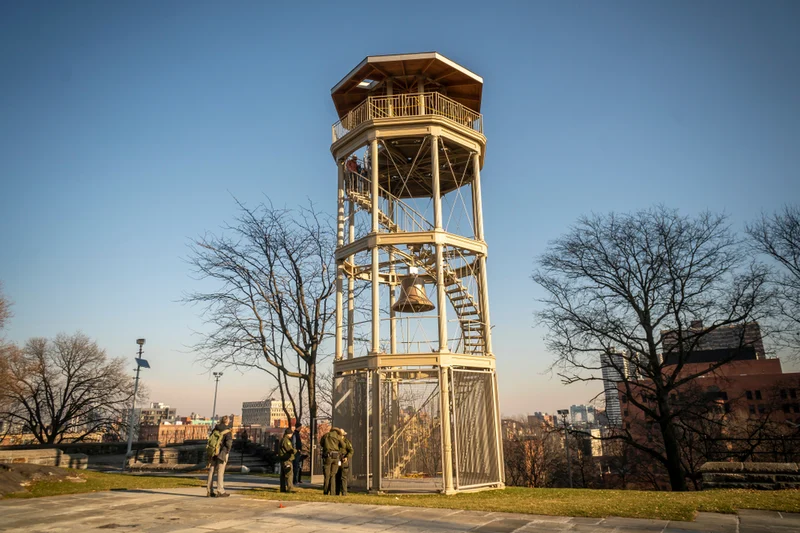
If you have the time and the stamina, follow the path to top of the park (it’s on a steep hill) where you’ll see the last remaining fire tower in the city. Starting in the 1850’s, watchmen were positioned here night at day to alert the neighborhood, via different combination of bell patterns, where fires had broken out. Once every neighborhood in the city had these towers.
Exit the park at Fifth Ave and 124th street and continue walking uptown to 127th St. Turn east and walk to 20 E. 127th St.:
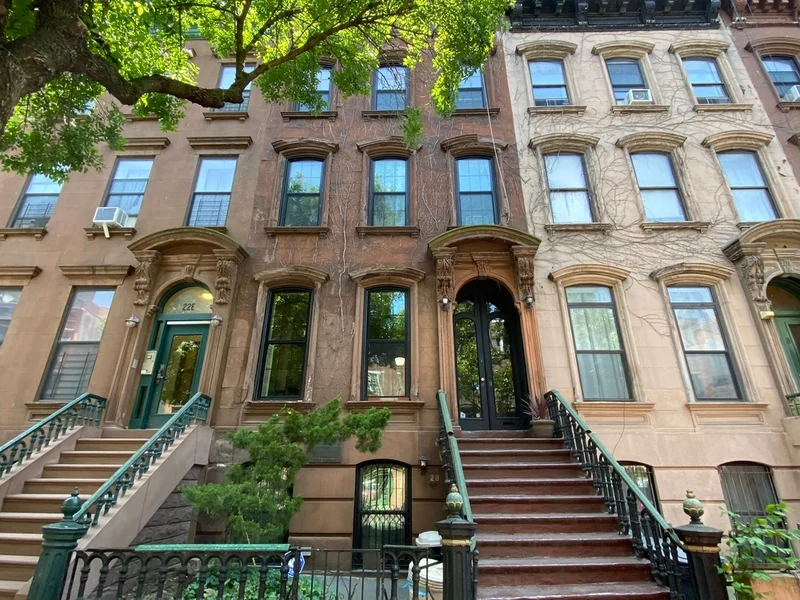
6 The Former Home of Poet Langston Hughes
Hughes bought this brownstone in 1947, likely with the royalties he received for writing the libretto to the Broadway musical Street Scene. His was an open house, with other writers, musicians, and friends from the neighborhood dropping by at all hours. He was particularly known for his kindness to the children of the neighborhood; he called the garden in front of his house “The Children’s Garden” and let the little ones plant whatever they wanted to there. It was in this house that he wrote his famous book-length poem, Montage for a Dream Deferred.
Walk back to Fifth Ave. and continue uptown to the corner of 128th St. Here, you’ll see:
7 Collyer Park
Are you a fan of the TV show Hoarders? This pretty pocket park marks the site where the most famous hoarders of the pre-television age once lived, a pair of reclusive brothers who occupied their home here from the 1880s until their deaths in 1947. Though rumors swirled about their compulsive behavior, nobody knew the extent of their hoarding until both were found dead in their home, surrounded by 140 tons of stuff—books, musical instruments, towering stacks of newspapers, baby carriages, guns, furniture, and all manner of junk, all set with booby traps to ward off outsiders. It took over a year to clear out the house, which was eventually razed—it was rotting on its foundations.
Walk back to Malcolm X Blvd. and walk downtown to 126th St.
Take a Break
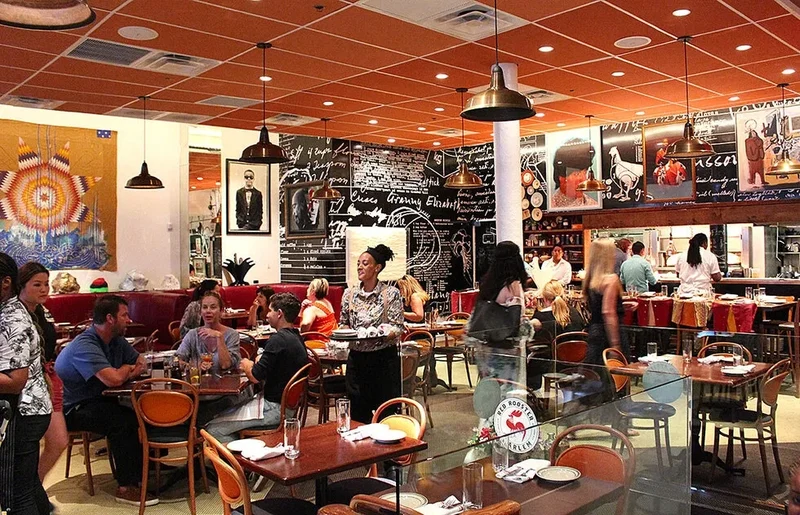
If it’s meal time, head to celebrity chef Marcus Samuelson’s Red Rooster Harlem for a bite to eat.
Continue down Malcolm X Blvd. to 125th Street. Turn right (west) and proceed on to:
8 The Corner of Adam Clayton Powell Jr. Boulevard and 125th Street
Abuzz with history, this intersection is one of the most important in Harlem. Look over first at the windswept northeast corner, where the statue of Adam Clayton Powell, Jr., Harlem’s first African-American congressman, stands. This is also the spot where Malcolm X spent many hours lecturing to Harlem residents on behalf of the Nation of Islam. His message—[“]We are Blacks first and everything else second”—was so powerful, and he was such an effective orator, that before he left the NOI that organization had nearly half a million members (it dwindled rapidly after he resigned). His controversial message, which rejected non-violence and condemned integration as cultural suicide, went directly against the goals of the NAACP, the largest civil rights organization of the time.
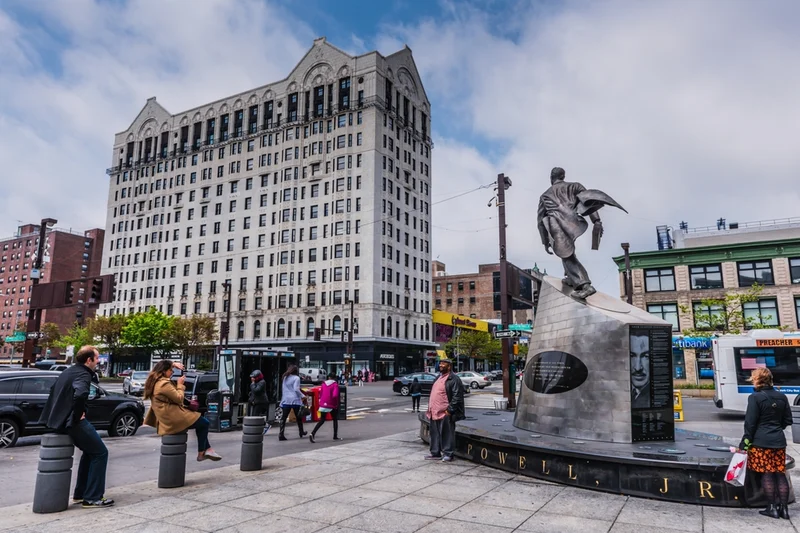
Now, look across the street at the tall white building with geometric patterns climbing up its facade, the former Hotel Theresa. If your olfactory glands have any imagination, you may detect a hint of Cuban cigar smoke in the air. In 1960, a young Fidel Castro was scheduled to speak at the United Nations, but no hotel in town would take him and his contingent. After he threatened to set up camp on the lawn of the United Nations, the government ordered city hotels to accommodate him, but Castro got into an argument with the midtown hotel he’d picked, the Shelburne Hotel. After a conversation with Malcolm X, he moved up here to the Hotel Theresa—a dramatic gesture Castro hoped would show his solidarity with Black Americans (and perhaps encourage a few to join the Communist Party). Repeated clashes between pro- and anti-Castro forces outside the hotel kept busy the 258 police officers assigned to guard him. On his second day at the Theresa, Nikita Khrushchev came to visit; his police contingent plus Castro’s created the greatest show of force Harlem had ever witnessed (to this day, it hasn’t been matched).
Four years later, when Malcolm X broke with the Nation of Islam to found his own Organization of Afro-American Unity (open to people of all religions), he held his press conference at the Theresa and soon afterward moved his offices here. When he was assassinated in 1965, just 1 year later, this is where crowds gathered to mourn, until they were dispersed by the police.
Walk farther west until you get to 230 W. 125th St., the former:
9 Blumstein’s Department Store
When it opened its doors in 1900, this was the neighborhood’s largest and most exclusive store, built at a cost of $1 million (notice the beautifully worked copper ornamentation on the facade, a mix of Art Deco and Spanish Renaissance in its patterning). And yes, it was owned by Louis Blumstein, whom we discussed at the beginning of this tour. At the time of its construction, it was an important resource for the Jewish community, as downtown department stores had signs in their windows announcing that Jews and dogs were not allowed to enter.
As the neighborhood changed, the vast majority of its clientele became African American, but Blumstein’s refused to hire any Black store clerks (a particularly maddening policy in the Great Depression, when jobs were scarce). In 1934, the Urban League began a campaign, spearheaded by Reverends John H. Johnson and Adam Clayton Powell, Jr., to boycott and picket the store until it changed its hiring practices. The action lasted 2 months, with picketers carrying signs with the simple but effective request DON’T BUY WHERE YOU CAN’T WORK. Blumstein’s finally relented, hiring 34 African-American women as clerks. Dr. Martin Luther King, Jr. often spoke of this strike in his speeches as an example of the power of non-violent protest.
In 1958, Dr. King himself was at the center of history at Blumstein’s. He was seated at a table signing copies of his book Strides Towards Freedom when a Black woman named Izola Ware Curry got to the front of the line. After asking, “Are you Martin Luther King?” she began shouting “You Communist, you Communist!” and stabbed him in the chest with a letter opener. Dr. King was rushed to Harlem Hospital with the blade still in (had it been removed, he would have bled to death) and underwent surgery. The next morning, the New York Times reported that had King sneezed, he would have died, as the blade was touching his aorta. From his hospital bed, King issued a letter of forgiveness to Wade, who was committed to an insane asylum for the act (she had had a long history of mental instability).
Cross the street, and you’ll see the marquee of:
10 The Apollo Theater
An impressive roster of Black musicians has performed at Harlem’s Apollo Theater.
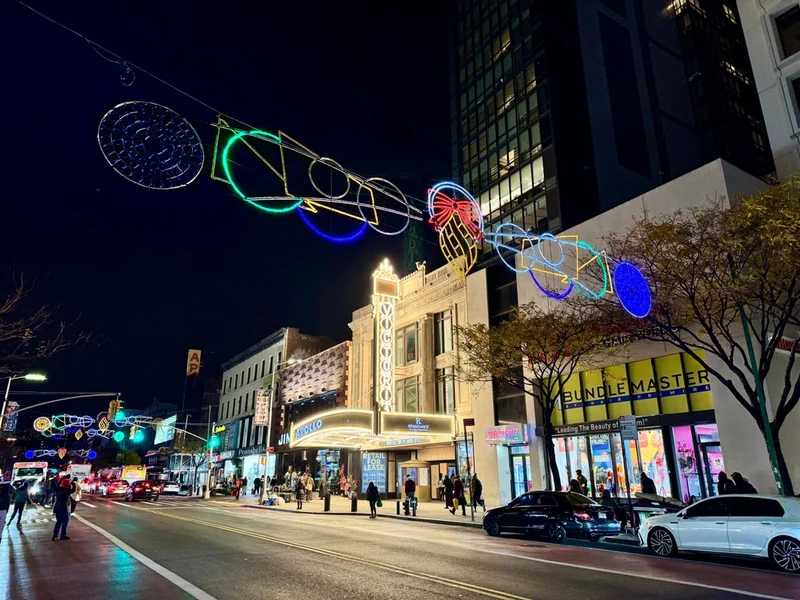
For years, 125th Street was known as the “Great Black Way,” in comparison to Broadway’s “Great White Way.” This was the theater district of Harlem. Only a few of these great show palaces still exist, but right in front of us is the most famous and influential: the Apollo Theater (253 W. 125th St.). A whites-only burlesque house until 1934, it changed its policy and its lineup, becoming a music hall in January of that year and introducing the legendary “Amateur Night” a few months later. Among the many big names who jump-started their careers at Amateur Night: Sarah Vaughn, James Brown, Lauryn Hill, and most famously Ella Fitzgerald, who was planning to dance but fortuitously changed her mind backstage right before she went onstage. Amateur night continues here every Wednesday at 7:30pm, and it’s as raucous as ever, with wild cheers for the performers the audience enjoys and painfully cruel shouts and boos for those who get the axe. There’s a gift shop inside the Apollo that’s open during the day time, so step inside and see it and the lobby.