New York City Self-Guided Walking Tour: Historic Lower Manhattan

Not only is this the most historic part of the city—New York reached no farther than Wall Street for its first 100 years—it also affords the best overview of architectural styles in the city. Buildings range from jazzy Art Deco structures, to pseudo-Greek temples, to the soaring glass rectangles of the “International Style” heyday, one rubbing up against the other like guests at a fantastic costume party. All the sites inhabit a compact, eminently walkable area
More importantly, Lower Manhattan is the area of the city that has seen the most tragedy, having endured terrible fires, not one but four terrorist attacks over the years (I describe them below), and a cruel occupation by the British during the Revolutionary War that left the city in rubble. The scars of these events, the weight of the tears shed, and the lives lost give this area a resonance and presence unlike those found in most other areas of the United States.
GETTING THERE: Take subway 4 or 5 to Battery Park; walk from there into Battery Park and toward the river.
START: Battery Park: Stand at a spot where you can see the river.
FINISH: The 9/11 Memorial
TIME: 2 hours
BEST TIMES: Weekdays during the daytime.
1 Battery Park
Look out at the river. It’s the reason this great city was built. When Henry Hudson and his crew of 16 sailed up it in 1609, mistakenly thinking they’d find Asia at its mouth, little did they know they were setting into motion a chain of events that would still be shaping lives over 400 years later. Hudson’s reports about the trading possibilities of the area (particularly for valuable animal pelts), plus his amazement at the great natural harbor here, spurred the Dutch to create settlements in the area. They guessed, rightly it turned out, that the harbor of New York would be the linchpin that would connect Europe (via the Atlantic Ocean) with the interior of this vast and wealthy continent (via the Hudson River). Later, after the building of the Erie Canal, which connected the Hudson with the Great Lakes, NYC became the most powerful city in the nation.
Walk toward the circular stone building known as:
2 Castle Clinton
Over the years, Castle Clinton has been everything from a fort to a concert space to an aquarium.
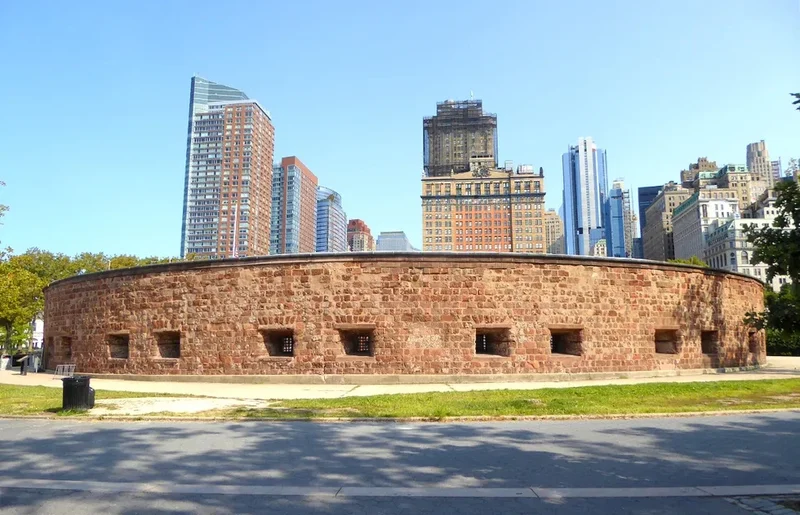
Go inside if the building is open. Though it doesn’t look like much now, this circular structure (it was taller in some earlier incarnations) has, over the years, been at the center of New York life. In 1807, the West Battery, as it was then called, was built as a fort on a landfill island in the water off Manhattan to ward off British invasions (it never saw action, however—the Brits attacked Washington, D.C., instead, during the War of 1812). In 1823, the federal government ceded the site—renamed Castle Clinton in 1817, in honor of Mayor De Witt Clinton—to the city, and it became an extremely popular entertainment center called Castle Gardens (the “Swedish Nightingale,” Jenny Lind, was a headliner here in 1850). In 1855, the space was transformed once more, into the city’s first immigrant processing center. Over eight million new arrivals, a full two-thirds of those who came to the United States at this time, spent their first hours in the United States here registering their names with the government, exchanging money, and getting information on jobs, medical care, and lodgings. By 1890, the vast number of immigrants—and the growing problem of outsiders scamming them—necessitated a move to a larger and more easily patrolled offshore space, Ellis Island. You can see Ellis Island from here, to the right of the Statue of Liberty. Its main hall reaches into the sky with four little spires.
But back to Castle Clinton: The famed architectural team of McKim, Mead, and White then stepped in and transformed the site into the nation’s first aquarium, visited by about 90 million people until it was moved in 1941 to Coney Island. After the site stood empty for many years, the National Parks Service took it over and restored the Castle Clinton of the original fort.
Walk around Castle Clinton, past the ferry terminal, and head inland (northeast) toward the tall buildings. Soon you’ll come upon:
3 Large Flagpole
At its base is a bas relief sculpture depicting the historic scene of Dutch official Peter Minuit “buying” Manhattan from Native American residents in 1626 in order to consolidate the Dutch colony in one easily defended spot.
Just how the “sale” of the island went down is still a matter of controversy. Most likely the “sellers” were the Canarsie tribe who, according to a letter by Dutch merchant Peter Schagen, let the island go for 60 guilders (the equivalent of $24). But did the Indians know they were selling the island, or did they think that they were simply accepting shiny trinkets as part of a welcome ceremony? And were the Canarsie even in a position to sell it, as it had long been a communal hunting ground used by a number of tribes? We’ll never know the truth of the matter or even if it happened on this spot, but this is the one place in Manhattan where the most infamous real estate deal in history is memorialized.
As for Peter Minuit, he was recalled from his post in Manhattan in 1631 (much to his dismay) but returned on behalf of the Swedish government in 1638 to set up a rival “New Sweden” colony on the Delaware River.
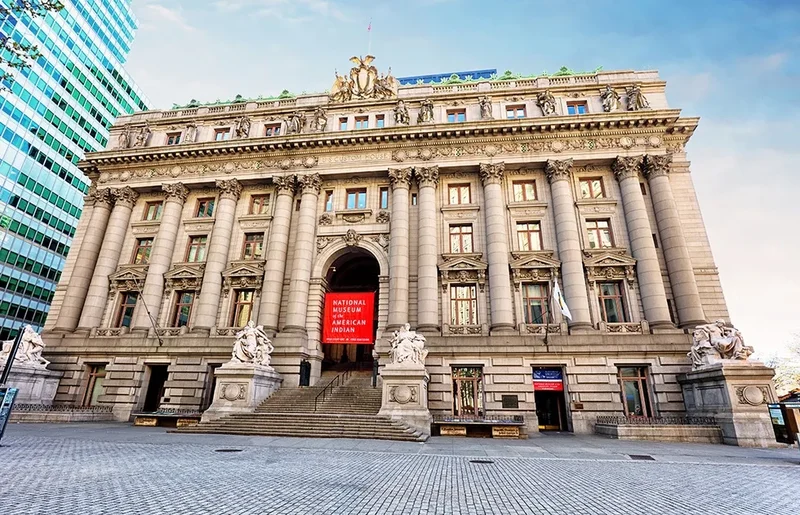
Now home to the National Museum of the American Indian, the ornate Alexander Hamilton U.S. Customs House once presided over the Port of New York.
Walk farther inland to the plaza in front of the:
4 National Museum of the American Indian
You are now standing at the foot of Broadway, the famous thoroughfare that leads all the way to the top of Manhattan, 13 miles away. The original Dutch fort stood in this exact place. But what you see in front of you is a building of just as much significance. Designed by Cass Gilbert, this was one of the most important structures in the city when it was built—the Alexander Hamilton U.S. Customs House. Before 1913, when the federal government instituted the personal income tax, the federal government’s revenue came almost entirely from customs on goods imported into the States. And a full 75% of this revenue came from the Port of New York, where it was processed in this appropriately grand Beaux Arts colossus, completed in 1907 and comprising over 450,000 square feet of interior space.
It’s a wedding cake of an edifice, with dozens of bright white sculptures adorning the gray granite facade. Daniel Chester French was the sculptor—he also did the moving sculpture of Lincoln at the Lincoln Memorial in Washington, D.C.—and his choice of symbols could be used as a treatise on the prejudices of Victorian-era America. The four women seated at the front represent the four “great” continents of the world. From left to right as you look at them, they are Asia; the Americas (South America, barely present, is tellingly represented by the Aztec-like structure that North America has her foot on); Europe; and Africa. America and Europe look full of vigor and purpose, but Asia has her eyes closed (perhaps in meditation?), and Africa—in a metaphor for her lack of vision and power?—is in a deep slumber. America is sheltering a new immigrant who crouches to her left, and the immigrant is pushing forward a wheel with wings on it, those of the Roman god Mercury, the divine overseer of commerce (a comment, some think, on the essential role immigrants were playing in the expanding economy).
At the top of the building are 12 more figures, meant to represent the great trading nations of history: Greece, Rome, Phoenicia, Genoa, Venice, Spain, Holland, Portugal, Denmark, England, France, and Belgium. Why Belgium, you ask? The official story is that during World War I, “vandals” carved BELGIUM across the shield of the figure that had originally been “Germany.” No explanation has ever been given on how vandals could surreptitiously make such a big change to one of the most visible and heavily guarded buildings in the city.
If you have the time, and are here during opening hours, go inside the building for a peek at the WPA murals in the rotunda (depicting the great conquistadors—ironic, as the building now houses the National Museum of the American Indian); the staircase on the right as you enter (meant to evoke the look of the inside of a nautilus shell); and, in what is now the museum’s gift shop, the elaborate, imposing rows of teller windows where merchants would pay their Customs taxes. Entry to the museum is free.
Turn around and walk into: \
5 Bowling Green Park
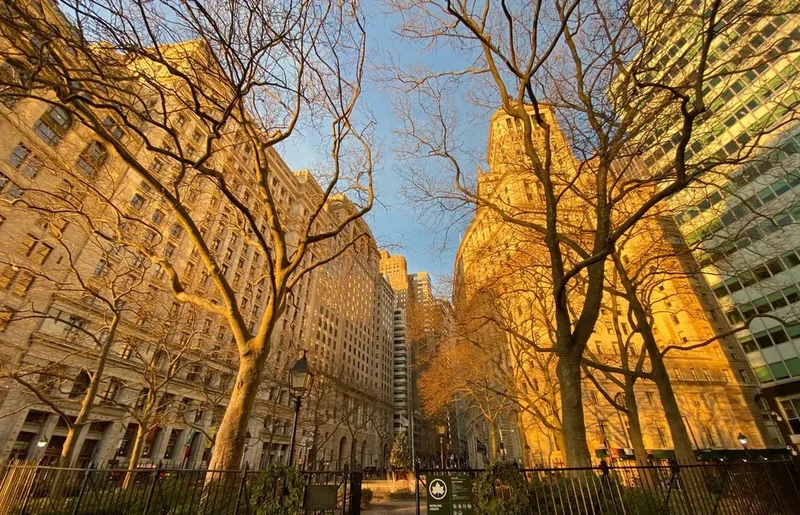
This was the city’s first official park (est. 1733). Had you been a soldier during the British Colonial era, you would have been stationed at the fort that once stood here, Fort George, and likely you’d have passed your leisure time lawn bowling where the park now stands (hence the name Bowling Green Park).
On July 9, 1776, the Declaration of Independence was read aloud (near City Hall) and a small battalion of agitated colonists marched here to behead the statue of King George that stood in the center of the park. It had been erected just 5 years previously by many of these same men, in gratitude for the king’s part in repealing the odious Stamp Act (the one that provoked the “no taxation without representation” movement). Though it can’t be proven, legend has it that the lead statue was then melted down and used for cannon balls and bullets in the war against the British. The fence that rings the park is the original, one of the few colonial structures of any sort left in Manhattan (when it was first erected, its spokes had royal crowns at their tips; these, too, were destroyed by the colonists).
Before you go to the center of the park, look up at the great skyscrapers that now shadow it. On your left, the building with the Egyptian motif (5 Broadway) was the headquarters of the White Star shipping line. It is here that distraught relatives came to learn the fate of their loved ones after the sinking of the Titanic. (There’s a famous photo of a stricken Jacob Astor exiting the building after learning that his son had perished.) Across the street, to your right at 26 Broadway, is the former headquarters of Standard Oil, the company that made John D. Rockefeller his millions. Depending on where you’re standing, you may be able to see the representation of an elaborate oil lamp at the top.
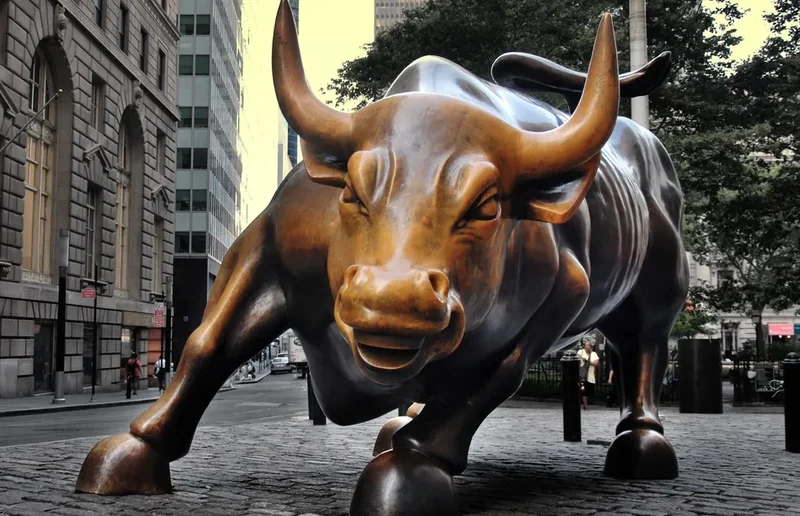
Walk to the uptown end of the park to view Charging Bull. In 1989, a recession inspired artist Arturo Di Modica to create the sculpture as a symbol of bull markets to come. The city hadn’t asked for this work of boosterism, though: Di Modica trucked it over to Wall Street in the dead of night and dumped it below a giant Christmas tree in front of the N.Y. Stock Exchange. The 7,000-pound statue proved so popular the city decided to let the “gift” stay, though not in its original spot.
Walk out of the park, going toward the museum and then walking on the side of the museum on Whitehall St. until you reach Bridge St. Turn onto it and walk to Broad St. Take a right, and in front of you will be:
6 Fraunces Tavern
The bad news first: This is not what Fraunces Tavern actually looked like, but a hopeful reconstruction completed in 1904 and based on the architectural styles of the period (about 40% of the building is original). Nonetheless, it was here that the Sons of Liberty met on dozens of occasions to discuss plans for evicting the British. Once the Revolutionary War was over, Fraunces Tavern was the place where George Washington delivered his famous “Farewell to the Troops” and where Alexander Hamilton set up his first Office of the Treasury.
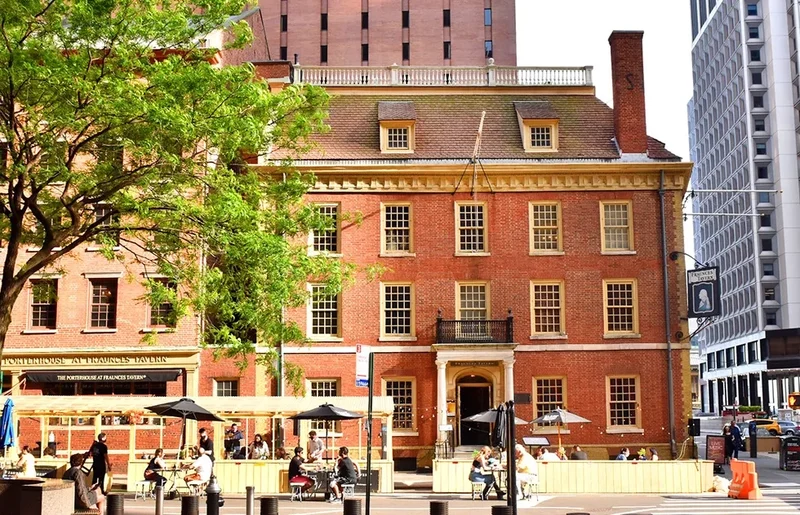
On a more sobering note, in 1975 Fraunces Tavern was bombed by the Armed Forces Puerto Rican National Liberation Front. Four people were killed and dozens injured. The choice of this site for the bombing had dual reasons: Not only is it a symbol of American ideals, it is one of the few important historic buildings in New York that has a Caribbean connection, as Samuel Fraunces was an immigrant from the West Indies.
Look behind you, diagonally across the street, to see the:
7 Goldman Sachs Building
Directly across the street from the tavern is the headquarters of Goldman Sachs, the massive glass-and-brownstone skyscraper that cuts Stone Street in two. When it was being constructed, crews found the foundations of old Governor Lovelace’s Tavern, another colonial-era watering hole, and briefly seat of the colonial government. In a compromise with local archaeologists, part of the site was left open with a glass viewing pane atop it. If you walk around the perimeter of the skyscraper in the same direction that you’ve been going, you should be able to see these excavations through glass panels in the sidewalk (they’re at the end of the rows of benches, one under the colonnade, one in the open air). Take a moment to read the plaques and gaze down.
By the way, this street is known as Pearl because it was once the beachy edge of the island, and it was where residents went to look for oysters. They were one of the most common foods served in New Amsterdam; some biologists have estimated that New York’s waters once contained as much as half the entire world’s supply of oysters.
Continue to walk northeast, curving around the Goldman Sachs building until you spot:
8 Stone Street
Here you’ll have a remarkably accurate snapshot of what the city looked like in about 1837. This narrow winding street (it’s the next street from Pearl St.) was the first to be paved in New Amsterdam and the only street that is thought to still be where the Dutch colonists originally placed it. All of the buildings were constructed in the period immediately following the great fire of 1835, which devastated the city, wiping out 20 square city blocks. Many blamed the volunteer firefighters of the time who, working in rival squads for cash payment, spent more time fighting one another than fighting the flames (Martin Scorsese’s 2002 film Gangs of New York dramatically re-creates a similar firefighter battle).
The buildings we see today are classic Greek Revival structures of straight up-and-down brick with granite bases. They were built as counting houses and warehouses for local merchants. 57 Stone St., you’ll notice, has a very Dutch steplike gable, added in 1908 by architect C. P. H. Gilbert as a nostalgic nod to New Amsterdam.
Continue to the middle of the street and then step to the left onto:
9 Mill Lane
Mill Lane has the distinction of being the shortest street on Manhattan (and yes, there was once a mill here). Folk tradition had it that it was here that Peter Stuyvesant, the Dutch Director-General of New Amsterdam, signed a treaty of surrender when the British invaded. Thanks to recently uncovered documents, we know that historic act actually happened at Stuyvesant’s farm, in what is today the East Village. Stuyvesant surrendered unwillingly, having torn to pieces the first letter sent by the British warship commander. City leaders then pieced the letter painstakingly back together. Upon seeing the favorable terms it presented the colonists (they would be allowed to keep their land and businesses), 93 leading citizens—including Stuyvesant’s 17-year-old son, a traitorous young fogey—demanded Stuyvesant surrender the colony to the British. Stuyvesant did so but mourned the loss of the colony for the rest of his life.
At the end of Pearl St. lies:
10 Hanover Square
One of the only places in New York City to retain its “royalist” title after the American Revolution, it was named for the House of Hanover, from which the era’s British monarchy was descended. Once the center of the social and political life of the city, this was where the colony’s first newspaper was published. The cotton exchange dominated one corner. When he was still considered a respectable citizen, notorious pirate Captain Kidd lived here in bourgeois splendor with his wife (they were known for their grand dinner parties). India House, on the west side of the square, is a perfectly preserved example of a brownstone banking house from the 1850s.
Continue walking to the uptown point of the triangle that is Hanover Square and hook a left onto Hanover St. You’re now entering the “canyons of Wall Street,” so named because the skyscrapers are so close together that the sidewalk gets little light. Walk until you come to:
11 Wall Street
You are now standing at what was the boundary of the city during Dutch Colonial times. If you had been alive then, you’d be staring at a 9-foot-high wooden wall erected to keep out British invaders, who, it was thought (wrongly), would be more likely to invade by land than by sea. If you walk to 74 Wall St. you’ll be standing in the heart of what was once the United States’ largest slave market, a bastion of inhumanity that held more auctions than any other in the U.S. The sale of humans began here in 1711, and was not fully outlawed in New York until 1827, making it one of the last two northern states to do so. (There’s a small plaque about the market at Water and Wall streets, but most scholars think it was actually here, not there.)
Continue walking east until you get to South Street. Turn left, and cross the highway at the nearest green light, walking to
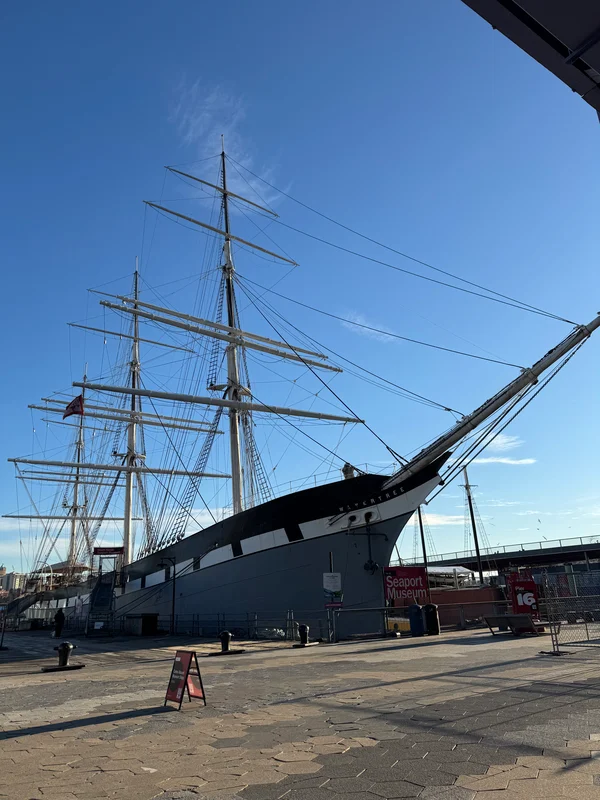
Wavetree
12 Pier 16
Docked at the pier will be the 1908 Lightship Ambrose and the Wavertree (see above), an 1885 cargo sailing vessel. Both are part of the South Street Seaport Museum and the Wavertree is visitable via free, self-guided tour in the warmer weather months, and by scheduled 30-minute tours in winter (the Ambrose is usually an add-on to those tours, and not open as regularly). If you have time, climb aboard for a look-see, but seeing these ships from afar is still evocative, giving you a glimpse of what this part of the harbor would have looked like when it was one of the busiest mercantile ports on the planet.
Go downtown to Maiden Lane and follow it inland until you get to 33 Liberty Street, the entrance to the:
13 Federal Reserve Bank of New York
No currency is printed in this fortress-like structure—that function was moved from this site to New Jersey in 1992—but this building holds more lucre than any other place on the planet. Down several stories, behind a door that’s a good 5 feet thick, the Fed keeps $100,000 billion worth of gold bars, a full 25% of all the gold reserves in the world, far more than is kept in Fort Knox. Ninety-five percent of the gold stored here belongs to foreign nations, who use this facility, embedded in the bedrock of Manhattan and guarded by a small army of marksmen (they have their own on-site firing range for practice), because it’s considered the safest place in the world for this type of storage. Tours used to be offered to the public, but now only school groups are allowed inside.
Retrace your steps back to Williams Street, and continue going in the direction you were heading before until you reach Wall Street. Turn right and walk to
14 40 Wall St.
Here is New York’s greatest monument to thwarted ambitions. Architect H. Craig Severance had a dream: He wanted to build the tallest building in the world, taller than the Woolworth Building (which held the record from 1917–30). Problem was, his former partner and archrival William Van Alen had the same aspirations, and in the summer of 1929, at the height of the bubble that preceded Black Tuesday (the great stock market crash), they began a “race to the top,” Severance at 40 Wall St. and Van Alen at the Chrysler Building (p. ###). In a record 11 months, Severance completed this building for the Bank of Manhattan at 40 Wall St., certain that the Chrysler Building was completed and his structure would be the tallest. But once Severance finished construction, Van Alen administered the coup de grâce that he’d been hiding in the elevator shaft of his building: the Chrysler Building’s iconic Art Deco spire, which added an unbeatable 125 feet onto the building. I can only imagine that Severance felt some small measure of satisfaction when the Chrysler’s title was snatched from it 1 short year later by the Empire State Building. Take a moment to gaze up at 40 Wall St.; it’s still an impressive achievement and a beautiful building, with all of the ziggurat-like step-backs (cascading layers) of the prototypical late '20s skyscraper. Those setbacks were added to allow more light to reach the street below—a change you’ll feel after having walked through the “canyons.”
Keep walking in the same direction until you get to the corner of Wall St. and Broad St. Our next stop is:
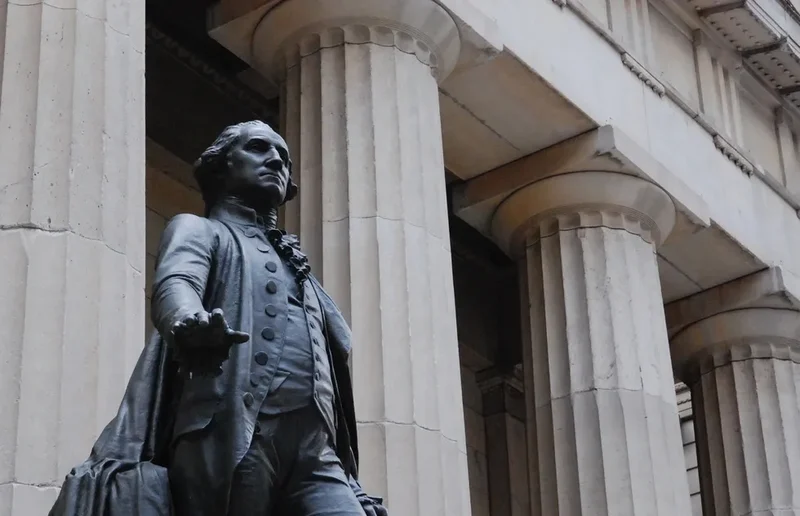
George Washington statue in front of Federal Hall in New York City
Josh Hallett [CC BY-SA 2.0], via Wikimedia Commons
15 Federal Hall
The most historically significant piece of land in the city, Federal Hall is a quintessential Greek Revival edifice, a modified version of the Parthenon (can’t get much more Greek than that!), completed in 1842. Note the statue of George Washington; it was here, perhaps on the very spot where the statue now stands, that George Washington took the oath of office to become president (though not in this actual building, but in an earlier one located on this spot). That momentous occasion would be enough to secure its place in history, but matters just begin there. In this former British City Hall (transformed into “Federal Hall” when the Brits quit the city), the famous 1735 Zenger Trial, which helped secure freedom of the press, was held; in 1765, the pre-Revolutionary Stamp Act Congress met to rail against “taxation without representation”; and after the war, the new nation’s first Congress met here to draw up the Bill of Rights. Head inside to see the magnificent rotunda, one of the loveliest public spaces in the city. Admission is free.
Note the austere, somewhat anonymous-looking building across the street from the hall; it was the headquarters of banker J. P. Morgan (the window of his former office is above the flagpole). If you look closely at the side of the building that faces Federal Hall, you’ll notice that it is pocked with small indentations. These are the scars of the Financial District’s first terrorist attack, which occurred in 1920. One bright and sunny morning (isn’t it odd that these events always seem to occur on beautiful days?), a horse and carriage loaded with explosives parked here. Moments later a huge explosion shook the street, killing 31 people and wounding scores more. The blast was so powerful that all that was ever found of the horse was a horseshoe. The police used this piece of evidence to trace the blacksmith who made it; he had vague recollections of shoeing the horse of an Italian man, and on this scanty piece of evidence the police (and press) decided that the blast must have been the work of Italian anarchists. No one was ever charged with the crime.\\
Next, walk toward:
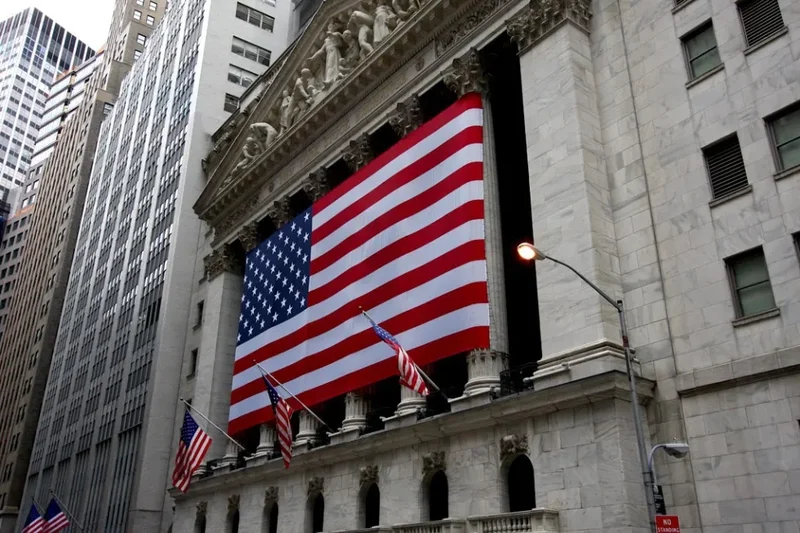
16 The New York Stock Exchange
You are now gazing at the most famous (some would say infamous) financial institution in the world. The building’s towering columns, crowded ornamental pediment, and huge flag trumpet louder than any opening bell that this is a place of incomparable might and prestige (it’s a much more imposing building than the government’s plainer Federal Hall across the street). In front of the Stock Exchange is a scraggly buttonwood tree, meant to invoke the buttonwood that New York’s first traders stood under in 1792 when they met to begin brokering the Revolutionary War debt—the first stock market in America. Also in front is the bronze statue of a fierce young girl, fists on hips—Fearless Girl, she’s called. In March of 2017 she was set in a face-off with the Charging Bull statue in Bowling Green (stop 5 on this tour) as a statement on the need for more women working in finance. The bull’s sculptor loudly objected to her presence, but she was such a popular photo op, the city moved her here in 2018.
Continue crosstown on Wall St. toward Broadway until you arrive at:
17 1 Wall St.
Take a moment to gaze at this absolutely stunning Art Deco building, once one of the priciest addresses in the city. The beautifully fluted, curtainlike limestone of the facade; the spider-web pattern of the cathedral window above the entry; and the sumptuous, soaring lobby remind us of a time when such excess and exquisite workmanship were the norm for places of business (which were, in the heady times before the Stock Exchange crash, conceived as temples of commerce).
Cross the street to:
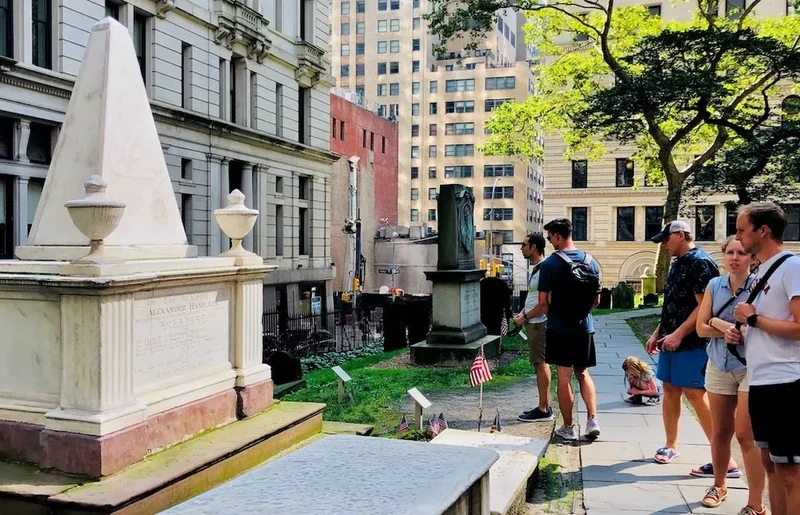
Alexander Hamilton's gravesite at Trinity Church in New York City
Zac Thompson18 Trinity Church
For a full description of the history and architecture of Trinity Church, click here. Do wander the graveyard here; it has the remains of Alexander Hamilton (see above) and other notables.
Exit the graveyard and look uptown on Broadway, as you are now in the:
19 Canyon of Heroes
Look down as you amble along at the brass plates with names and dates listing the ticker-tape parades that have been held along this swatch of Broadway. Had you been here on one of those occasions in the 1930s or '40s, the crowds around you would have been shoulder-to-shoulder, and above your head, hundreds would have been standing at the windows, showering the street with the long paper ribbons of stock market quotations that spewed from their machines, marking the dance of the stock market. Read the plates. The catalogue of names is an interesting retread of American history and political alliances; along with athletes, astronauts, and presidents, you’ll find parades for the American hostages released from Iran (1982), pianist Van Cliburn (1958), and the controversial President Sukarno of Indonesia (1956).
Walk uptown on Broadway and turn left on Liberty St.:
20 Zuccotti Park
There’s not much to see anymore, but this private 1-block-long park is where the “Occupy Wall Street” movement started in September of 2011, bringing the concept of the power of the 1% into modern political discourse. Activists occupied the park for almost 2 months before being forced out on November 15 by the police.
Continue walking on Liberty St. to Church St. You’ll pass the Oculus. Follow the signs to:
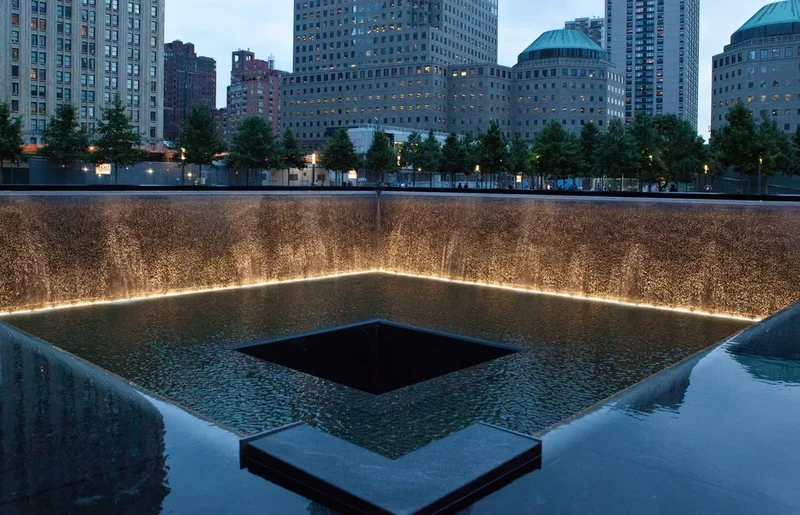
21 The 9/11 Memorial and Museum
Be sure to reserve advance tickets online so that you can skip some of the lines at this sobering museum. If you don’t have time for the museum, be sure to walk around the 8-acre 9/11 Memorial Plaza, which is centered on the 1-acre footprints of both towers. This is the final stop on this walking tour.