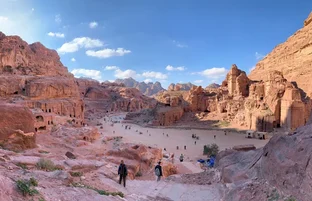
Planning a trip to Petra
A 2- to 2 1/2-hour drive north of Aqaba, Petra is the jewel in the crown of Jordan’s attractions, and the main draw for many travelers to the country. The canyon city of Petra is vast, mysterious, and really demands a 1- or 2-night stay and 2 full days of exploring to get a feel for the atmosphere, to say nothing of the contents of the ruins. You could easily spend 3 or 4 very full days exploring Petra and the surrounding countryside
Getting There
After crossing from Eilat into Aqaba, it’s easy to find taxis that will take you up to Petra. Some bargaining is required, but the general fare is around JD 55. This is the fastest, safest, and most direct way to make the journey. Splitting a taxi to Petra (or to Wadi Musa, the town at the entrance to Petra National Park) with others you may meet at the border can make the fare per person very reasonable. A taxi to the Aqaba Bus Station, plus bus fare up to Petra, will be less than JD 8, but there are few buses per day and it’s hard to find a schedule.
If you want to avoid the hassle of bargaining with taxi drivers, ask your hotel in Petra to arrange for a pickup for you at the border crossing for an agreed price. Most Petra hotels in all price categories will be happy to do this—it ensures you won’t be lured somewhere else. Again, the fare will be about JD 55. Such is life in the Middle East that your taxi fare back from Petra/Wadi Musa to the Aqaba/Eilat Crossing should be more like JD 36 to JD 40.
Travel agencies in Eilat can arrange for escorted, 1-, 2-, or 3-day tours, or unescorted packages to Petra that will include transportation arrangements.
Entry Requirements
You must have a passport valid for at least six months as of your entry date. The easiest way to get to Petra from Israel is via the Eilat/Aqaba Crossing. First take an Israel taxi from Eilat to the border (officially around NIS 40, although many drivers will demand a higher rate). Pack lightly, or carry a bag on wheels, as you will have to walk from the Israeli border across a no man’s land of approximately .8km ( 1/2 mile). There is a $65 USD border crossing fee, and a $60 USD Jordanian visa fee that must be paid at the border. T
Important: If you entered Jordan via the Eilat/Aqaba Crossing, you can reenter Israel at the Eilat/Aqaba crossing or at the Sheik Hussein crossing in northern Jordan near the Israeli town of Beit She'an, but you cannot reenter Israel via the Allenby Bridge/King Hussein Crossing into the West Bank near Jericho. No entry visas are issued at the Allenby Bridge Crossing from the West Bank into Jordan; if you plan to use this route, you must obtain your Jordanian visa ahead of time from a Jordanian Consulate or Embassy. If you have your Jordanian visa ahead of time, and you exited Israel via the Allenby/King Hussein Bridge (not to be confused with the Sheik Hussein Bridge in the north), then you can reenter Israel via the Allenby Bridge. Note: The Allenby Bridge Crossing involves travel through the currently unstable West Bank, and can involve very long delays at the Allenby Bridge due to security. We don’t recommend using this route. All border crossings are closed on Yom Kippur and on Eid al Adha.
Good travel agents and reputable tour companies can generally handle the arrangements for their clients’ visas. To find the nearest Jordanian diplomatic mission to your location, go to the Jordanian Foreign Ministry website.
Money
The Jordanian dinar is valued at approximately $1.40, 92p, So $1 = JD 0.70 and £1 = JD 1.07.
The Jordanian dinar (JD) is divided into 1,000 fils: 10 fils are 1 piaster; 500 fils are generally referred to as 50 piasters. Paper currency comes in denominations of JD 1, 5, 10, 20, as well as 500 fils (half a JD); there are silver coins for 25 fils, 50 fils, 100 fils, and 250 fils; copper coins are 5 and 10 fils.
Visitor Information
The Jordan Tourism Board website offers very thorough information about touring Jordan and Petra. Excellent information on Petra can also be found at www.go2petra.com.
The Royal Society for the Conservation of Nature website has specific information about eco-tourism and hiking in Petra; Wadi Rum, south of Petra; the wild, mountainous Dana Reserve, north of Petra; as well as to other nature and wildlife reserves in the Kingdom of Jordan.
The visitor center at the entrance to Petra (tel. 03/215-6029) is open daily from 6am to 4pm in wintertime; 6am to 6pm during summer time. Admission to Petra is JD 50 for 1 day; JD 55 for 2 days; and JD 60 for 3 days. A fourth day is free of charge. If your passport indicates you are only visiting Jordan for a 1-day excursion to Petra, admission to Petra National Park is JD 90. Children under 15 are half-price. The fee may seem high, but Petra is a vast area, and the money is needed to preserve and maintain the site.
Tips: Petra by Night
To the dismay of romantics and adventurers, Petra National Park closes at sunset or earlier, even though this mysterious, long-hidden site is especially evocative in the evenings. In fact, it was once a great place to camp at night, but now camping is forbidden.
At times, the park service has been offered escorted candlelight tours for an additional fee—a great way to spend the evening if you plan to be in Petra when the tours are available. Night tours are generally available when there’s a full moon. Check with the park authorities and reserve in advance. In good weather, a Bedouin camp dinner in the mountains is another evening option. Not only do you get a traditional meal, but you also get a feel for the beautiful, wild countryside at night. Check with your hotel or the visitor center. The price is approximately JD 30 for two people.
Bedouin guides can be arranged through the visitor center. The official fee 4 hours of guiding is JD 50. Or, once inside the park, if you feel you need a guide, you can easily find one to escort you to specific places. Tip: If you have hired a Jordanian guide before entering the park and the price of his admission is included in the arrangement, you should know that the admission price for Jordanian citizens is only JD 1; don’t let your guide add a JD 50 entrance fee for himself to the price of your tour. Many of the guides are colorful, and although they may not have had formal training, most know their stuff (and have picked up great multilingual skills). It’s a good idea to hire a guide, at least for your first foray into Petra, especially if you plan to do a hike to some of the more off-the-beaten-track parts of the city. A standard 2 1/2-hour Petra city tour costs JD 20. Like camels? Add JD 10 for one to accompany you on the walk from Khazneh to Qasr al-Bint. Seniors (no age limits set yet) and special-needs visitors can hire a carriage from the entrance gate to Qasr al-Bint for an additional JD 40.
At the Visitor Center, you’ll also find a variety of books and maps of Petra for sale. A good guidebook and map are very useful investments, even if you hire a guide; most books make a basic self-guided tour of Petra quite easy, especially if you have a chance to read up before your visit. Officially, the park is open daily until 6pm, but in summer the guards may let visitors stay a bit later in order to take in the sunset and twilight.
Tip: To avoid dehydration, bring your own bottle of water when you enter Petra; as the day progresses you’ll need to buy more bottled water from the Bedouins who until recently inhabited the site. A number of stands inside Petra sell refreshments and food, though prices will be high. Don’t hesitate to shell out for water: It’s important to keep drinking even if you’re not especially thirsty to avoid the dangers of dehydration. In summer, you’ll need four 1.5-liter bottles of water to get through the day.
Tour Operators
Reputable tour operators that run excursions to Petra (among other locations in Jordan) include Abercrombie and Kent Jordan (tel. 962-06/566-5465 in Amman); Desert Eco Tours (an Israeli-based company; tel. 972-52/276-5753 outside Israel, or 052/276-5753 from inside Israel); and Petra Moon Tourism (tel. 962-03/215-6665 in Petra). For further options, check with the Jordan Tourism Board.
Fast Facts
Banks-The Arab Bank and the Housing Bank, in the center of Wadi Musa, and the Cairo Amman Bank, in the Mövenpick Hotel just outside the entrance to Petra, both change money. They also give Visa cash advances. Banking hours are Saturday to Thursday 8:30am to 12:30pm. The Housing Bank has an ATM connected to Cirrus and PLUS.
Emergencies-Throughout Jordan, for police dial tel. 191 or 192. For an ambulance, dial tel. 193.
Hospitals-The Petra Emergency Clinic (tel. 03/215-6694), across the parking lot from the Petra Forum Hotel, is not a hospital, but it has an X-ray machine, an operating room, and other modern equipment. It’s open daily 8am to 8pm. In an emergency, your hotel or the police (tel. 191) can help get you there. The Petra Polyclinic (tel. 077-733-9209) is near the main traffic circle and is open 24 hours.
Pharmacies-The Wadi Musa Pharmacy (tel. 03/215-6444) is on the main traffic circle in Wadi Musa and is open daily 24 hours. The Modern Petra Pharmacy, a block from the Wadi Musa Traffic Circle, has an English-speaking staff and carries tampons, condoms, and other items not normally stocked by local pharmacies.
Telephones-The country code for Jordan is 962. The area code for Petra is 03. The area code for Amman is 06.