Side Trips from Pontevedra

Only 34km (21 miles) west of Pontevedra on the PO-308, O Grove (El Grove in Castilian) is a summer resort and fishing village, surrounded by 8km (5 miles) of beaches and some of the most extensive shellfish flats on the Galician coast. The nominally 45-minute drive from Pontevedra is a pleasure. We say “nominally,” because you’ll be hard-pressed to drive through without stopping frequently for photographs. The road follows the north coast of the Ría de Pontevedra, part of the famous Rías Baixas wine district. Small vineyards hanging with Albariño wine grapes are on one side of the road, and the rugged coast with scenic vistas on the other.
When you do reach O Grove, you can get local information at the tourist office, Praza Do Corgo, s/n (tel. 98-673-14-15), which is usually open Monday to Friday 10am‒2pm and 4‒6pm, Saturday and Sunday 11am–2pm. Besides feasting on shellfish at the intimate family-run Beiramar, Avenida Beiramar 30 (tel. 98-673-10-81; entrees 15€–24€; closed Mon), there are really only two other things to do. The first is to cross the bridge next to La Posada del Mar to visit A Toxa (La Toja in Castilian), an island holding Galicia’s most famous spa and fashionable resort. The casino and the golf course are both very popular. The island is covered with pine trees and surrounded by some of the finest scenery in Spain. A Toxa first became known for its health-giving properties when, according to legend, the owner of a sick donkey left it on the island to die. The donkey recovered, and its cure was attributed to the waters of an island spring.
The other principal attraction is the Acuario de O Grove, Punta Moreiras (tel. 98-673-23-27). Exhibits mainly focus on the immediate coastal zone and lessons in responsible ecological stewardship. (The facility is powered entirely by wind and solar.) In addition to displaying a lot of the tastiest local sea life in its natural environment, the aquarium also shows other marine environments around the world. Admission is 15€ adults, 13€ seniors, 12€ ages 4‒14. From April to mid-October it is open daily 11am‒7pm; the rest of the year it is open Saturday and Sunday 11am‒2pm and 4‒7pm.
Wine & History on Galicia’s Southwest Coast
The coastline from the Ría de Vigo to the Río Miño, which forms the border between Spain and Portugal, is steeped in history and blessed with a climate that favors the cultivation of Albariño grapes. It is also an area with some of the greatest fishing ports in the world, and consequently some of Spain’s best casual fish restaurants.
Begin at the village of Baiona, 57km (36 miles) south of Pontevedra. Its moment of enduring fame came on March 1, 1493, when Columbus’s ship La Pinta made landfall here (the ship’s navigator was from Baiona), making it the first place in Europe to learn of Columbus’s discoveries across the Atlantic Ocean. A life-size replica Pinta (tel. 986-687-067), constructed for the quincentennial, bobs in the harbor among recreational sailboats. The ship is open April to October daily 10am‒7:30pm. Admission is 2€. Just above the harbor stand the picket-fence stone walls of Baiona’s Fortaleza de Monterreal (tel. 986-687-067), which was constructed fitfully from the 12th century onward and finally completed in the early 1600s. Its 3km (2 miles) of walls wrap around the headland. It now houses the Parador de Baiona; grounds are open to the public.
As you drive south on the PO-552 from Baiona, several pull-outs along the road allow you to enjoy the dramatic views. In 30km (19 miles), the fishing port of A Guarda (La Garda in Castilian) nestles in a deep cove at the mouth of the Río Miño. This ancient Celtic port predates the Roman presence and is now home to Europe’s most important swordfish fleet. Pastel houses, restaurants, and bars form a Cubist wall around the harbor. The Paseo Marítimo leads to a breakwater with a walkway along the top, and to tiny Museo do Mar (tel/ 98-661-00-00), set in a replica of the cannon emplacement that once guarded A Guarda. Exhibits include aquarium tanks and good explication of traditional local fishing equipment and vessels. The museum is open early June to mid-September daily 11am‒2pm and 4:30‒8:30pm, the rest of the year Tuesday to Friday 10am‒2pm and 4‒7pm, Saturday and Sunday 11am‒2pm and 5‒8pm. Admission is 5€, 3€ seniors and students. If you’re hungry, head to the road above the harbor for grilled swordfish or rice and shellfish casseroles at Xeito Restaurante Mariquería, Av. Fernández Albor, 19 (tel. 98-661-04-74). Set on a rocky headland, the restaurant has outdoor tables so diners can enjoy the view. It’s open daily for lunch and dinner. Main dishes cost 15€‒30€.
The highway turns north at A Guarda to follow the Río Miño toward Túi. In about 11km (7 miles), you reach the important D.O. wine district known as O Rosal (a subdivision of Rías Baixas). The highway suddenly sprouts side roads leading to vineyards. Grapes line the roadside in tracts as small as backyard gardens and as big as fields reaching over the hillside. The dominant grape is Albariño, which makes a fruit-forward, slightly acidic wine with a long finish, for which the Rías Baixas region is justifiably famous. Several winemakers in O Rosal offer tastings, including Bodegas Terras Gauda, PO-552, Km 55 (tel. 98-662-10-45). The tasting room is open Monday to Saturday 11am‒2pm and 4‒8pm, Sunday 11am‒2pm. One-hour winery tours (14€) are offered in English Monday to Saturday at 4pm.
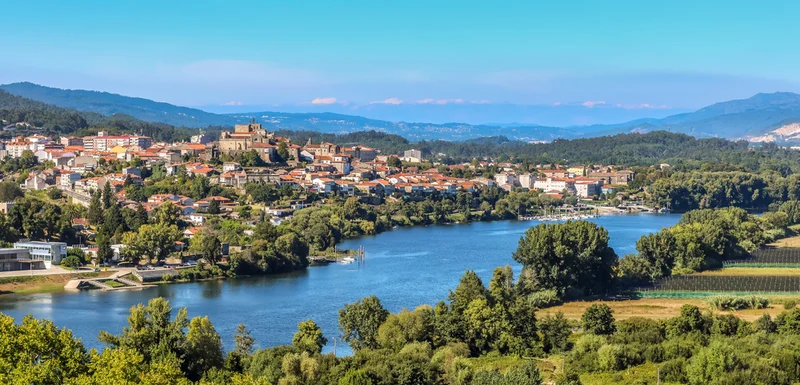
About 16km (10 miles) north, the cathedral city of Túi sits right on the border with Portugal near the two-tiered road-and-rail bridge over the Río Miño that links the two countries (the city is pictured above). The bridge was designed by Alexandre-Gustave Eiffel. (He designed a tower in Paris you may have heard of.) A footpath along the river here represents the southern Iberian branch of the Camino de Santiago. Locals maintain it as a greenway, and recreational anglers often come to the path to cast a line into the Río Miño. The winding streets of Tuí’s Old Quarter lead to the Catedral (tel. 98-669-05-11), a national art treasure that dominates the zona monumental. The acropolis-like cathedral/fortress, built in 1170, wasn’t used for religious purposes until the early 13th century. Later architects respected the original Romanesque and Gothic styles and made few changes in its design. It is usually open daily 10:45am‒2pm and 4‒7pm (longer hours in summer). Admission to the church, museum, cloister, and gardens is 5€. For 9€ you can also visit the roof Monday to Saturday at 1:15pm.
From Túi, it is a 40-minute drive north on PO-340/AP-55 to return to Pontevedra.