A Driving Tour Through Spain's Famed Pueblos Blancos

The brilliantly whitewashed villages and towns of inland Andalusia are called Pueblos Blancos. These are archetypal towns and villages that dot the steep slopes of the mountains, which extend north of Gibraltar. They occupy that part of Andalusia that is between the Atlantic in the west and the Mediterranean extending eastward. One of the most traveled routes through the towns is the road that stretches from Arcos de la Frontera all the way to Ronda in the east.
Many towns have "de la Frontera" as part of their name, an ancient reference to the frontier towns that formed a boundary between Christian-held territories and Muslim towns and villages during the Middle Ages. Although the Catholic troops eventually triumphed, it is often the Moorish influence that makes these towns architecturally interesting, with their labyrinths of narrow, cobblestone streets, their fortress-like walls, and their little whitewashed houses with the characteristic wrought-iron grilles.
If you take the drive we've outlined below, you'll pass some of the great scenic landscapes of Spain, various thickly wooded areas that are often the home to some rare botanical species, including the Spanish fir, Abies pinsap, which only grows in four locations at more than 1,000m (3,281 ft.). As you drive along you'll approach limestone slopes that might rise as high as 6,640m (5,000 ft.). Castle ruins and old church bell towers also form part of the landscape. For those who have been across the sea to North Africa, much of the landscape of the Pueblos Blancos will evoke Morocco. The white towns sprawl across the provinces of Cádiz and Málaga, east of Seville, which is often the gateway for tours of this landscape.
The ideal time to drive through the Pueblos Blancos is spring, when all the wildflowers in the valleys burst into bloom. Fall is another good time. Allow at least a day for Ronda, covered in depth on another part of this site. You can pass through the other villages on this tour, admiring the life and the architecture and then moving on. The best hotels and restaurants along the entire stretch of the Pueblos Blancos are found in Ronda and Arcos de la Frontera. Elsewhere accommodations and restaurants are very limited, although we have included some recommendations along the way.
These whitewashed villages are fairly close together, so driving times, as indicated below, are fairly short. From Seville, you can begin your tour by heading to the Pueblos Blancos along A-4, which becomes N-IV. Continue southeast along N-IV until you come to the turnoff for C-343. At this point our first stopover on the tour, Arcos de la Frontera, will be signposted. Follow C-343 south into Arcos de la Frontera. The first part of the tour from Arcos to Ronda can be done in 1 day, with an overnight in Ronda.
The second part of the tour, from Ronda to Jerez de la Frontera in the west, can also be done in a day. However, those with more time can extend this tour to 3 or 4 days. In the towns along the way, we have recommended the best places to stay and dine: If you find a place that enchants you and your schedule allows it, you can stop over rather than pressing on to Ronda.
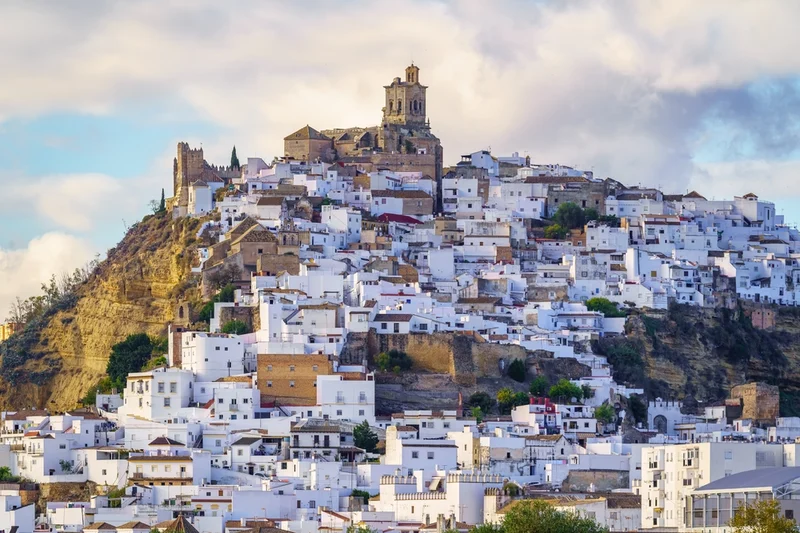
Arcos de la Frontera, photo by Jose Miguel Sanchez / Shutterstock
Arcos de la Frontera
This old Moorish stronghold is a highlight of the Pueblos Blancos, and its parador—which you’ll see hanging out over that cliff—is a dramatic spot for an overnight stay. Now a National Historic Monument, Arcos de la Frontera was built in the form of an amphitheater. The major attraction here is the village itself and the views as you approach the town along the twisting Guadalete river (featuring historic towers perched at the edge of a sandstone cliff and whitewashed houses tumbling down the hill). Wander at leisure and don't worry about skipping a particular monument.
Known to the Romans as Arcobriga, the town became an independent Moorish taifa, or kingdom, in the 11th century. As with all the towns bearing the suffix de la Frontera, it was on the frontline between Arab and Christian forces. It fell to Alfonso X in 1264. You’ll spend most of your time on the narrow medieval streets of the Medina and unless you’re staying at the parador it’s best to park on the Plaza de España and walk up the hill. The tourist office at Calle Cuesta de Belén, 5 (tel. 95-670-22-64; Mon–Sat 10am–2pm, Wed–Sat 4:30–7:30pm, Sun 10am–2pm), occupies a lovely old palace.
The old town’s main square, Plaza de Cabildo, sits at the top. From the mirador you can see the other end of the view you had as you arrived, stretching for miles across the plain of the river Guadalete. Behind you is Santa María de la Asunción, a 15th-century church built—as was so often the case—on the site of the old mosque. Its Plateresque western façade is magnificent but the bell tower, rebuilt after the Lisbon earthquake of 1755, is something of an under-achievement. It was originally intended to rival Sevilla’s Giralda, which it resembles, but a lack of funds meant the church had to settle for a squat, 37m-high (120-ft.) tower. Inside, there’s a mixture of styles: Gothic vaulting, a Renaissance altarpiece, and a Baroque choir. The church is open to visitors Tuesday to Saturday 11:30am to 3.15pm and 5 to 7pm, Sunday 9:30 to 11am and noon to 2:15pm. Admission is 2€, or 3€ for a combined ticket which also gives access to the Iglesia de San Pedro. The Moorish-era castle on the main square is privately owned and closed to the public.
The Iglesia de San Pedro sits at the edge of the cliff beyond the parador. As well as lavish 15th-century gilding, it contains a couple of interesting paintings by Francisco Pacheco, tutor and father-in-law of Velázquez, works by Zurbarán and Ribera, and some rather spooky relics. You can climb the bell tower for amazing views, although that’s not for the faint-hearted. It opens Monday to Saturday 10:30am to 1pm and 4:30 to 6:30pm, Sunday 11am to 1pm, admission 2€ for the church and 2€ for the tower. On your way back, step into the doorway at the Convento de las Mercederías (Plazuela de Botica, 2), where the cloistered nuns sell traditional almond cookies through a revolving compartment in the wall.
Where to Eat & Stay in Arcos de la Frontera
Alcaraván Café & Copas—Behind a modest front door next to Plaza de Cabildo, the brick-vaulted alcoves of this famous cave bar are an atmospheric spot for coffee and regional pastries or a late-night cocktail. A good tapas list features regional ham and cheeses, and reflects the town’s devotion to seafood, despite its inland, hilltop location. If it’s closed, try La Carcel opposite, run by the same team. (Calle Nueva 1. tel. 95-690-72-93. Tapas 4€–8€. Thurs–Sat 4pm–2am, Sun 9am–2am).
El Aljibe—This lovely restaurant in a restored 13th century mansion opposite the tourist office serves a wide range of Mediterranean cuisine, from Moroccan tagines to Italian pastas and pizza. There are excellent regional dishes too, including game stews cooked at low temperature, and grilled red tuna transported from Barbate and served with a sherry sauce. The décor, featuring horseshoe arches and decorative ceramics, is as fresh and appealing as the salads and seasonal vegetables. (Cuesta de Belen, 10. tel. 62-283-65-27. Tapas 2.20€–9.50€, entrees 13€–28€. Thurs–Mon 1–4pm and 7:30–11pm).
Jóvenes Flamencos—With its flamenco theme, red-painted chairs, and bulls’ heads on the wall, this bar on the uphill climb looks like the kind of tourist restaurant you might walk past. Don’t do so—the traditional cooking and friendly service make it well worth stopping. As well as Andalucian tavern favorites and good sandwiches, there’s an extensive menu featuring local delicacies. Ajo molinero is perhaps the most typical Arcos dish—a thick mix of bread, garlic, tomato and peppers. If that sounds too heavy, try a salad with figs, jam and local Payoyo cheese. (Calle Dean Espinosa,11. tel. 65-713-35-52. Tapas 2.50€–4.50€, raciones 8€–12€. Thurs–Tues 11am–midnight).
Parador Casa del Corregidor—Once again, the parador has the best spot in town, occupying one side of Plaza del Cabildo. Formerly the headquarters of the king’s magistrate, this upstanding building has a contemporary wing that hangs dramatically over the cliff edge. Choose a room here for exhilarating views of the Guadalete plain far below. Older rooms in the original building overlook the square but have more character. The gracious, wood-beamed restaurant has great views too, and a menu featuring traditional Arcos stews of which the corregidor would no doubt have approved. Even if you’re not staying here, you can order a drink on the terrace and enjoy the vista. (Plaza del Cabildo, s/n. tel/ 95-670-05-00. 24 units. 85€–200€ double. Entrees 15€–27€. Limited parking on square. Amenities: Restaurant; bar; terrace; free Wi-Fi).
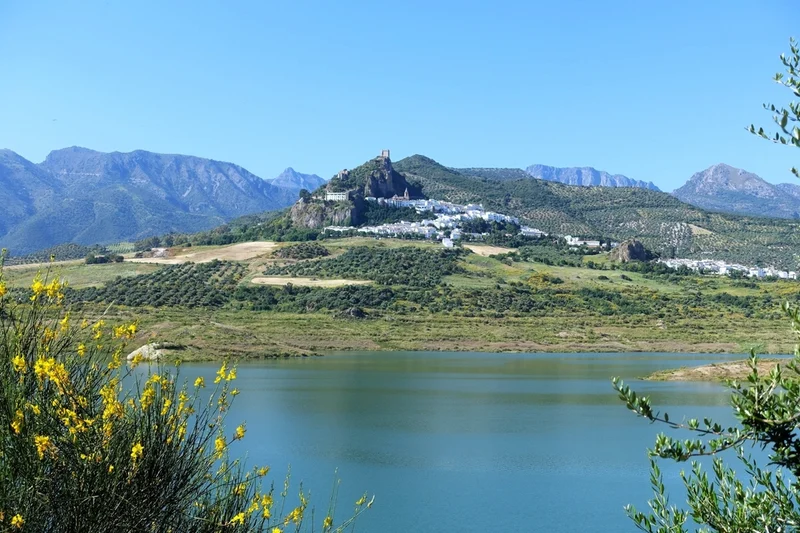
Zahara de la Sierra, photo by Sophie Picard / Shutterstock
Zahara de la Sierra
From Arcos de la Frontera, take the A-383 northeast, following the signs to Algodonales. Once you reach this town, head south at the junction with CA-531 to Zahara de la Sierra, the most perfect of the province's fortified hilltop pueblos. Trip time from Arcos is about 35 minutes, and the distance is 51km (32 miles).
Zahara is in the heart of the Natural Park Sierra de Grazalema, a 50,590-hectare (125,000-acre) park. An important reserve for griffon vultures, among other creatures, the park is studded with pine trees and oak forests and is an important habitat for griffon vultures. The Parque Natural Information Office (tel. 62-347-59-06) is at Calle San Juan (the eastern end of main street). Hours are daily from 9:30am to 6:45pm. It dispenses information, permits and maps for those who'd like to go for walks in the park or camp. There are five major routes in the park, and for most you'll need to seek permission at the office, which also organizes horseback riding, canoeing, and bike trips. The area may be best known today for Fly Spain, Calle Sierra, 41 (tel. 65-133-10-08), a first-rate paragliding center.
Zahara de la Sierra itself exudes civic pride. Its neatly arranged streets of whitewashed houses rise to a heavily restored 10th century Muslim fortress on the outcrop above. Climb to the castle via a zigzagging path near the information office. It takes a good 20 minutes to reach the top, more than 500m (1,640 ft.) above sea level, but it’s worth the effort. From the battlements there are wonderful views of the reservoir and an array of white villages stretching across the landscape.
Back in the village center, reward yourself with a snack. Join locals in one of several bars on Calle San Juan for a generous slice of toast topped with tomato and cloudy local olive oil. That street links the two most important churches in town, Iglesia San Juan and Iglesia Santa María de la Mesa. The latter is an 18th-century baroque church worth a look inside if it's open. It displays an impressive retable with a 16th-century image of the Madonna. The best time to be here is in June for the Corpus Christi celebration (annual dates vary). Streets and walls seem to disappear under a mass of flowers and greenery.
Zahara was, in fact, so prized by the Moors that the ruler, Abu al'Hasan of Granada, recaptured it in 1481 from the Catholic troops. But with the fall of Granada at the Reconquista, Zahara once again fell into the hands of the Catholic monarchs.
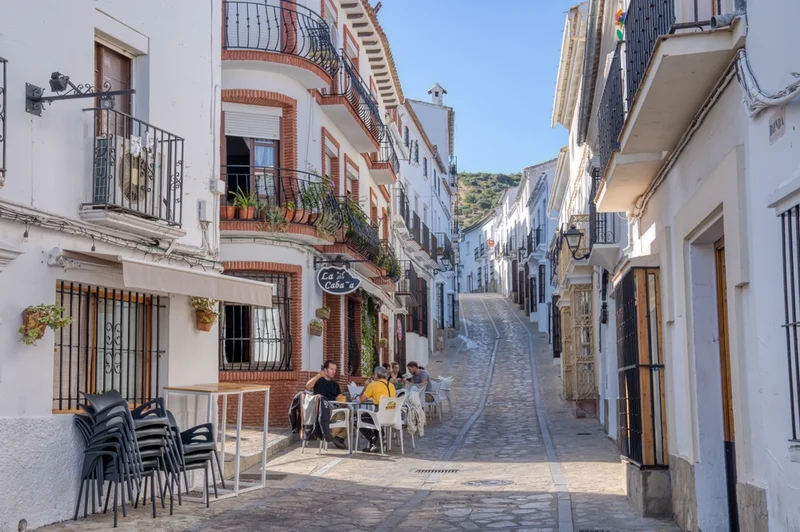
Zahara de la Sierra, Paul Brady Photography / Shutterstock
Where to Stay & Eat in Zahara de la Sierra
Arco de la Villa—Tugasa, the rural tourism arm of the province of Cádiz, runs this little stone-built inn perched above the Zahara reservoir. The guest rooms are basic but spacious and the views are to die for. The restaurant has a surprisingly varied menu, including game meats, hearty soups, and good regional wine. If you plan to hike in the area, Arco de la Villa makes a no-nonsense base. (Camino Nazarí, s/n. tel. 95-612-32-30. 17 units. 45€–65€ double. Free parking. Amenities: Restaurant; bar; free Wi-Fi.
Molino El Vínculo—Just outside Zahara on the road to Grazalema, this old mill has been producing olive oil since 1755. You can lodge here in rustic villas that sleep two to 12 people. Each is equipped with a washing machine and microwave. There’s a shared swimming pool and a terrace with wonderful views over the reservoir below. Even if you don’t plan to stay, it’s worth dropping in to see the traditional mill and buy a bottle of delicious olive oil. (Carretera Zahara–Grazalema, 1km. tel. 95-612-30-02. 3 units. 86€ double, 6 bed villa 360€. Free parking. Amenities: Kitchen; swimming pool; terrace; free Wi-Fi).
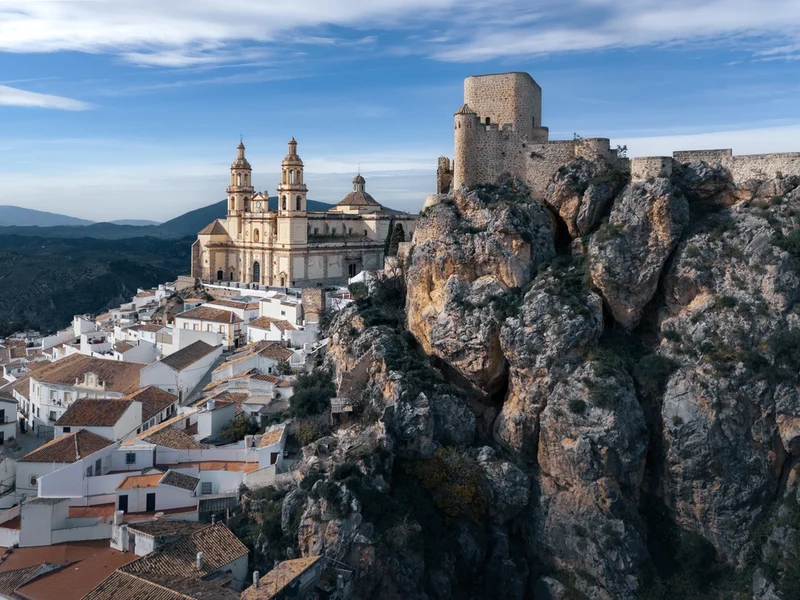
Olvera by Igor Zuikov / Shutterstock
Olvera
From Zahara, return to CA-531 and follow the signs north to A-382. Once on A-382 head northeast to the village of Olvera. The distance between towns is only 24km (15 miles), usually taking only 15 minutes for the transfer.
Declared a national monument, Olvera was another Moorish stronghold. It played a major role in the defense of Granada, until it too fell to troops of the Catholic monarchs. Its two chief monuments are its castle and its cathedral, but even better is the view of the town and the surrounding countryside. Olvera comes at you like an explosion of little whitewashed houses tumbling down a hill crowned by the twin towers of its church and ancient castle. Climb the hill by walking up the town's long main street.
In the town's Muslim heyday, El Castillo de Olvera, Plaza de la Iglesia 3, was one of the most impregnable fortresses in Andalusia. But even such a mighty bastion fell to the troops of King Alfonso XI in 1327. After the citadel was conquered, the castle and the surrounding village became part of the feudal estate of Pérez de Guzmán, a local nobleman. As late as the 19th century, the castle was still in private hands, the home of the dukes of Osuna.
Adjoining the castle is Iglesia de San José, an 18th-century church with a clock tower.
The village is known for its handicrafts, and you can see little shops on the narrow streets selling esparto and other hand-woven straw products. Foodies may want to stock up on Olvera's pure virgin olive oil. Its aceite de oliva virgen is among the best in Andalusia.
More information can be had at Olvera's Oficina de Turismo.
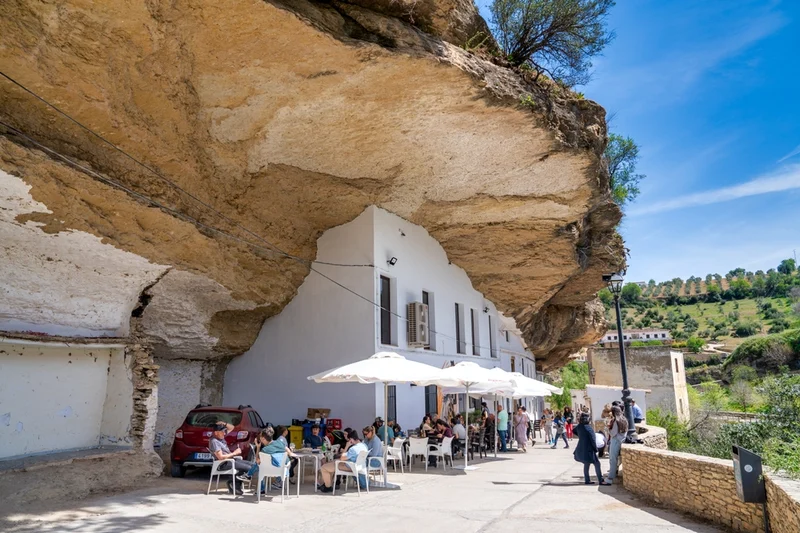
Sentenil de las Bodegas by Gagliardy Photography / Shutterstock
Setenil de las Bodegas
From Olvera, follow the signs to CA-4222, which will take you southeast for 14km (9 miles) to Setenil de las Bodegas. This winding road stretches for 13km (8 miles), taking you by olive groves and farming valleys. You'll pass through the town of Torre Alhaquime after 4km (2 1/2 miles). Allow 15 to 30 minutes for this trip. Tip: navigating Setenil’s hairpin streets by car is very challenging. Follow signs to Parking Los Caños on the edge of the town, which costs just 9€ a day.
Setenil is one of the most bizarre of the Pueblos Blancos. The Río Trejo carved itself through the tufa rock to make room for the town, which is literally crammed into clefs of rock, its cavelike streets formed from the overhanging ledge of a gorge. Houses rise two or three floors, using the natural rock as their roofs. One street of town is actually a tunnel.
Other than the town itself, there are no specific attractions. The 16th-century Gothic church, Iglesia La Encarnación, is on a rock in the center of the village next to an Arab tower, and the ruins of a Muslim castle are nearby. Another building, the Ayuntamiento (town hall), boasts a magnificent Mudéjar artesonado ceiling. Of all the streets in town, Calle Herreria is the oldest, its houses wedged into the massive rock.
Locals will tell you the town’s name comes from the Latin phrase septum nihil, meaning “seven-nil”, referring to the number of times the Christians unsuccessfully tried to take the town from the Muslims. Following its reconquest in 1484, the town became prosperous thanks to its olive groves and vineyards—hence de las Bodegas.
The tourist office on Calle Villa (tel. 61-655-33-84) provides route maps for beautiful walks in the surrounding countryside and information about the town’s many traditional festivities. You can also download them from the website.
Where to Stay & Eat in Setenil de las Bodegas
On sunny days, grab a terrace table at one of the bars on Calles Cuevas de la Sombra or Cuevas de la Sol, under the shade of alarmingly large slabs of rock. The friendly La Tasca and Cafeteria-Bar Sol y Sombra are among the most atmospheric. La Telera 1860(tel. 64-433-07-17) is the best spot for lunch, offering platters of jamón, regional cheeses, and tomatoes drizzled with local olive oil, scattered with herbs on its riverside terrace. For a memorable stay, rent one of the extraordinary cave dwellings, several of which are available on Airbnb and Booking.com. Casa Cueva Las Chicas del Puente Calle Cuevas de la Sombra, 58, is a very well maintained apartment in every room, available from just 65€ a night.
Continuing on to Ronda
To reach Ronda, the capital of the White Towns, return to CA-4222 and head southeast following the signs. The route will become CA-4211 as you continue south by the town of Arriate then change to MA-428, which takes you into Ronda. In all, this is a distance of only 18km (11 miles), taking about 15 to 20 minutes. Spend at least 1 night in Ronda before continuing the driving tour the next day. Or you can end the tour in Ronda if you feel you're going blind from seeing too many white villages glistening in the bright Andalusian sun.
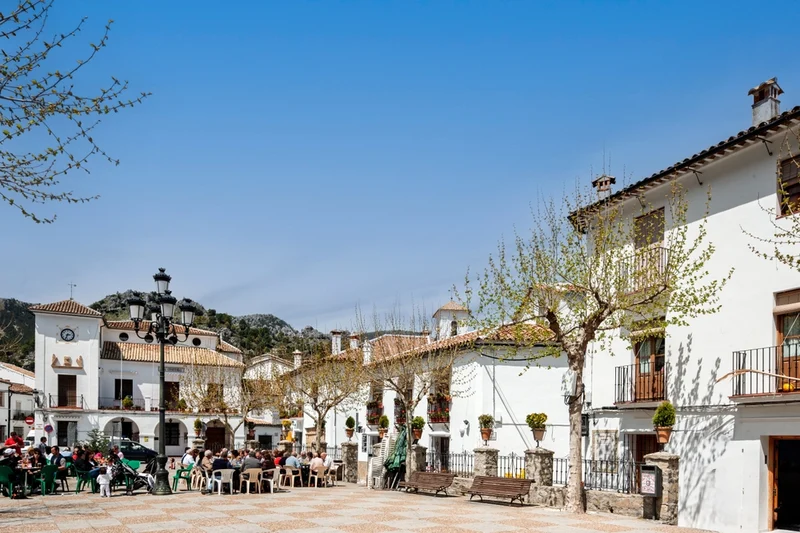
Grazalema by Right Perspective Images / Shutterstock
Grazalema
After visiting Ronda, head to the village of Grazalema by taking A-376 northwest. At the junction with A-372, follow signs southwest to Grazalema. Travel time for the 33km (20-mile) drive is about a half-hour.
This is the whitest of the White Towns -- perhaps a pueblo blanquísimo (extraordinarily white town). It was founded in the 8th century by Berbers from Morocco, a peaceable lot who chose this green valley over an arid peak and never fortified the town. Somehow, Christian and Muslim armies passed them by. It is the wettest town in Spain, receiving more than 2m (79 in.) of rain a year. The tourist office, Plaza de los Asomaderos, 3 (tel. 67-330-03-23) is open Wednesday to Sunday 9am to 2:30pm. It hands out hiking trail maps and permits needed for some walks, not surprising as it is also one of the best centers for exploring the Parque Natural of the Sierra de Grazalema.
Towering limestone crags overlook the town. For the best view, climb to a belvedere near the 18th-century chapel of San José. From here, you're rewarded with a panorama.
The town has two beautiful old churches, Iglesia de la Aurora on Plaza de España and the nearby Iglesia de la Encarnación. Both date from the 17th century.
Grazalema takes pride in its idiosyncratic bull-running festival, Toro de Cuerda, in which the animal is tethered on a rope. A sculpture on the main street celebrates the age-old event, which takes place every July. The village is also known for its crafts, especially hand-woven blankets and rugs made from local merino wool. Mantas de Grazalema, Carretera de Ronda (tel. 95-613-20-08), has a small factory and textile museum where you can buy beautiful blankets produced using hand-operated looms. It is open Monday to Friday 9:30am to 1:30pm; admission is free.
Where to Stay & Eat in Grazalema
Cádiz El Chico—This grand old building on the main square was Grazalema’s first proper restaurant and remains the best in town. Founded by José Gómez Rojas in 1984, it made its name by reviving the region’s traditional lamb and kid stews and continues to be run by José’s daughters. Try sopa de Grazalema to start, a meal in itself involving bread, garlic, diced ham, sausage, and egg. After that, perhaps paletilla de cordero lechal, slow-cooked shoulder of lamb that falls off the bone, or wild boar with raspberries. When the film star Antonio Banderas dined here, he requested the recipe for the prawn and chard fritters for his own restaurant in Málaga. (Plaza de España, 8. tel. 95-647-97-12. Entrees 13€–20€. Set menu 16€. Tues–Sat 12:30–4:30pm and 8pm–midnight. Sun/Mon 12:30–4:30pm.)
Hotel Villa de Grazalema—Built by the Andalucian tourist board to encourage family vacations in Grazalema, this holiday village has simple rooms and apartments with a garden swimming pool and views of the village. It feels like a junior parador and its rates offer terrific value. The restaurant offers a selection of rustic dishes, including an unusual local specialty: baked trout stuffed with mountain ham and cheese. The complex is an easy 10-minute walk to the center of Grazalema. (Carretera Olivar, s/n. 📞 95-613-20-32. 24 rooms, 38 apartments. 65€–100€ double, 120€–150€ 4 person apartment. Free parking. Amenities: Restaurant; bar; outdoor pool; free Wi-Fi).
Gaucin
From Grazalema, take A-374 southwest to Ubrique. From here, get on A-373 south. The route will curve east to Cortez de la Frontera. Once you reach this town, continue along the same A-373 south to Algatocin. At this point, connect with the A-369 and follow it southwest until you connect with the A-377 into Gaucín. (Look for signs.) Allow at least an hour for the 63km (39-mile) trip.
This whitewashed mountain town is perched on a ridge below a former Muslim fortress, which opens onto a panoramic vista of the countryside. At the eastern edge of the village, head up to the Castillo del Aguila, the Moorish castle. From its battlements, you can look out over the countryside and on a clear day see all the way to the Rock of Gibraltar.
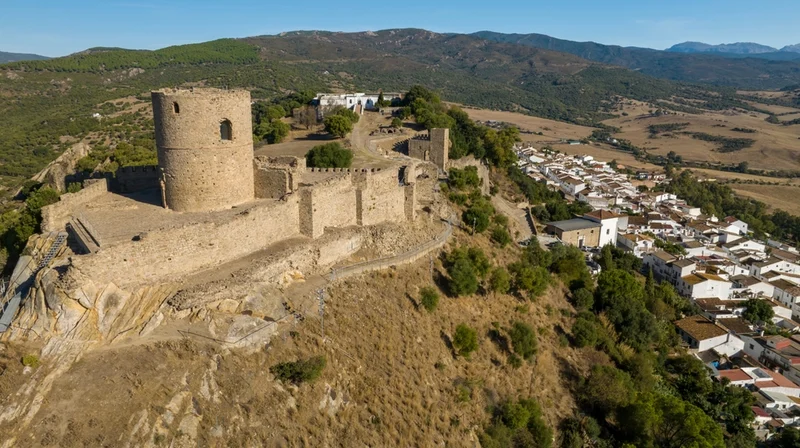
Jimena de la Frontera by Antonio Ciero Reina / Shutterstock
Jimena de la Frontera
To reach this white town from Gaucín, take the winding A-369 out of town, traveling southwest for some 30 minutes, a distance of 23km (14 miles). Enveloped by Los Alcornocales Natural Park, Jimena was built 200m (656 ft.) above sea level. It is so close to San Roque on the Costa del Sol and its string of beaches that it gets a lot of visitors on day trips.
You enter Jimena through a gateway of three arches. Over the years the town has known many rulers, from the Phoenicians and Romans to the Moors and ultimately the Christian armies.
It's a delight to walk the steep and narrow cobblestone streets of Jimena, one of the more stunning of the Pueblos Blancos. It takes about 15 minutes to ascend to the highest point, the castle-fortress built on Roman ruins. Today the Castillo-Fortaleza (see above) is in ruins but still impressive. Inside the castle enclosure, you can take in one of the most panoramic views of the Costa del Sol, including the Rock of Gibraltar and the port of Algeciras, where ferries depart for Morocco.
Visitors with more time will find that Jimena is the gateway to the Parque Natural de los Alcornocales, stretching south to the Mediterranean and north to one of the white towns, El Bosque. The park is named for its cork oaks (alcornocales), which are among the largest in the world, but is also home to the gall and the holm oak as well as wild olive trees. Creatures such as the Egyptian mongoose, the royal eagle, eagle owls, lion buzzards, and the roebuck also inhabit the park. The park is one of the most heavily forested in Spain and will give you a sense of what Iberia used to look like before being deforested.
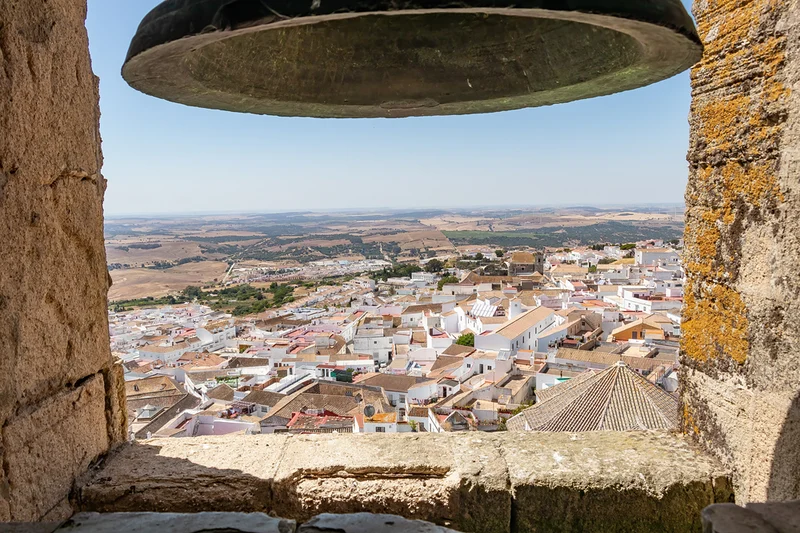
Medina Sidonia, photo by agsaz / Shutterstock
Medina Sidonia
From Jimena, take C-333 northwest until you come to the junction with A-375 heading southwest to the junction with A-381. Once on A-381 continue northwest into Medina Sidonia. This hour-long trip takes you across 86km (54 miles).
Medina Sidonia fell to Catholic troops in 1264 under King Alfonso X. It was an ancient hilltop Muslim fortress. In the Middle Ages it became a famous seat of the Duke de Medina Sidonia, a title bestowed on the heirs of Guzmán El Bueno who helped recapture the town from the Moors.
This village has seen better days, but wandering its cobbled and narrow streets is still an evocative experience, a bit like stepping back into the Middle Ages. Start at the central square, Plaza de España. The most impressive architecture here is the Renaissance facade of the 17th-century Ayuntamiento (town hall).
Nearby is the town's second-most beautiful square, Plaza Iglesia Mayor. Here you can visit Iglesia Santa María La Coronada. Built on the foundations of a former mosque, it is celebrated for its stunning retablo, standing 15m (49 ft.) high. The retablo depicts scenes from the life of Jesus and is a piece of master work in polychrome wood achieved by the artisans of the Middle Ages. The photo above is taken from its bell tower.
After the church you can visit the Archeological Museum, which showcases the towns impressive Roman-era sewers, and a bit of the Roman road nearby. The museum's hours vary greatly by season. Admission is 3.50€ ($5.60). The sewers date from the 1st century A.D. More Moorish architecture is seen in a trio of gates, the best preserved of which is Arco de la Pastora, close to the Carretera de Jerez.
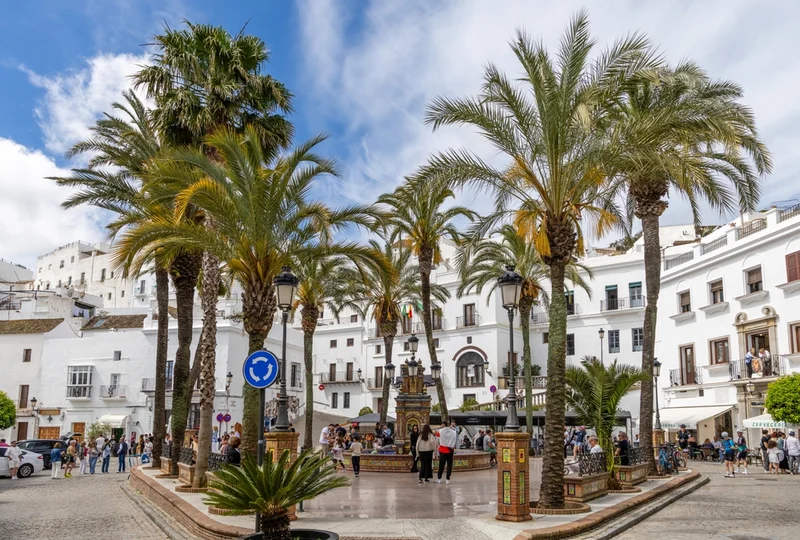
Vejer de la Frontera, photo by Jose Luis Vega / Shutterstock
Vejer de la Frontera
From Medina Sidonia, follow the C-393 south to Vejer de la Frontera, a distance of 26km (17 miles), usually taking 20 minutes. This is one of the more dazzling Pueblos Blancos. Like most of the other towns we've visited, this Pueblo Blanco also reflects its Moorish history.
Vejer, still partially walled, is in a deep cleft between two hills on the road between Tarifa (southernmost point in Spain) and the port of Cádiz, 10km (6 1/4 miles) inland. Dominated by its castle and a Gothic church, it looks like a town you'd find in the Greek islands.
You can skip most of the monuments and simply enjoy the beauty of the town. Or else you can duck into Iglesia del Divino Salvador, the major church. It's a mix of styles, including Romanesque, Mudéjar, and Gothic.
Castillo Moro or the Moorish castle is reached by heading down Calle Ramón y Cajal from the church. The castle keeps such erratic, changing hours it's best to check the hours on the tourist board's website. Over the years it's been altered drastically, but as of 1000 B.C. it is known to have been some sort of fortress, standing watch over the fishing grounds and factories along the coast for the approach of an enemy vessel by sea. The site was also used by the Phoenicians and Carthaginians long before the coming of the Romans. Even if you can't see the castle, you can admire the panoramic view.
Continuing on to the Sherry Triangle
After your tour of Vejer, you can take N-340 northwest. At the junction with N-IV, continue northeast into Jerez de la Frontera. The distance from Vejer to Jerez is 62km (39 miles). The trip takes 45 minutes. Once in Jerez, you'll be in the center of the sherry-producing district of Andalusia, the Sherry Triangle.