Side Trips
One-Stop Adventure Shop
Hacienda Guachipelín offers up a range of adventure tour options, including horseback riding, whitewater tubing, ziplining, canyoning, rappelling, hot springs, and mud baths. If all of this sounds good to you, buy the 1-Day Adventure pass ★★, where you can do all of the above any day (except the canyoning and rappelling, which are offered only a couple of times a week) at a published price of $105, including lunch. For a daylong multi-adventure package, this is one of the best bargains anywhere in Costa Rica. Almost all Guanacaste beach hotels and resorts offer day trips here, or you can book directly with the lodge. Be forewarned: During high season, the operation has a cattle-car feel, with busloads of day-trippers coming in from the beach.
Hot Springs & Mud Baths
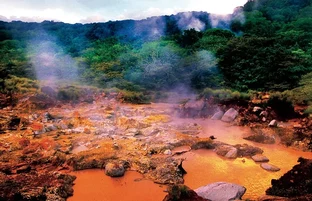
The active Rincón de la Vieja Volcano has blessed this area with several fine hot springs and mud baths. Even if you’re not staying at the Hacienda Guachipelín or the Borinquen Thermal Resort, you can take advantage of their hot spring pools and hot mud baths. Both have on-site spas offering massages, facials, and other treatments.
Up the road from their lodge, Hacienda Guachipelín has opened the Río Negro Hot Springs ★★ (tel. 2666-8075). Admission is included in the 1-Day Adventure or Nature pass, otherwise there is a $25 entrance fee that gets you access to the pools and an application of the hot volcanic mud. For $55 you can do a horseback ride from the main lodge to the springs. A wide range of massages, mud wraps, facials, and other treatments are available at reasonable prices. Guachipelín also has a second hot spring option, Simbiosis Spa, which has similar facilities and fees.
At the Borinquen Thermal Resort, a $30 entrance fee allows you access to their range of hot spring–fed pools ★, which vary from tepid to very hot, as well as their fresh volcanic mud bath area, and large freshwater pool, though various other adventure packages can be combined too.
Finally, Vandara Hotsprings ★★ (tel. 4000-0660) is an excellent spa and adventure center, with a lovely manmade pool fed by natural hot springs. Unlike the other pools mentioned above, this one has no sulfuric smell. Admission is $39 for halfday entry plus lunch. Various packages, with a canopy tour, horseback ride, waterslide, hanging bridges, and other activities, are also available. Spa treatments are also offered.
Río Celeste & the Tenorio Volcano
One of Costa Rica’s best-kept secrets is the Río Celeste ★★★, the stunning, sky-blue river that is the centerpiece of Tenorio Volcano National Park. The unique color of the Celeste is caused by aluminosilicate particles suspended in the water that reflect sunlight only in the blue spectrum, and the effect is glorious. The Río Celeste Waterfall, with its cool blue pool at the bottom, is arguably the most beautiful in the country. Río Celeste (“sky-blue river”) is inside the Parque Nacional Volcán Tenorio (Tenorio Volcano National Park; tel. 2206-5369; daily 8am–4pm, last entry at 2pm; admission $12). An easy trail follows the river and its prime attractions—the Blue Lagoon, the Borbollones (where the water bubbles because of venting gas), and the Teñidores (“dyer’s shop”), where you can see two colorless rivers collide and turn blue. The hike is one-way in, one-way out, and could be jogged in 1 hour or strolled for 3 or 4. Be aware that rainstorms can turn the water muddy and brown, so check with the rangers at the entrance on the current state of the water and the weather outlook. Tip: Once you’ve seen Río Celeste, you’ve seen the best of Tenorio Volcano National Park, so this makes a great day trip from Arenal, Monteverde, and elsewhere.
If you do want to overnight here, look up the humble yet delightful La Carolina Lodge ★ (www.lacarolinalodge.com; tel. 843/343-4201 in the U.S. and Canada, or 2466-6393), which is on a working farm, next to a clear flowing river. Another solid option is the Celeste Mountain Lodge ★ (www.celestemountainlodge.com; tel. 2278-6628), a handsome property boasting swell views of the surrounding volcanoes.
Getting There and Getting In: Tenorio National Park is located near the small town of Bijagua. The road to Bijagua (CR6) heads north off the Inter-American Highway about 5km (3 miles) northwest of Cañas. From here, it’s another 30km (18.5 miles) to Bijagua, and another 12km (7[bf]1/2 miles) to the park entrance. Construction on the final stretch was completed in 2018, which has caused visitor numbers to increase drastically. A quota system limits the number of visitors to the park to 500 people at any given time and a maximum of 1,000 per day, though it rarely fills up. Know that if you’re denied entry when you arrive, it’s usually just a short wait until another guest leaves and you’re admitted.
Near the Miravalles Volcano
Part of a string of active volcanoes running down the spine of the country, the Miravalles Volcano is a major energy supplier for the country’s electric grid, but a rather undiscovered area for tourism. Río Perdido ★★ (www.rioperdido.com; tel. 888/326-5070 in the U.S. and Canada, or 2673-3600) aims to change all that. With a setting among rolling hills and striking rock formations, this hotel, spa, and adventure center features 30 lovely bungalows and a gorgeous hot-springs complex. The hot springs here range from a modern pool fed by warm mineral waters up near the main lodge, to a natural river with pools of clear water and varied temperatures. The lodge also has a zipline canyon tour, an extensive mountain bike park, and whitewater tubing.