Side Trips in Seville

An easy trip by bus or car 35km (21 miles) east of Sevilla, Carmona (see above) is a beautiful walled city with fine buildings and fascinating Roman remains. It is one of the oldest settlements in Europe, fortified in turn by the Carthaginians, Romans, and Moors. Julius Caesar called it the best defended town in Andalucía, and you can still see why.
The Puerta de Sevilla, one of four defensive gates, is a good place to start. Enter via the tourist office at Alcázar de la Puerta de Sevilla (tel. 95-419-09-55; 2€ adults, 1€ students and seniors; Mon–Sat 10am–6pm, in summer 9am–3pm, Sun 10am–3pm) and climb to the top to admire the town’s whitewashed houses and church towers gleaming in the sun. After that, it’s an easy walk around the main sights of the town, or you can book a guided tour in English at 11am Wed–Sun (except in summer) for 2€. Don’t miss the Ayuntamiento (town hall), Calle el Salvador, 2 (tel. 95-414-00-11, Mon–Fri 8am–3pm; free admission) which has a near-perfect Roman mosaic depicting Medusa; and Prioral de Santa María, Plaza Marqués de las Torres, s/n (tel. 95-419-14-82; 3€ adults, 1.80€ seniors, children free; Tues–Fri 10am–1:30pm and 5–7pm, Sat 10am–1:30pm and 4–6:30pm, Sun 10am–2pm and 6-7pm), an impressive Gothic church built on top of the former mosque, of which it retains an orange-tree patio. Nearby, the Museo de la Ciudad, Calle San Ildefonso, 1 (tel. 95-414-01-28; 2.50€ adults, 1.20€ students, free for seniors and children under 18; Tues–Sun 11am–7pm, Mon 11am–2pm; summer daily 10am–2pm) has an interesting collection of archaeological finds from the various cultures who settled here, including the mysterious Tartessians from the 4th century b.c. It also has a good cafeteria and tapas bar.
The only part of town that’s a bit of a walk is the area named after Jorge Bonsor, the French-English archaeologist who discovered the Roman amphitheater and necropolis here in the 19th century. The Necropolis, Avenida de Jorge Bonsor, 9 (tel. 60-014-36-32; free admission; Tues–Sat 9am–6pm, Sun 9am–3pm), contains the tombs of Roman families who lived in and around Carmona between 200 b.c. and 400 a.d. The Elephant tomb is named after the trunkless sculpture discovered there, and may indicate a temple to Mithraism, a religion that once rivalled Christianity.
The locals don’t seem to be in any doubt about the best place to eat. At lunchtime, extended families spill out of Bar Mingalario, Calle Salvador, 1 (tel. 95-414-38-93, daily noon–4:30pm and Wed–Sat 7:30–midnight) along the wall of the Divino Salvador church opposite. The food is traditional Andalucian fare with some interesting, and vegetarian friendly, twists such as spinach with chickpeas, and pisto—a rustic ratatouille topped with a fried egg. After lunch, stroll into the circular plaza for an ice cream at Los Valencianos, Plaza San Fernando, 1 (tel. 95-414-12-23; daily noon–11pm, until midnight at weekends).
If you plan to stay overnight, the Parador de Carmona, Alcázar, s/n (tel. 95-414-10-10) is a luxurious option. It is set within the ruins of a fortress that was once the home of the 14th-century king, Pedro the Cruel. The view from its terrace, down to a huge swimming pool and the parched countryside beyond, is spectacular. From Sevilla, there’s a daily bus to Carmona leaving at 9.30am from Plaza de Armas returning at 8pm. It costs 3€ and takes about 40 minutes; for information, contact Alsa (tel. 90-242-22-42). By car, take the A-4 toward the airport and stay on the road to Córdoba. The turning for Carmona is clearly signposted. As it’s not far from the airport, this delightful town makes an excellent stop for the last night of your tour.
Italica
Lovers of Roman history shouldn’t miss Itálica, the extensive ruins of an ancient city at Santiponce on the northern outskirts of Sevilla.
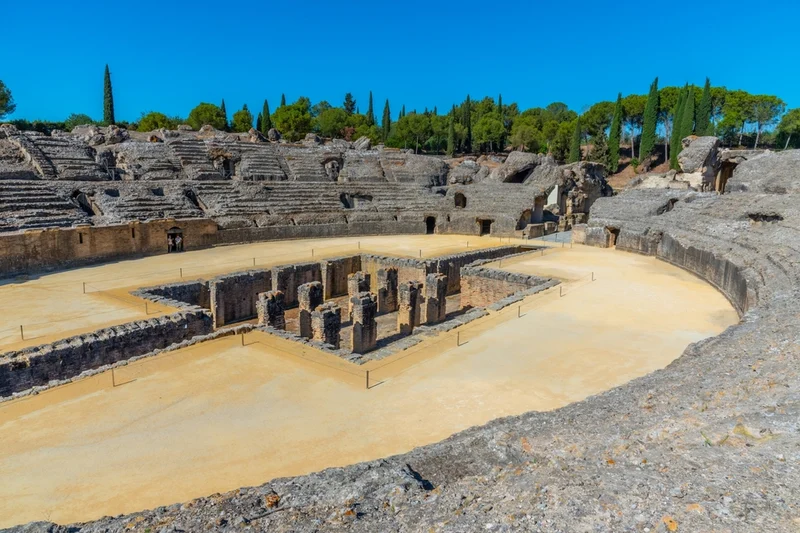
Italica's Amphitheater (Trabantos / Shutterstock)
After his victory in the second war against the Carthaginians in 206 b.c., the Roman general Scipio Africanus founded Itálica for his veteran soldiers to remind them of home. Its name means “Little Italy”. The city quickly grew in importance as an exporter of wheat and olive oil, and two of the most famous Roman emperors, Trajan and Hadrian, were born here. The enthusiastic builder Hadrian commissioned much of its development, including the amphitheater (see above) which, with a capacity of 25,000, was among the largest in the Roman Empire.
For centuries after the fall of that empire, the people of Sevilla treated Itálica as a ready source of building materials, looting its elegant columns, mosaics, and masonry. Today, it is protected as a leading site for ongoing archaeological research. As you wander around the grid of ancient streets, you can look in on the wealthy homes with mosaic floors depicting gods, birds, and the days of the week. The Traianeum was a huge temple built by Hadrian to honor his uncle and adoptive father, Trajan. In the small visitor center, you can see a reconstruction of what it once looked like and understand why Itálica became the go-to place for marble columns. On a separate site in the village of Santiponce is a well-preserved Roman theater. There are some good options for lunch nearby—try La Caseta de Antonio, Avenida Rocío Vega, 10 (tel. 95-599-63-06), for excellent paella and stews.
To visit the ruins, head to the Conjunto Arqueológico de Itálica, Avenida de Extremadura, 2 (1.50€, free to EU citizens; check website as hours vary, closed Mon). You can also find private guided tours online, catering to renewed interest in the site after it featured in the TV show Game of Thrones, but it gets expensive, especially if you include transport from the city center. To visit under your own steam, take bus M-170A or B from Sevilla’s Plaza de Armas. They leave every half hour for the 30-minute trip. By car, take the SE-30 beltway and follow signs for E-803, direction Mérida.
El Rocío
Set within the nature reserve of Doñana, the tiny town of El Rocío comes alive for just three heady days in late May or early June. That’s when nearly a million devotees in traditional dress—on horseback, horse-drawn wagons, and on foot—descend for the Romería del Rocío. One part religious festival, two parts party, it takes place 50 days after Semana Santa and honors the statue of La Virgen del Rocío, who is paraded through the streets. Some 25,000 horses are involved, making the town look like something from the Wild West with its hitching posts and saddle-high bar tables. Overseas visitors take part too, but it requires careful planning as accommodation is close to impossible to obtain. Many camp, others don’t go to bed at all.
A better option for most is to visit when the crowds have gone. Lunch at Aires de Doñana, Avenida de Canaliega, 1 (tel. 95-944-22-89), for wonderful views of La Ermita de el Rocío, Calle Ermita s/n (tel. 95-944-24-25), the hermitage where the Virgin resides, and the marshes (marismas) where wild horses roam. You can also arrange a 4x4 tour of the Doñana nature reserve from the sleepy, deserted, town (see link above for more info).
To get to El Rocío, daily buses run from Sevilla operated by Damas, taking 1.5 hours, costing 7.50€. By car, it’s about an hour from Sevilla or Huelva. Tip: It’s not easy to get to El Rocio from Jerez or Cádiz as access to the natural park from the southern side is restricted. Go via Sevilla instead.