Shelburne Historic Complex

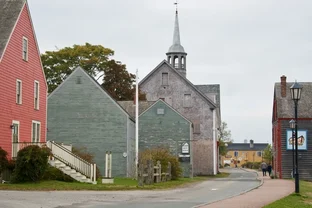
An association of three local museums, located within steps of each other, the complex is animated by costumed interpreters who give tours and lead activities (like hand-dipping candles). The most engaging is the Dory Shop Museum right on the waterfront. On the first floor are examples of the simple, elegant Shelburne dory, a small, lightweight flat-bottomed boat used for offshore fishing, and videos about the late Sidney Mahaney, the master builder who built 10,000 dories from the time he was 17 until he was 95. Upstairs, where all the banging is going on, visitors see workers constructing dories. You’ll learn about the rivalry between the Shelburne and the Lunenburg shops, which drove innovations in the construction of the boats such as the streamlining of the framing process.
The Shelburne County Museum features a potpourri of locally significant artifacts from the town’s Loyalist past. Most intriguing is the 1740 fire pumper equipped with wooden wheels and leather buckets; it was made in London and imported here in 1783. Behind the museum is the austerely handsome Ross-Thomson House built in 1784 through 1785. The first floor contains a general store as it might have looked in 1784, with bolts of cloth and cast-iron teakettles. Upstairs is a militia room with displays of antique and reproduction weaponry.
You could easily spend a half-day here, particularly if you’re travelling with kids, who will be captivated by the craftspeople and the hands-on activities offered—such as dressing like a Loyalist or churning butter.
An association of three local museums, located within steps of each other, the complex is animated by costumed interpreters who give tours and lead activities (like hand-dipping candles). The most engaging is the Dory Shop Museum right on the waterfront. On the first floor are examples of the simple, elegant Shelburne dory, a small, lightweight flat-bottomed boat used for offshore fishing, and videos about the late Sidney Mahaney, the master builder who built 10,000 dories from the time he was 17 until he was 95. Upstairs, where all the banging is going on, visitors see workers constructing dories. You’ll learn about the rivalry between the Shelburne and the Lunenburg shops, which drove innovations in the construction of the boats such as the streamlining of the framing process.
The Shelburne County Museum features a potpourri of locally significant artifacts from the town’s Loyalist past. Most intriguing is the 1740 fire pumper equipped with wooden wheels and leather buckets; it was made in London and imported here in 1783. Behind the museum is the austerely handsome Ross-Thomson House built in 1784 through 1785. The first floor contains a general store as it might have looked in 1784, with bolts of cloth and cast-iron teakettles. Upstairs is a militia room with displays of antique and reproduction weaponry.
You could easily spend a half-day here, particularly if you’re travelling with kids, who will be captivated by the craftspeople and the hands-on activities offered—such as dressing like a Loyalist or churning butter.
Details
Bookstore

Available as paperback
and as e-book.