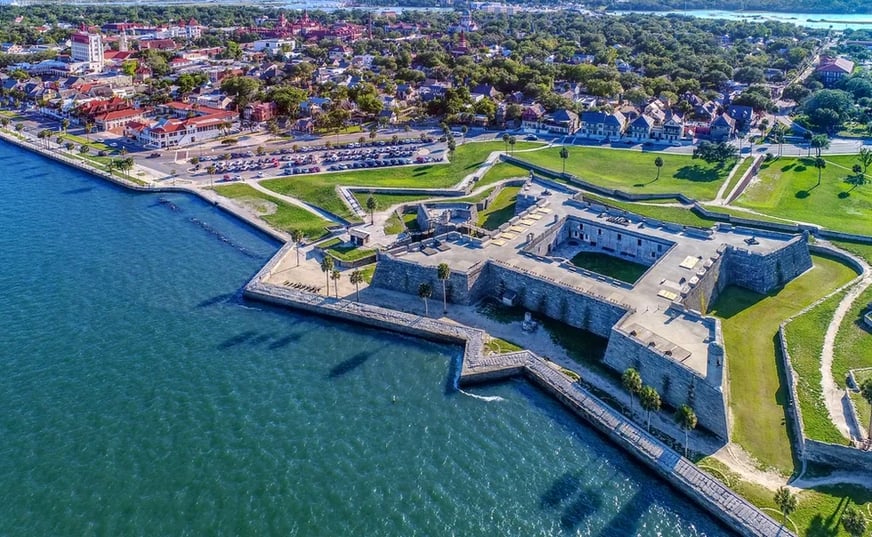
Castillo de San Marcos

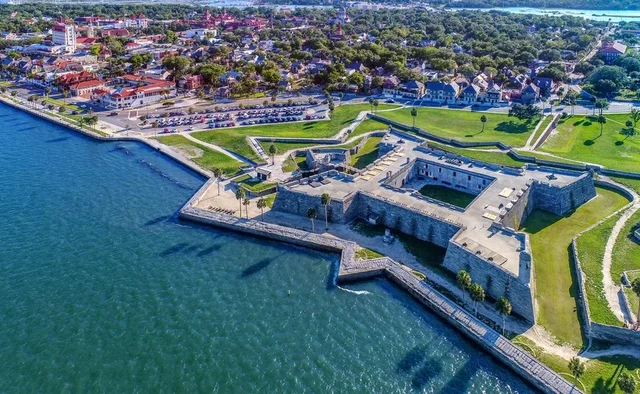
Should you ever wish to build an authentic fort, take notes at Castillo de San Marcos, America's oldest and best-preserved masonry fortification. The structure represents the quintessence of the "bastion system" of fortification. It took 23 years (1672–95) to build, and its design includes a double drawbridge entrance (the only way in or out) over a 40-foot dry moat. Diamond-shaped bastions in each corner, which enabled cannons to set up a deadly crossfire, contained sentry towers. The Castillo was never captured in battle, and its coquina (limestone made from broken seashells and corals) walls did not crumble when pounded by enemy artillery or violent storms over more than 300 years. Today the old bombproof storerooms surrounding the central plaza have exhibits about the history of the fort, a national monument since 1924. You can tour the vaulted powder magazine, a dank prison cell (supposedly haunted), the chapel, and guard rooms. Climb the stairs to get a great view of Matanzas Bay. A self-guided tour map and brochure are provided at the ticket booth. If available, the 20- to 30-minute ranger talks are well worth attending. They also do weapons demos. Popular torchlight tours of the fort are offered in winter.
If you like forts, you should also check out Fort Matanzas, built on an island in the 1740s to warn St. Augustine of enemy attacks from the south (which were out of reach of Castillo de San Marcos). For information, visit nps.gov/foma. Ferrys depart for Fort Matanzas Wednesdays through Monday from 9:30am to 3:30pm, and admission and the ferry ride to the island are free, but boarding passes are required and available at the Fort Matanzas Visitor Center, 8635 A1A South.
Should you ever wish to build an authentic fort, take notes at Castillo de San Marcos, America's oldest and best-preserved masonry fortification. The structure represents the quintessence of the "bastion system" of fortification. It took 23 years (1672–95) to build, and its design includes a double drawbridge entrance (the only way in or out) over a 40-foot dry moat. Diamond-shaped bastions in each corner, which enabled cannons to set up a deadly crossfire, contained sentry towers. The Castillo was never captured in battle, and its coquina (limestone made from broken seashells and corals) walls did not crumble when pounded by enemy artillery or violent storms over more than 300 years. Today the old bombproof storerooms surrounding the central plaza have exhibits about the history of the fort, a national monument since 1924. You can tour the vaulted powder magazine, a dank prison cell (supposedly haunted), the chapel, and guard rooms. Climb the stairs to get a great view of Matanzas Bay. A self-guided tour map and brochure are provided at the ticket booth. If available, the 20- to 30-minute ranger talks are well worth attending. They also do weapons demos. Popular torchlight tours of the fort are offered in winter.
If you like forts, you should also check out Fort Matanzas, built on an island in the 1740s to warn St. Augustine of enemy attacks from the south (which were out of reach of Castillo de San Marcos). For information, visit nps.gov/foma. Ferrys depart for Fort Matanzas Wednesdays through Monday from 9:30am to 3:30pm, and admission and the ferry ride to the island are free, but boarding passes are required and available at the Fort Matanzas Visitor Center, 8635 A1A South.
Details
Bookstore

Available as paperback
and as e-book.