Side Trips from Toledo: In Search of Don Quijote

“In a certain village in La Mancha, which I do not wish to name, there lived not long ago a gentleman . . .” is how Cervantes’ masterpiece begins. Miguel de Cervantes was born in 1547 in Alcalá de Henares, and by the time he got around to writing Don Quijote he’d already had an eventful life as a soldier, captive, failed accountant, and convict. His two-part epic, regarded as one of the greatest works of fiction ever written, recounts the adventures of the self-styled knight errant and his squire Sancho Panza as they travel the countryside of La Mancha in search of chivalrous deeds. Along the way, the deluded Don Quijote mistakes windmills for giants, an inn for a castle, and a garlic-munching farm girl for his fair lady. The story paints a wonderful picture of life and landscape in Golden Age Spain, and a day’s road trip across La Mancha’s empty plains lets you relive it. Be prepared for a lot of so-so metal sculptures of the knight of the sad countenance along the way.
Consuegra, 45 minutes by car southeast of Toledo, is a good place to start, with 12 photogenic windmills and a 10th-century castle above the unremarkable agricultural town (all pictured at the top of the page). One is set up as a working museum where you can see how wheat was milled; another has been converted into a tiny restaurant. The first windmill you meet, Molino Bolero, Calle Cerro Caldérico, s/n (tel. 92-547-57-31), houses the tourist office, whose staff can advise on tours and activities.
Head 20 minutes south to reach the charming village of Puerto Lápice, where Cervantes depicted Don Quijote and Sancho staying at its inn. Our hero, mistaking the inn for a castle, persuades its embarrassed landlord to knight him. The inn, Venta del Quijote, El Molino, 2 (tel. 62-088-77-14), still stands. It’s a touristy spot with a restaurant, a small museum, and the obligatory souvenir shop.
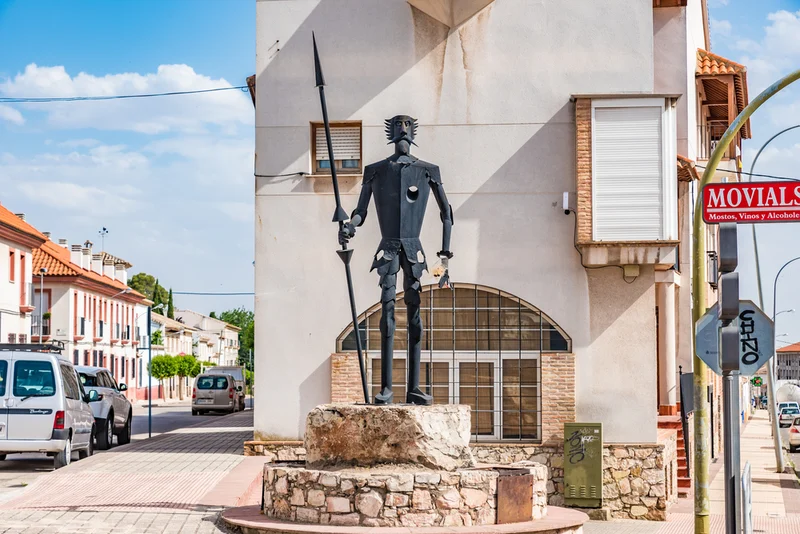
Campo de Criptana (photo by Takashi Images / Shutterstock)
Another half-hour across flat wine country brings you to Campo de Criptana, which claims to have inspired Don Quijote’s most famous episode—the tilting at windmills which he mistook for giants. In Cervantes’ day there were probably as many as 30 windmills standing above the town; today 10 remain, three of which date from the 16th century. The tourist office at Calle Barbero, 1 (tel. 92-656-22-31) can advise on exhibitions housed within.
Restaurante El Ricote, Calle Rocinante, 15 (tel. 62-397-35-28) is a friendly spot for a good-value tapas lunch, with wonderful terrace views of the windmills.
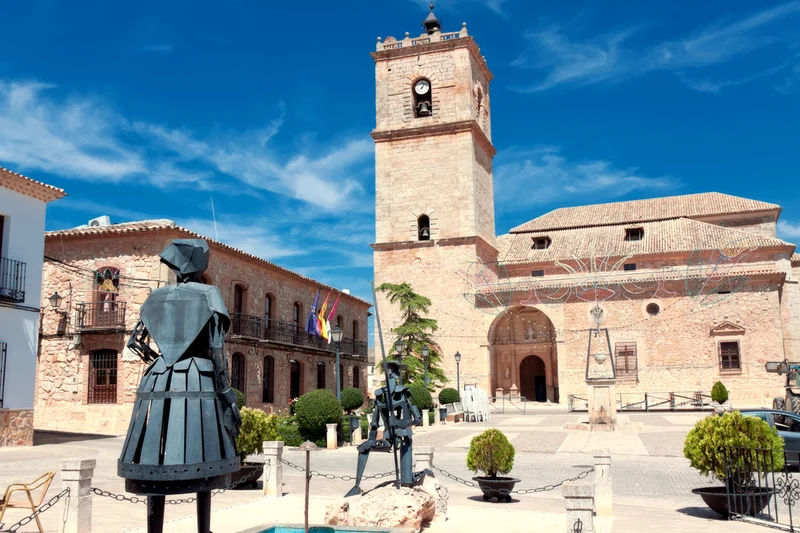
El Toboso (photo by Mikhail Mandrygin / Shutterstock)
The prize for the most imaginative exploitation of the Don Quijote story goes to El Toboso, hometown of the knight’s unrequited love, Dulcinea. The Museo-Casa de Dulcinea del Toboso, Calle Don Quijote, 1 (tel. 92-519-72-88) is not where any Dulcinea ever lived—being a fictional character—but it may have been the house of Ana Martínez Zarco de Morales, upon whom Cervantes based the knight’s imagined lady. The restored homestead paints an evocative picture of life in Cervantes’ time.
Next to the tourist office, the Museo Cervantino, Plaza Juan Carlos I (tel. 92-519-70-77), was born of another bright idea. In the 1920s, the mayor of El Toboso asked world leaders to send the museum a signed copy of Spain’s most famous book in their own language. Today, the museum has around 200 editions signed by leaders ranging from Ronald Reagan to Margaret Thatcher and Nelson Mandela. Two volumes don’t contain Don Quijote: Adolf Hitler and Libya’s Colonel Gaddafi somehow misunderstood and sent signed copies of their own books.