

Riccardo De Luca
By Sylvia Hogg & Stephen Brewer
Frommer's Italy Day by Day features regional and city itineraries that will help you maximize your time while touring the country's top sights. Buy it in a bookstore, or pick up the app at Inkling.com. Here we look at how piazzas in six different cities embody the best of the distinctive Italian way of life.
Photo Caption: Piazza San Marco at night, Venice.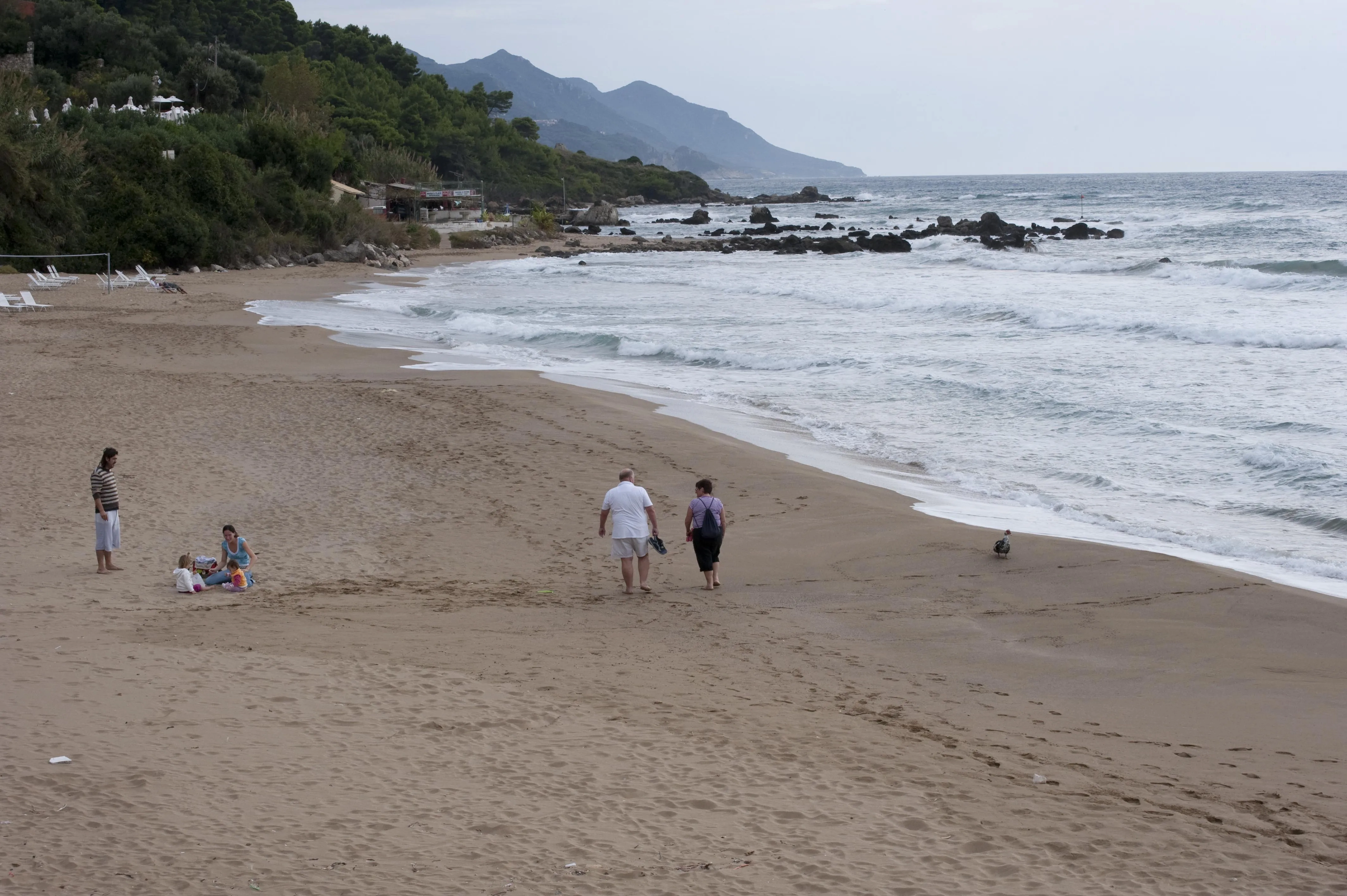 Pedestrians can't help but be drawn into this L-shaped square, dominated by the towered and crenellated Palazzo Vecchio. The Loggia dei Lanzi showcases much of Florence's best open-air sculpture, including Benvenuto Cellini's masterful Perseus, and a copy of Michelangelo's David. Although it's certainly a prime tourist destination, Piazza della Signoria remains a place where real Florentines also enjoy spending free time. You'll see them having coffee at Café Rivoire on Sundays, or on weekday mornings, sitting and reading the newspaper under a statue on the loggia, or just taking their dogs for "art-historical" walks across the grand expanse of flagstones.
Photo Caption: Florence's town hall, the Palazzo Vecchio, on the Piazza della Signoria. The most beautiful piazza in Italy is Siena's Piazzo del Campo. First laid out in the early 12th century on the site of a Roman forum, it is dramatically shaped like a sloping scallop shell or fan. By 1340, the town leaders had paved the square in brick and divided it into nine sections in honor of the Council of Nine, who ruled Siena during its golden age. Today the biggest festival in Italy, the Palio, takes place here. At the upper end of the square stands the Fonte Gaia (Fountain of Joy), created from 1408 to 1419 by Jacopo della Quercia; Siena's today is an inferior copy from 1868. The eroded remains of the original panels for the fountain can be seen on the loggia of the Palazzo Pubblico.
Photo Caption: Siena's medieval Piazza del Campo.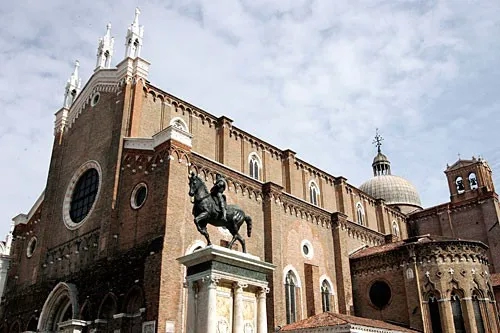 Bartolomeo Colleoni, a 15th-century mercenary, rides across one of Venice's most beautiful squares astride an equestrian monument by Verrocchio, and the Church of Santi Giovanni e Paolo is the final resting place of 25 doges, entombed in marble splendor.
Photo Caption: The basilica in Campo Santi Giovanni e Paolo is known as San Zanipòlo in Venetian dialect.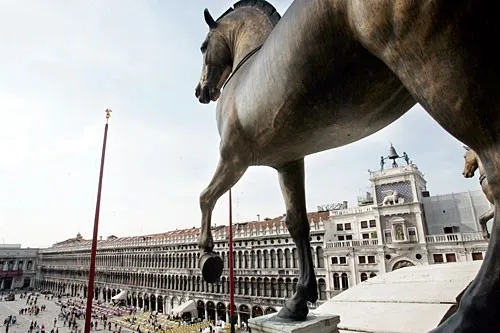 The Piazza San Marco contains many of Venice's major attractions: In the Museo Civico Correr, maps, coins, costumes, and, best of all, paintings by Jacopo Bellini (Room 36) and Vittore Carpaccio (Room 38) recall the days of the republic. In Carpaccio's Two Venetian Ladies, the bored subjects wait for their husbands to return from hunting. Among the other curiosities is a pair of sandals with 2-foot-tall heels upon which women of fashion once tottered.
Across the square, bronze Moors strike the bells of the Torre dell'Orologio to mark the time. During the feasts of the Ascension and Epiphany, statues of the Magi appear out of the clock on the hour, accompanied by a procession of angels. Nearby, the Basilica di San Marco, which inspired 19th-century man of letters John Ruskin to exhale into his journals, "The crests of the arches break into a marble foam, and toss themselves into the blue sky in flashes and wreaths of sculpted spray"; less poetical observers will be moved by its ornate Byzantine architecture and the bronze horses (pictured) overlooking the scene. The adjacent Palazzo Ducale, the palace where the doges lived and ruled, is majestic but has a touch of whimsy as well. The city's tallest structure, the Campanile of the Basilica, in the center of the piazza, affords stunning views.
Photo Caption: Replicas of the original bronze Horses of St. Mark overlook the Piazza San Marco while the original sculpture stand inside the Basilica protected from environmental damage.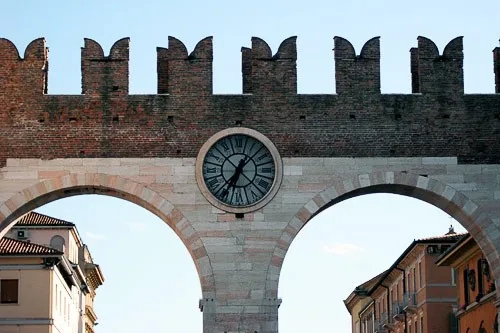 Verona's central square Piazza delle Erbe was initially the site of a Roman forum but is now surrounded by palazzi and the venue for a daily market. Many of the wares on offer are of the ho-hum T-shirt variety, but enough fresh produce from the Veneto is on sale to lend an air of authenticity to the marketplace. Standing amid the hubbub is a statue of Madonna Verona, presiding over these scenes of workaday life since 1368. The adjoining Piazza dei Signori is more somber and was for many centuries the scene of such civic affairs as assemblies of the medieval citizens' council that played a large part in the city government. In the middle of the square is a statue of Dante, who spent part of his years in exile from Florence in the beautiful 13th-century palazzo of the Scaligeri family, which faces the piazza. Walking between these two beautiful squares involves a risk, but only to the truly honest -- a whalebone suspended in the Arco della Costa (Arch of the Rib) will fall on the first person to walk beneath it who has never told a lie.
Photo Caption: Piazza delle Erbe in Vernoa, Italy. Photo by cdavis/Frommers.com Community.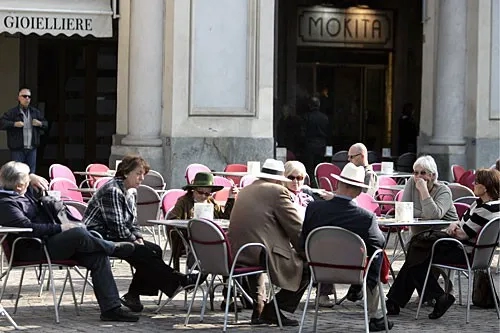 This elegant square is a pleasant introduction to many facets of Turin: to the Savoys, whose 16th-century duke Emanuele Filiberto rides a bronze horse across the center, to the city's many chocolate shops and cafes, whose terraces provide an outdoor living room for the Torinese, and to such urbane innovations as the Galleria San Federico, a glass-vaulted shopping arcade from 1858.
Photo Caption: Piazza San Carlo is home to Turin's grandest street cafes, including Caffè San Carlo.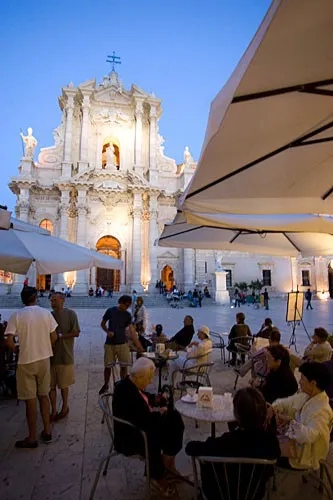
Frommer's Italy Day by Day features regional and city itineraries that will help you maximize your time while touring the country's top sights. Buy it in a bookstore, or pick up the app at Inkling.com. Here we look at how piazzas in six different cities embody the best of the distinctive Italian way of life.
Photo Caption: Piazza San Marco at night, Venice.
Photo Caption: Florence's town hall, the Palazzo Vecchio, on the Piazza della Signoria.
Photo Caption: Siena's medieval Piazza del Campo.
Photo Caption: The basilica in Campo Santi Giovanni e Paolo is known as San Zanipòlo in Venetian dialect.
Across the square, bronze Moors strike the bells of the Torre dell'Orologio to mark the time. During the feasts of the Ascension and Epiphany, statues of the Magi appear out of the clock on the hour, accompanied by a procession of angels. Nearby, the Basilica di San Marco, which inspired 19th-century man of letters John Ruskin to exhale into his journals, "The crests of the arches break into a marble foam, and toss themselves into the blue sky in flashes and wreaths of sculpted spray"; less poetical observers will be moved by its ornate Byzantine architecture and the bronze horses (pictured) overlooking the scene. The adjacent Palazzo Ducale, the palace where the doges lived and ruled, is majestic but has a touch of whimsy as well. The city's tallest structure, the Campanile of the Basilica, in the center of the piazza, affords stunning views.
Photo Caption: Replicas of the original bronze Horses of St. Mark overlook the Piazza San Marco while the original sculpture stand inside the Basilica protected from environmental damage.
Photo Caption: Piazza delle Erbe in Vernoa, Italy. Photo by cdavis/Frommers.com Community.
Photo Caption: Piazza San Carlo is home to Turin's grandest street cafes, including Caffè San Carlo.