

Jessica Langan-Peck
By early spring, winter-weary travelers looking for fresh air, open space, hiking trails, and almost zero percent humidity should consider a trip to Death Valley National Park. Situated on the edge of the Mojave Desert northeast of Los Angeles and just west of Las Vegas, Death Valley is at the base of three mountain ranges: the Panamint Mountains, the Amargosa Mountains, and the aptly named Funeral Mountains. Its 3.3 million acres are some of the hottest and driest on earth, and these extreme conditions make for geological oddities, strange landscapes, and rare fauna.
During the spring months of March and April, blue skies and sun during 85-degree days give way to breezy 70-degree nights, and wildflowers bloom yellow and pink.
On your next outdoor adventure, don't miss these top things to do and see in Death Valley National Park.
Photo Caption: Death Valley National Park, CA.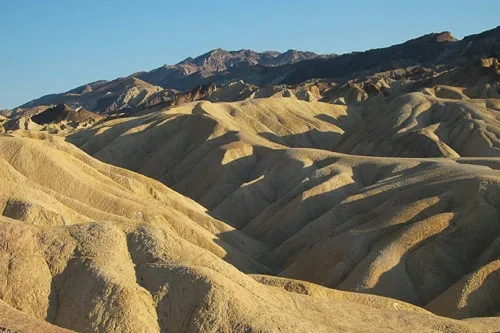 A lookout spot that offers a panoramic view of the valley, Zabriskie Point is particularly striking during sunrise and sunset, when the light makes the unique bedrock formations known as alluvial fans (aprons of sediment and debris that spread out on the valley floor in fan-shaped deposits) positively glow.
Photo Caption: Zabriskie Point, a lookout point in Death Valley National Park with incomparable views.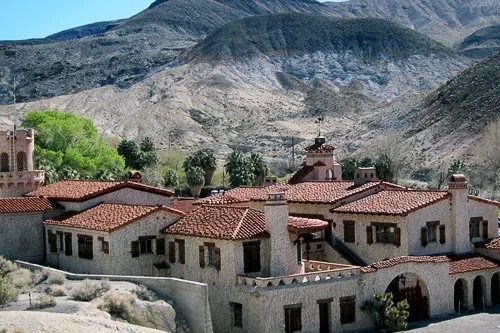 Scotty's Castle, a Spanish-colonial mansion plopped in the middle of the desert, is worth touring for its elegant, well-preserved interior, and for the foray you'll take into its odd history. Built by prominent businessman Albert Johnson in the 1920s, the "castle" served as a desert retreat for Johnson's family and for his eccentric friend Walter Scott, a creative con artist whose wit and vitality renewed Johnson's joie de vivre. The guides here, dressed in period garb, have a knack for bringing these flawed (human) players to life.
Note: Scotty's Castle isn't always open. Always check the official park website before planning a visit to it.
Photo Caption: Scotty's Castle in Death Valley National Park.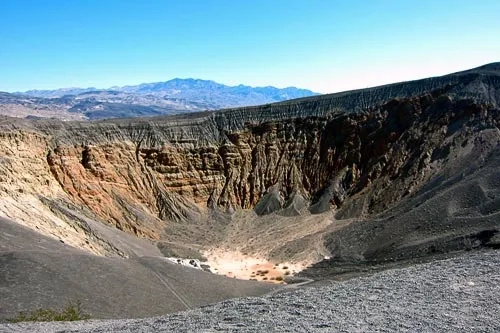 A short drive from the castle is the Ubehebe Crater, a geological formation caused by a steam explosion about 3,000 years ago. Stand at the edge of this 600-foot crater or hike around the rim -- just be sure you're wearing sturdy shoes with serious tread.
Photo Caption: The 3,000-year-old Ubehebe Crater is relatively young, geologically speaking.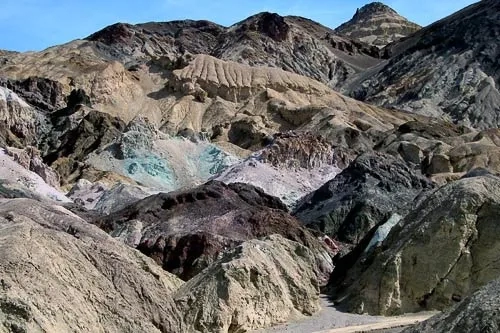 Artist's Drive climbs and dips through volcanic and sedimentary canyons with pastel mineral deposits that do indeed look painted on. Reds and pinks are evidence of iron oxide deposits, and the lovely pale green is the result of iron oxide mixing with decomposing mica. Leave the car at the pull-off and get a closer look at the chalky, crumbly colors -- though there are no designated trails here, you're permitted to hike off-trail anywhere in the park.
Photo Caption: Artist's Drive, where pastel-colored mineral deposits adorn the rocks along the one-way road.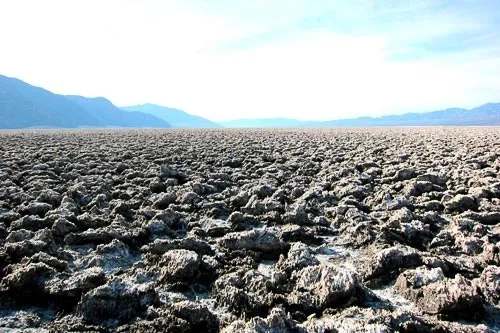 This vast area of crystallized salt formations is not a golf course at all, though legend has it that Devil's Golf Course was so named because "it's so rough that only the devil could play golf on it."
The otherworldly expanse, roughly 40 miles long and 12 miles wide, was likely underwater at some point in its geological history. The water evaporated long ago, but the salt remains -- in craggy, coral-like spires that should be walked upon gently. Pick your way out a few hundred feet from the pull-off, and you'll be struck by the area's eerie beauty.
Photo Caption: Devil's Golf Course in Death Valley National Park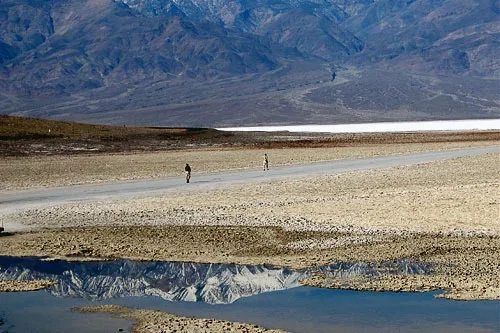 A few miles down the road, you'll come to the lowest point in the western hemisphere, at 282 feet below sea level -- an area known as Badwater. Here you can walk on a salt flat that stretches for miles in the shadow of the highest point in the park, Telescope Peak.
Photo Caption: A reflection of snow-capped peaks at Badwater, a salt flat almost 300 feet below sea level.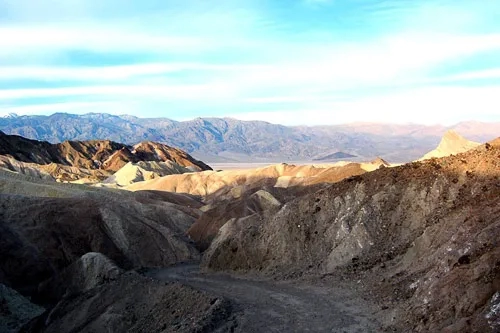 The moderate Golden Canyon hike travels through warm-hued badlands. On the two-mile round-trip hike, you'll see the effects of water erosion on a parched landscape. The soft rock has been carved away over many years, and it's still changing -- in fact, a section of this hike was a road at one time, until the pavement was swept away by a flash flood. The views are incredible, particularly early in the morning. You can still see the ripple patterns in the sedimentary rock, formed by the lake that may have existed here several million years ago.
Photo Caption: Hiking in Golden Canyon, Death Valley National Park
During the spring months of March and April, blue skies and sun during 85-degree days give way to breezy 70-degree nights, and wildflowers bloom yellow and pink.
On your next outdoor adventure, don't miss these top things to do and see in Death Valley National Park.
Photo Caption: Death Valley National Park, CA.
Photo Caption: Zabriskie Point, a lookout point in Death Valley National Park with incomparable views.
Note: Scotty's Castle isn't always open. Always check the official park website before planning a visit to it.
Photo Caption: Scotty's Castle in Death Valley National Park.
Photo Caption: The 3,000-year-old Ubehebe Crater is relatively young, geologically speaking.
Photo Caption: Artist's Drive, where pastel-colored mineral deposits adorn the rocks along the one-way road.
The otherworldly expanse, roughly 40 miles long and 12 miles wide, was likely underwater at some point in its geological history. The water evaporated long ago, but the salt remains -- in craggy, coral-like spires that should be walked upon gently. Pick your way out a few hundred feet from the pull-off, and you'll be struck by the area's eerie beauty.
Photo Caption: Devil's Golf Course in Death Valley National Park
Photo Caption: A reflection of snow-capped peaks at Badwater, a salt flat almost 300 feet below sea level.
Photo Caption: Hiking in Golden Canyon, Death Valley National Park