

Situated well above the Arctic Circle, Northeast Greenland is one of the most extreme and remote regions in the world.
The area’s superlatives give you an idea of just how vast, unpeopled, and naturally dramatic a destination this is. You can visit the world’s largest, northernmost national park, bordering some of the world’s most isolated human settlements in the world’s coldest, least densely populated country on the world’s largest island with the world’s biggest head-scratcher of a name—Greenland, even though nearly 80% of the place is covered in ice.
Setting out from Reykjavik, Iceland, aboard Quark Expeditions’ Ocean Explorer to make the 2-day journey across the North Atlantic and the Denmark Strait, you might feel like you’re leaving the known world behind to sail into the icy unknown.
Greenland has received an unusual amount of press in recent years, both for Donald Trump’s oft-repeated desire to acquire the island from Denmark, and for newly established ways for tourists to access Greenland, thanks to airport openings and flights from the United States.
The Seattle-based, polar-focused Quark Expeditions offers three cruises centered on Greenland: two in the west and one in the northeast. The latter itinerary, an 11-day trip showcasing fjords and glaciers along a rugged, sparsely populated coast bathed in endless daylight in the summer (the only time departures are available), is what we’ll be discussing here.
Even if you’ve taken other expedition cruises or gone on adventures to other polar regions (as I have), Greenland has surprises in store.
Here’s what the experience is like—and some things you should know when considering whether to book.
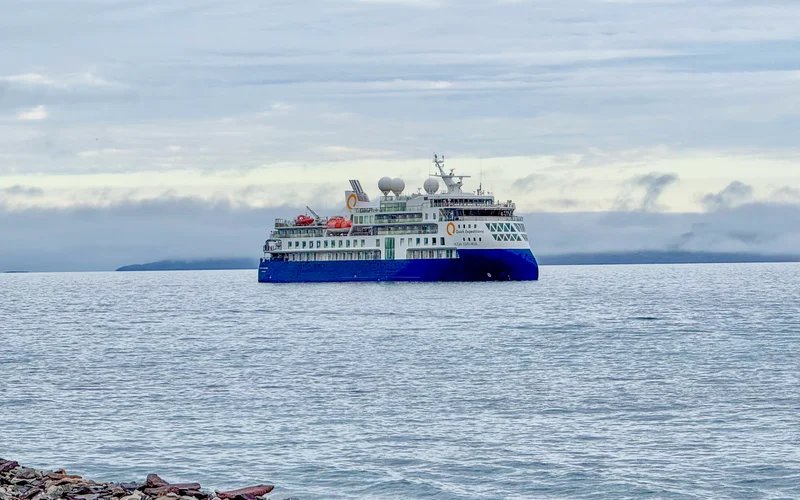
In this extreme climate, landings, activities, and wildlife sightings aren’t guaranteed.
The plan for the Quark trip encompassed several days of cruising, crossing the Arctic Circle and the Denmark Strait twice, and exploring Northeast Greenland for 5 days.
The advertised itinerary for the expedition lists landings, Zodiac cruises, kayaking trips, and other activities. But after boarding the 138-guest ship, we were reminded that whether those activities took place would depend on the unpredictable weather and sea. This is a common caveat on voyages to similar destinations, such as Antarctica, where conditions may simply be too unsafe for certain stops and excursions.
There was also mention of visiting Ittoqqortoormiit, a remote Inuit community of just 350 people at the entrance to the Scoresby Sund fjord. But there’s no guarantee the ship will make the call on Ittoqqortoormiit, as it also depends on the state of the weather and the ocean. In addition, the community reserves the right to decide whether a ship can visit on a particular day.
Sightings of wildlife and the northern lights likewise go on the trip’s wish list rather than its will-see list. For my part, I hoped to see several species of Arctic wildlife, including polar bears, musk oxen, arctic hares, seals, narwhals, walrus, whales, and birds typical of the region, such as the northern fulmar and rock ptarmigan. And, of course, many on board no-doubt dreamed of viewing the elusive aurora borealis, which is usually visible in far northern locales on cold, clear evenings between September and April.
Provided the captain can navigate the ship to the right places, there’s a string of exciting adventures passengers can take, from going ashore for hikes across the tundra to taking Zodiac rides around the fjords to get closer to icebergs. These designated locations include spots in the Kejser Franz Joseph Fjord, Kong Oscar Fjord, and Scoresby Sund, the largest fjord system in the world.
Thanks to cooperative weather, the cruise I took was able to have landings, Zodiac rides, and paddling or sea kayaking in nearly every destination planned by the expedition leader, with activities for every level of physical ability (including four types of hikes, from leisurely strolls to brisk treks).
But remember: None of that is guaranteed. Attach a mental weather-permitting asterisk to all of your plans for the trip.
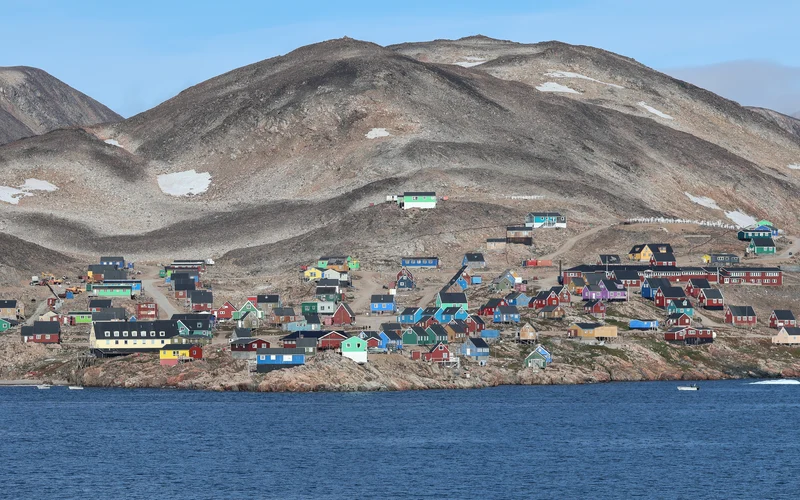
There are definite advantages to choosing a ship purpose-built for polar exploration.
Quark specializes in polar expeditions to the Arctic and Antarctica, so the Ocean Explorer is equipped with engineering innovations such as stabilizers for rough seas (which we'll get to next). The elegant, Scandinavian-inspired interior design features spacious staterooms with balconies, a lounge and bar area, a main dining room, a fitness center, two outdoor hot tubs, a ready (or mud) room where you gear up for excursions, an observation lounge, and expansive outdoor decks for viewing the mesmerizing scenery and wildlife.
A light-filled, two-story lounge, with a library upstairs, sits at the bow of the ship. This is where guests meet with the expedition team for daily updates, recaps, and lectures throughout the cruise. Our expedition team consisted of specialists in history, science, geology, ornithology, marine biology, local culture, photography, logistics, and adventure activities such as sea kayaking and paddling.
In the evenings following dinner, team members shared stories about their background or personal exploration experiences, such as tales of living amid penguins in Antarctica. One night, we joined the ship's historian in singing a rousing selection of sea shanties.
If you’re prone to motion sickness, beware.
In our initial briefing aboard the ship, we learned that conditions during the Denmark Strait crossing could be “lake or shake”—i.e., placid or turbulent. That’s not uncommon during polar cruises, but woe betide passengers stuck on a ship in the midst of a shake.
During the Greenland cruise, the doctor on board was even offering medicine for guests prone to motion sickness. Thankfully, in the end, things weren’t as rough as they could have been (in either direction). But it’s wise to be prepared if you know you tend to get seasick.
If you're especially susceptible, consider talking to your doctor about prescribing scopolamine, which comes in a patch worn behind the ear. As an alternative to medication, you can try wearing wristbands that apply pressure to acupressure points to alleviate nausea.
The scenery is impressive—though muted and eerily silent.
The Arctic summer was coming to a close during our voyage, as we headed into early September. The scenery, with endless views of mountains—some still capped in snow from the previous winter—as well as the tundra and fjords, would change in appearance as we sailed north from Kap Humboldt in the Kejser Franz Joseph Fjord (our first landing spot on Day 3), to further north on the following days. Surprisingly, it wasn’t until we headed south that we started to see more icebergs as we moved into Scoresby Sund.
There was very little color across the muted landscape, save for an occasional wildflower, dwarf birch, or fern—but the view was strikingly beautiful nonetheless. Clouds would occasionally hover over a mountain, then gradually retreat, exposing clear blue skies. Sometimes eerily blue glaciers would appear after low-lying mist dissipated across the water.
The stillness and quiet of the place were particularly pronounced during a paddling excursion in Bjørne Øer, or the Bear Islands. As your group paddles around the islands, you get close to spectacular icebergs in what feels like a scene made entirely of glass. The illusion is shattered only by a bird and its loud call that reverberates throughout the rocky islands and could probably be heard for miles—if there was anybody around to hear it, that is.
It was Greenland’s silence amid the otherworldly beauty that stuck with me most.
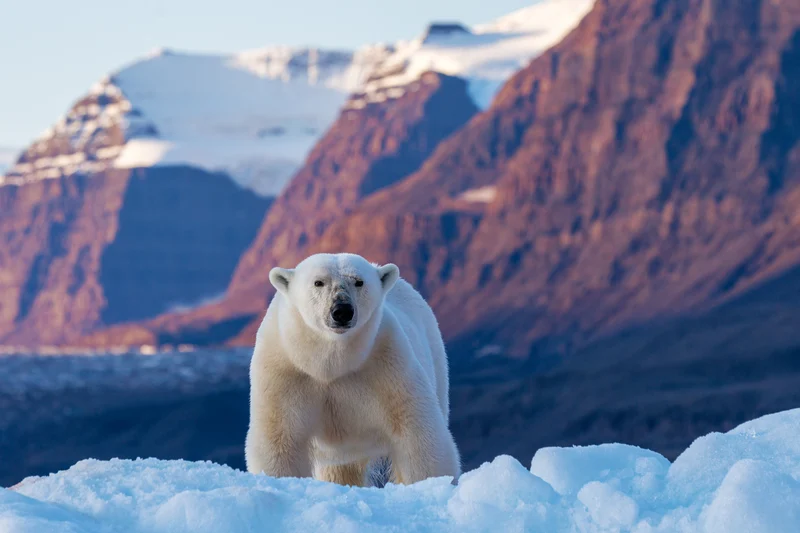
You might not see as much wildlife as you’d like.
We were sailing through Northeast Greenland National Park, known for having 40% of the world’s musk oxen, several species of whales, arctic hare, reindeer, arctic foxes, giant walruses, and the one animal everyone hopes to see in this area—the polar bear. Given this ballyhooed abundance, I thought we’d see more wildlife during our extended time in this remote region than we did.
Over the course of the 11-day expedition, some passengers spotted whales as the ship departed Iceland. Many of us saw several musk oxen far off in the distance at Kap Øetker. And there were arctic hares in a few locations as well as seals and several species of birds. Tracks of polar bears and musk oxen were pointed out by guides.
So we weren’t completely deprived of wildlife. But it wasn’t exactly the live-action Ice Age movie some might have hoped for, either.
Where were all the animals?
We were visiting the region in late summer, so it’s possible some species of birds had already migrated south. And the melting of the ice cap and the change in the global environment could be causing a shift in the movement of the region’s wildlife as animals search for food.
Lectures on the ship and chats with expedition guides revealed another reason cruisegoers might have limited wildlife viewings: the presence of the passengers themselves. When animals hear boats and human voices, in other words, they disappear to avoid what they sense as a possibility for danger.
In less isolated national parks and nature preserves where wildlife viewing is more common, animals become to some degree accustomed to people because they don’t consider us a threat, so the creatures don’t always go into hiding when they hear us coming.
You don’t want to leave your binoculars at home.
There was one final surprise near the end of the trip.
We were all eager for just one more chance to head off the ship for a Zodiac ride on the last day, but none of us ever anticipated how it would end.
As we were making our way through the ice-choked waterways in Scoresby Sund, a call came across the two-way radio that there had been a polar bear sighting from the ship. The animal was seen over by the glacier, a more than 30-minute ride by Zodiac at nearly full speed.
After advancing, then stopping several times while awaiting confirmation, we finally received word that a polar bear was indeed along the shoreline. With that, all the Zodiacs charged forward to the glacier. The excitement was palpable as we got closer and closer to the location where we could hope to get a glimpse of the bear—if it was still there when we arrived.
Because of strict regulations for expedition ships visiting the Arctic regions, we stayed far from shore, making it almost impossible to see the polar bear, which appeared as a mere white dot to the naked eye, and wasn’t much bigger even through the telephoto lens on my camera. After the bear disappeared into the water (someone said it might have been escaping from the commotion of the Zodiacs), another passenger spotted a mother polar bear and two cubs on the rocky hill. Sure enough, there they were—though still somewhat difficult to see in the distance.
Then that bear in the water came back on shore, walked left, and continued up the steep hill, where it joined two more polar bears.
Six polar bears in one sighting.
Sure, they were far away and nearly unrecognizable without a telephoto lens or binoculars. But there they were. It gave me hope before leaving this beautiful and wild land, enveloped in an indescribable silence.
To learn more about the 11-day Northeast Greenland cruise from Quark Expeditions (starting at $12,479), go to QuarkExpeditions.com.