

What follows is a transcript from the April 26, 2025, episode of the Frommer's Travel Show podcast. The interview has been edited for length and clarity. To listen to the episode, click here.
Warning: This interview contains material some readers might find disturbing.
Pauline Frommer: Ever since Truman Capote's In Cold Blood, true crime has been a major [genre for] film, in podcasts, in books, and now perhaps in travel. My guest, Dawn Barclay, has written a really great guidebook—or [maybe] almanac—about the topic of true crime travel. It's called Vacations Can Be Murder: A True Crime Lover's Travel Guide to New England. How did you get the idea to write this book?
Barclay: I was in Minneapolis for the World Mystery Convention [Bouchercon] because I write fiction—I write psychological thrillers and domestic suspense. [While there] I took a true crime tour of Minneapolis and St. Paul, which I thought was really interesting.
I wondered to myself if anybody had written a book that listed all the true crime tours around the country. And that was the seed of the idea of [the book]. ... [It] gave me a chance to feed into people's passions because I love subcultures.
Frommer: Why do you think true crime has become so popular?
Barclay: I think a couple of reasons. One is that people seem to love sensationalism and just how horrible can it get. [That’s why] horror movies are as popular as they are.
But also, I think that there is a feeling of . . . I don't know, there's a catharsis. There's a great feeling when the evildoers get their due and they get incarcerated.
A lot of women watch true crime and read true crime and it might be to learn what to watch out for—so they're a bit more cautious out there.
I give synopses of the major crimes in each state [in the book]. So it's more of a primer for people who are new to true crime, but also a refresher for people who know a lot about it. And I include a list of books to read to learn more.
Frommer: And also to anybody who's saying that you're just on the sensationalism track, you also give victim services [resources] in the book.
Barclay: Yes, yes. Purposely. Because I thought that was a really important thing to add.
But the key to the real heart of the book are the locations of each crime. I put those in the itineraries in the back.
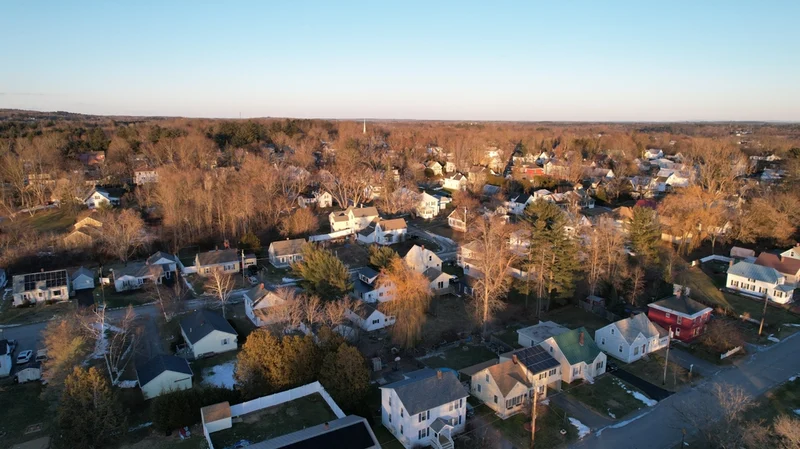
Frommer: Let's give some of the stories that you recount in the book. You write about a woman named Constance Margaret Fisher who lived in Waterville, Maine. What was her story?
Barclay: Constance Fisher, who initially lived in Waterville, Maine, was later diagnosed as a paranoid schizophrenic. But I think a lot of what she suffered from was postpartum depression. In 1954, she had three children. She had a boy that was almost seven. She had another boy that was five and a daughter who was one. And she drowned them all in the family bathtub. And then she tried to kill herself by swallowing a bottle of shampoo.
She left a note saying that she wanted to protect them from evil. [The authorities] committed her to the state hospital.
Five years later, they decided she was okay. They let her out. The couple moved to Fairfield and had three more children.
Frommer: And this is the same couple. So her husband took her back?
Barclay: Her husband took her back. They had three more kids. A daughter that was six, a son that was four, and another daughter who was nine months. And she drowned them again.
This time she took pills to [try to overdose]. Afterwards they rushed her to Thayer Hospital and saved her.
At that point they got the idea that maybe they don't want to let her out again. So they admitted her for the rest of her life back to the psychiatric hospital. She stayed there to 1973, until she escaped and drowned herself in the Kennebec River.
Frommer: Wow. You also tell the story of Pamela Ann Smart. Her tale was so sensational it was made into a film, right?
Barclay: Yeah. To Die For with Nicole Kidman. Great film.
[Smart] was a media coordinator at a high school in Hampton, New Hampshire, and she seduced a 15-year-old student named Billy Flynn because ... she wanted him to help her kill her husband. She either wanted to end the marriage just because she didn't want to have a messy divorce, or she wanted the $140,000 life insurance policy. So [Flynn] recruited three friends to help him kill Gregory [the husband].
They tried to make it look like a burglary gone wrong. Later, she admitted to the affair, but said she had no knowledge of the murder plans.
Meanwhile, one of the students in the school secretly taped her and had evidence to prove [she was behind the killing]. She ended up being convicted. She's serving a life sentence in Bedford Hills, New York, which is not so far from where I live.
And the four accomplices have either been paroled or released by now.
Frommer: [Let’s] tell one more story just so we understand the scope of what true crime can be. This is the story of Jeffrey S. Mailhot.
Barclay: Yeah, he's a charmer. He was somebody that nobody would have ever suspected of doing anything. He hadn't even gotten a traffic ticket in his life.
So it was shocking when it turned out that he was the Rhode Island Ripper. In 2003 and 2004, [he picked] up prostitutes and he strangled and dismembered them. He used a bow saw in his bathroom in, I guess, the bathtub, which is a technique he learned from watching The Sopranos.
Frommer: I thought that was stunning.
Barclay: Then he left the bodies in various dumpsters in communities. I give the addresses of those dumpsters if you want to, you know, go and see them.
One woman ended up escaping, and her description of him led to his arrest.
They were able to only find one woman's remains in a landfill in Johnston.
He was arrested in 2004 and sentenced to three life terms. He's at the Rhode Island Maximum Security Prison in Cranston. He will be eligible for parole in 2047 at the age of 77.
Frommer: It's fascinating to me that you are telling where these people are now, what prisons they're in.
In fact, in the book, you're talking about a place not far from where I am right now, the Danbury Federal Correctional Institution. [And you include info on] past and present [inmates]. The inmates included hotelier Leona Helmsley—remember she left all her money to her dogs.
Barclay: I got married at her hotel, so I know her well.
Frommer: She was in prison for tax evasion. The Reverend Sun Myung Moon of the Unification Church was also in there for tax evasion. Singer/actress Lauryn Hill—I never knew she went to jail. She went to [the Danbury prison] for income tax reasons. Piper Kerman, who was the author of Orange Is the New Black [was also there], so this must be the prison that they based that series on. Reality star Teresa Giudice [served there] for bankruptcy and tax fraud, fertilizer manufacturer Alexander Salvagno for environmental crime, and Mafia boss Michael Mancuso, who orchestrated a murder.
So this is all fascinating, but can people visit these prisons? I mean, how does a tourist build an experience around these prisons?
Barclay: In the itineraries, I include [addresses so] you can drive by them, because you can't actually visit these prisons.
There are prisons around the country that you can visit. [In my] book that's coming out in August, which is [about true crime in] New York, New Jersey, and Pennsylvania, there are certain prisons where they have programs that allow visitors to eat at the prisons. They have culinary programs where they're training low-security individuals that are very close to getting out. ... You can interact in that way and you can feel like you're actually helping with somebody's rehabilitation. The food is very inexpensive for that reason.
There's also some [prisons] that have gift stores where the inmates have made crafts and you can purchase them.
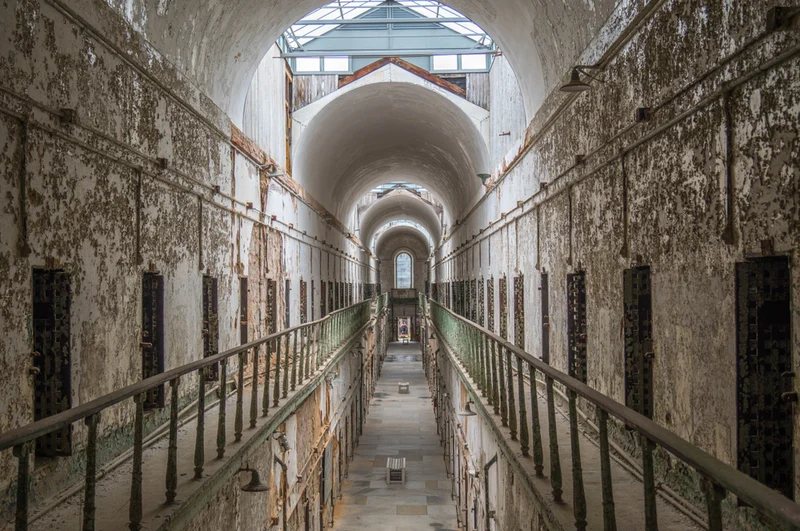
And then there are also several penitentiaries around the country that are now museums. I went to one when I was in Philadelphia—the Eastern State Penitentiary. It was fascinating, a really interesting tour.
[Other prison museums include] Alcatraz [and] the Missouri State Penitentiary. There's one in Tennessee called Brushy Mountain State Penitentiary and also one in Michigan called Jackson Historic Prison.
Frommer: You also have a whole section on both hotels and restaurants that have either a true crime [connection] or are haunted.
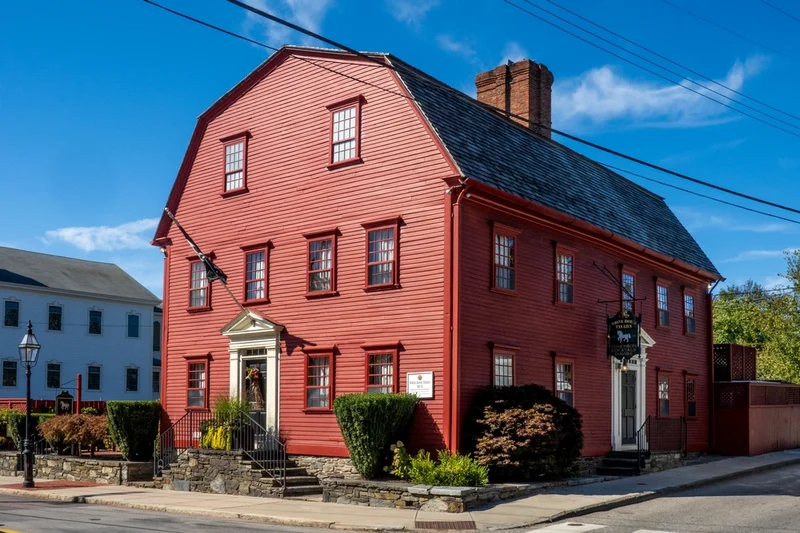
So let's talk about a couple of those places because they're really fascinating. In Newport, Rhode Island, which you say may be one of the most haunted places in the country, is the White Horse Tavern.
Barclay: This is America's oldest haunted bar. It was built in 1652, and has served adult beverages since 1672.
A man that died of smallpox stayed there, and now he supposedly haunts the bar and also the restaurant, as well as the room near where he died.
They say that he will pester female diners while they eat, and he'll appear behind them in the dining room mirror, prompting them to make a quick departure.
But even more interesting is this woman named Rebecca Cornell. She died in a fire in the building, and she came back as a vision to her brother 3 days later to tell him she was murdered. The brother went to the police, and the police examined the body again and found a very odd wound in her stomach and ended up arresting her son for murder. She supposedly haunts the place, too.
Frommer: So not just a haunting, there’s a true crime twist here.
Barclay: Yep.
Frommer: It's not just you who's creating touristic ways to enjoy true crime. There are now dedicated true crime tours and also haunted tours across the United States. You talk about one in Burlington, Vermont, Queen City Ghostwalk tours. Why did you decide to feature this one?
Barclay: Thea Lewis is a pretty well-known historian. She founded the tour company and she was running the tours until this year. Holli Bushnell took over. [Thea] wrote a book called True Crime Stories of Burlington, Vermont, which is a fascinating book.
They have a lot of places that are very interesting in that tour, including a spot where a woman named Marilyn Dietl shot her daughter outside a synagogue because she wanted to save her from a life of prostitution after the woman was dating a suspected pimp.
Frommer: Well, yours was a fascinating book, too. Thank you so much for appearing on the show.