

On Thursday, August 28, at 9:48 a.m. in New York City, the first passenger-carrying NextGen Acela pulled into Moynihan Station.
It was an event nearly a decade in the making. President Barack Obama green-lit the project in 2016, and the Department of Transportation gave Amtrak a $2.4 billion loan against the costs.
The new trains were supposed to go into service in 2021, but pandemic supply chain issues caused major delays in manufacturing and testing.
Acela's NextGen trains won’t initially shave time from the journeys along the Washington, D.C.–New York City–Boston corridor. Amtrak still runs on very old rails, which limits speeds (more on that below). But the new trains feature a number of improvements—most significantly their increased passenger capacity.
And with those additional seats could come, potentially, more price discounts because there will be more seats to fill.
“These trains will carry 27% more passengers,” Amtrak spokesperson Marc Magliari told me at the launch event. “That will definitely mean more price points, and some [prices] could be lower. Our prices are driven by demand, so it’s hard to say.”
In a press release, Department of Transportation Secretary Sean Duffy also alluded to lower fares: “With these new Acela trainsets, Amtrak will provide more reliable service and lower prices for the American people—all while increasing the organization’s profitability.”
Magliari did note that travelers can always save money on Amtrak by booking far in advance. “We’re selling tickets right now for next Memorial Day, and the earlier you buy, the less you pay, even for a holiday weekend. The same goes for Christmas and New Year’s travel, Valentine's Day, you name it.”
According to Magliari, Amtrak has a liberal policy for passengers who need to change reservations, “so there’s not a lot of risk in booking early".
Amtrak gives full refunds for cancellations made 24 hours in advance for reservations with reserved seats and 1 hour ahead for unreserved rides. See all its policies here.

What's new about Amtrak's new Acela NextGen trains?
The NextGen Acela trains are all-American, but with a French accent.
They were designed and assembled by French train manufacturer Alston SA in Hornell, New York.
An interesting side note for history buffs: The manufacturer recommissioned a plant that was once used to service the historic Erie Railroad.
Some 95% of the 180 components that go into each train were made in factories across the United States. Engines come from Michigan, air conditioning units from Nebraska, wheel carriages from Illinois, etc.
Amtrak estimates that building the new trains created 15,000 jobs in the United States.
Though I haven’t ridden in one of the new carriages yet, I was able to quickly duck aboard, and I attest that they still have that new train smell. They’re also quite sleek-looking, with a soothing grey and slate-blue décor and large windows, which are tinted to cut down on glare.
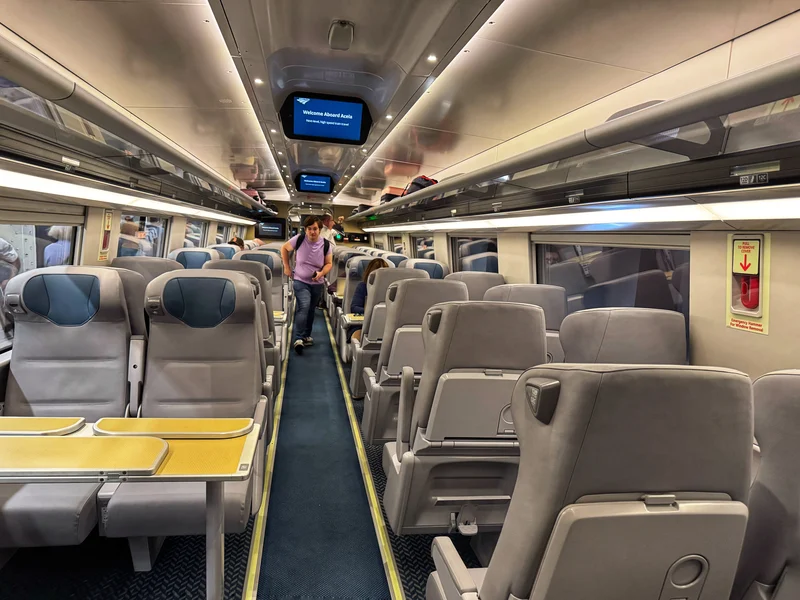
Here’s a few other ways they are different from the old Acela rolling stock:
Speed: The trains are engineered to hit 186 miles per hour, which is roughly 10 miles an hour slower than many European high speed trains. They won’t be gunned up to those rates anytime soon: America's antique rails prevent locomotives from exceeding 160 mph. Still, that's 10 mph faster than the old Acelas. As tracks are repaired and changed out, trains should be able to go faster.
The train has also been engineered to tilt a bit at high speeds, which will allow it to take curves better. Amtrak claims the ride is less bumpy, though I chatted with a journalist who took a preview ride, and he said that things still get pretty bumpy on sections with older rails.
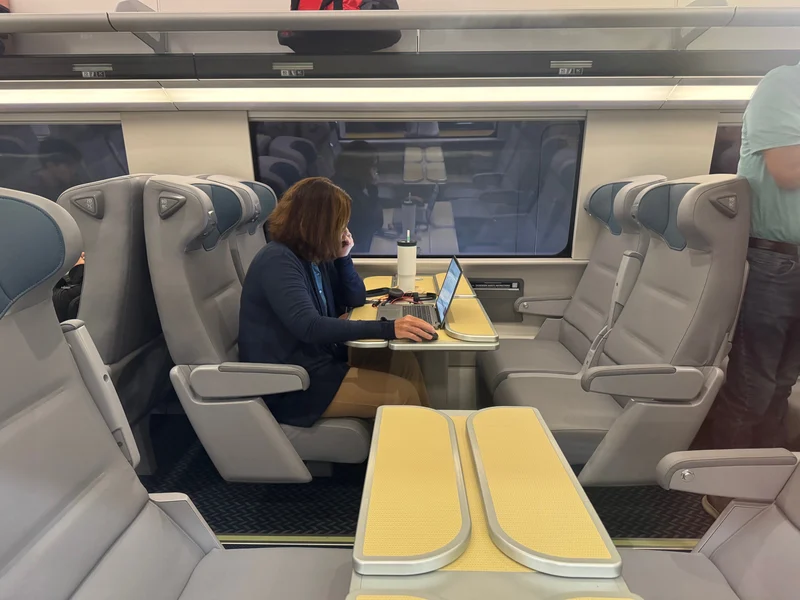
Connectivity: No more accidentally groping your neighbor as you reach over them to plug your laptop in to the wall outlets. Now there are outlets and USB ports embedded in every seat. Plus, the internet onboard should be lightning fast, thanks to 5G-enabled Wi-Fi. Each seat also has its own reading light.
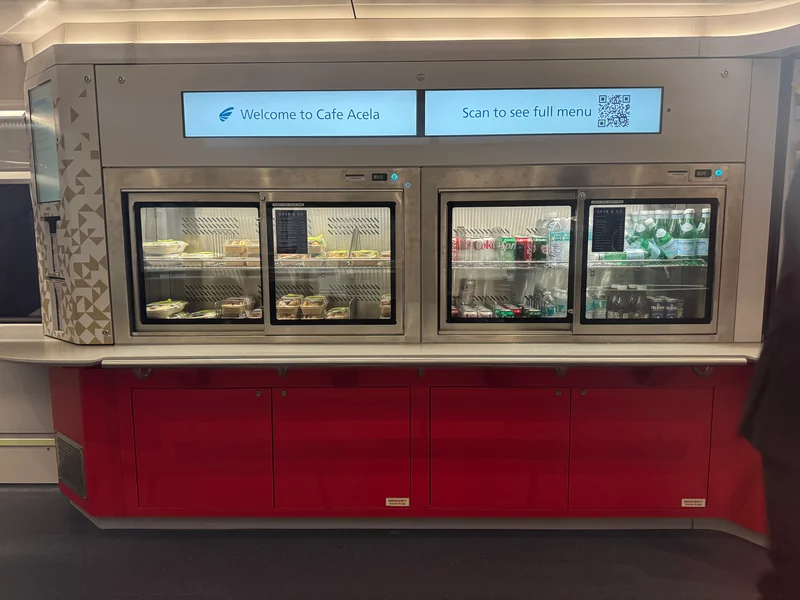
Food: The dining car has been overhauled on NextGen—with a change that may annoy some passengers. Dining cars are now configured for quick service. A lot of the food and drink available for purchase will be stored in refrigerated cabinets so customers can simply grab what they want and head to the counter to pay.
That’s the good news. Alas, all seating in the dining cars is now gone, so there’s nowhere to sit when you need a break from your assigned seat for a bit.
Accessibility: Doors and other features are now no-touch, which is just one of the ways in which these trains have been made more accessible for people with disabilities.
Comfort: For once, more passengers doesn’t translate to less leg- and elbow-room. Seats remain large, and they are ergonomically designed for extended sitting.
How to make sure your Acela trip is on a new train
Service launched on August 28. Because just 5 of the 28 new NextGen Acelas are passenger-ready, for now you’ll need to do a bit of planning to make sure your next trip is aboard one.
The outgoing version of Acela trains are still running, too, so to book one of the new carriages, look for the following numbers when you buy your ticket:
- Weekdays: Trains 2153, 2154, 2170, and 2173
- Saturdays: Trains 2250 and 2251
- Sundays: Trains 2248, 2258, 2259, and 2271
All 28 NextGen Acelas should be in service by 2027, with a bunch more launching this autumn.
In other Amtrak news, the Department of Transportation has announced that it will overhaul New York City's Pennsylvania Station.
But since the Acela arrives and departs from nearby Moynihan Station (located across Eighth Avenue), we don't expect the renovation work to affect NextGen performance.