
Nature-loving American travelers are understandably weary of hearing new alerts about threats to public lands being posed by the federal government—but many conservation groups are sounding that well-rung bell once again. This time the warnings are about a bill that passed the Senate on Nov. 19 and now proceeds to the House of Representatives for final approval.
The proposed legislation bears a generous-sounding name: the Bipartisan American Affordability and Jobs Act, or BAAJA (read the full text here).
The BAAJA bill contains a lot of provisions and amendments, so its effects would be complex. But as Time magazine sums it up, “How the law is interpreted could depend on who is in office, some say—and could shape America’s energy infrastructure for decades.”
Most of the urgency from citizens groups centers on the sections of the bill that aim to speed up the permitting process for energy projects and make those permits tougher to revoke once they’re issued.
According to Jake Johnson of Common Dreams, BAAJA ”would make federal approvals for fossil fuel projects, along with wind and solar, much harder for a future administration to undo.”
That's the part of BAAJA that some legislators view as an effort to thwart President Donald Trump’s ability to pull the plug unilaterally on previously approved sustainable energy projects like offshore wind generation networks. That's one reason why 15 Senate members who caucus with the Democrats joined Republicans to advance the bill to the House.
The prospect of quicker construction progress and the corresponding employment rush accounts for why solar energy industry groups, labor unions such as the AFL-CIO, and the American Petroleum Institute are all on board with the new bill.
But making big energy projects tougher to slow down is exactly the thing that's alarming groups who work to protect American public lands and the people who live near them.
The Yale Journal on Regulation suggests BAAJA would grant too much power to industry and strip the American people of their ability to weigh in on construction that would destroy nature. "The price of certainty for developers cannot be ambiguity for the agencies or the public," commentator Sara Gonzalez-Rothi argued in the journal. "Perhaps in the business of statutory drafting, if it is not transparent, it shouldn’t be acceptable.”
On Nov. 19, Sen. Ron Wyden of Oregon posted on social media that "Republicans are blocking a vote on my amendment [to BAAJA] to ban data centers on public lands."
Former U.S. Vice President Al Gore has said passing BAAJA would be a “serious mistake" and that it could make new data center construction nearly bulletproof from both scrutiny and neighbors' objections.
On the other side, Democratic Senator Sheldon Whitehouse, one of the bill’s authors, has said his team is working on “a variety of amendments to see what can be done to shore up potential holes in the bill," including any loopholes that would allow Trump to block clean energy initiatives.
“There was a huge surge of misinformation that came kind of immediately after the text was released,” Whitehouse told reporters.
To help travelers understand the nuances of the vocal opposition to BAAJA and how its passage could impact people who vacation on U.S. public lands, let’s look at what some major nonprofits are saying about the bill.
Here are a few direct quotes from influential watchdog groups that have released statements about BAAJA. Below each statement a link will take you to the organization's fuller explanation so that you can understand more and decide whether to contact your House representative about the matter.
National Parks Conservation Association
“The path to a clean energy future should not run through our national parks. The sponsors’ latest changes include welcome improvements, and we thank the senators who advocated for them. But those changes don’t go far enough. Despite the efforts of many organizations to improve it, this bill still limits the voice of the public, Tribes, and park experts in decisions affecting our most cherished places. In fact, its historic preservation provisions were written without consulting Tribal Nations. The bill also weakens safeguards against irresponsible development and creates uncertainty for our country’s most threatened and endangered species.”
Read more: Parks Group Urges Senate to Reject Permitting Bill, Calls for Better Plan in the Next Congress
Native American Rights Fund
“Despite claims that the revised legislation responds to Tribal concerns, the proposed changes to Section 106 of the National Historic Preservation Act in Title III of BAAJA continue to fundamentally undermine Tribal sovereignty, weaken longstanding federal protections, fail to ensure meaningful government-to-government Tribal consultation, and threaten sacred sites and cultural resources. ... Congress must not advance legislation that diminishes these protections or disregards the sovereign rights of Tribal Nations. We ask Congress to hold this bill until the next Congress can engage in meaningful Tribal consultation on permitting reform.”
Center for Western Priorities
"A manager’s amendment to the bill released on November 7 made some improvements, but it leaves the core threats in place. ... It left the limits on what courts can do when agencies skip or botch environmental reviews untouched, and Earthjustice warns it fails to fix the bill’s 'forever permit' problem. The All Pueblo Council of Governors said the updated bill remained 'an affront to their sovereignty,' and they had still not been consulted by the bill’s authors."
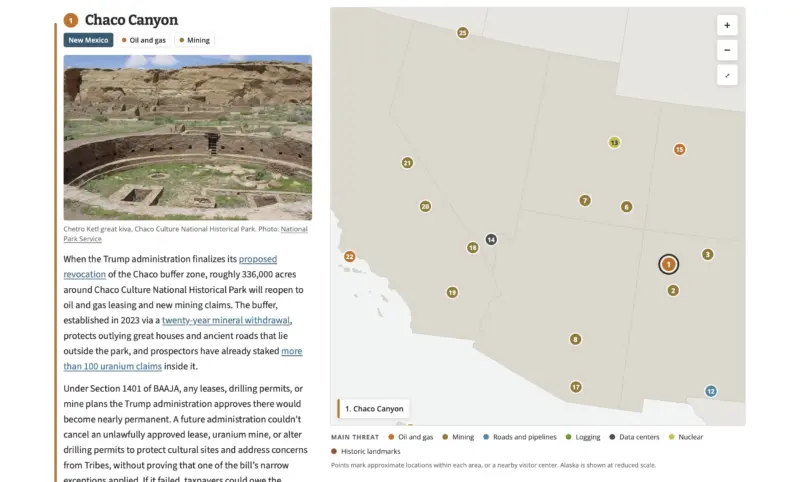
Read more: BAAJA would lock in destruction at Bears Ears and beyond. This statement includes an interactive map showing “places where the bill’s anti-public lands provisions could do lasting damage," pictured below.
The Wilderness Society
"This bill would:
• Lock in drilling and mining projects making it virtually impossible for future administrations to correct permits, even if they are unlawful;
• Weaken public participation in decisions affecting shared lands;
• Erode Tribal consultation and Tribal sovereignty while threatening sacred sites and cultural resources;
• Limit judicial review and make unlawful projects harder to correct in court; and
• Expand industry access to public lands without adequate safeguards."
Sierra Club
"Four Red Flags:
• Eliminating the power of the Courts to act on legal violations
• Removing states’ ability to protect their own waters
• Handing endangered species consultation to states
• Permitting 'certainty' at odds with environmental standards"
Read more: A Hard Look at What’s in the 400-Page Permitting Reform Bill
National Congress of American Indians
"While some senators may consider the latest amendment a sufficient response to the concerns raised by Native Nations, we strongly disagree. Our concerns have not been resolved, and the changes offered do not meaningfully address the harm this legislation would cause. ... Congress must reject BAAJA in its entirety. Native sovereignty, sacred places, and cultural heritage are not negotiable, and meaningful consultation cannot be replaced by amendments that fail to address the fundamental concerns of Native Nations."
Read more: Native Organizations to Congress: Our Position Has Not Changed. Reject BAAJA in its Entirety
Public Citizen
"Senate permitting legislation (named the Bipartisan American Affordability and Jobs Act, or BAAJA) and its manager’s amendment are characterized by supporters as necessary to eliminate barriers to building needed energy and mining infrastructure. While the legislation contains admirable efforts to improve transparency and accountability for electric transmission projects and implement ratepayer protections for data centers, it bestows significant new legal rights for fossil fuel developers and—importantly—undermines long-standing statutory protections over existing and future Liquified Natural Gas (LNG) exports. ... BAAJA significantly interferes with existing Department of Energy authority to maximize protections."
NAACP
"A more just approach to permitting requires building from the ground up with community protection at its core, a foundation that BAAJA fundamentally lacks in any form. The NAACP calls for legislation that protects our neighborhoods and preserves our power to hold polluters accountable, not legislation that shields them."
Read more: NAACP Condemns Senate Advancement of the BAAJA Bill
Winter Wildlands Alliance
“BAAJA could help accelerate the clean energy deployment we need. As written, however, it also seriously threatens foundational federal laws that govern permitting and environmental integrity, including the Clean Water Act (CWA), the National Environmental Policy Act (NEPA), the Endangered Species Act (ESA), and the National Historic Preservation Act (NHPA). We’re not opposed to permitting reform. In fact, we share that goal. Our concern is how this bill gets there: by narrowing the bedrock laws that protect water, wildlife, and public lands. “
Read more: Permitting Reform Is Needed, but BAAJA Falls Short for Winter
Natural Resources Defense Council
"Public lands [would be] handed to the mining industry ... While NRDC supports the elements of the bill that would help accelerate needed transmission and grid modernization, the bill goes too far in weakening essential environmental safeguards and opportunities for public participation. We oppose the bill as written.”
Read more: NRDC Assessment of BAAJA