

What follows is a transcript from the August 3, 2025 edition of the Frommer's Travel Show podcast. It has been edited for length and clarity. To listen to the original podcast, please click here.
Pauline Frommer: There's a song in the musical Wicked: “Dancing Through Life”. My next guest has been doing that for many, many years. In fact, she has danced all over the damn world. Her name is Mickela Mallozzi. She has a wonderful show on PBS called Bare Feet with Mickela Mallozzi.
I am not using dancing as a metaphor here. You have literally danced all over the world. In fact, that's the topic of your show. How did you come up with this idea?
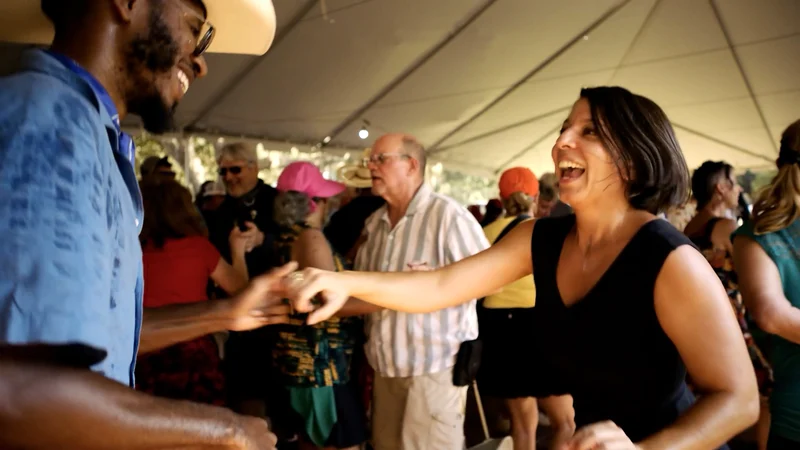
Mallozzi: I literally dance around the world, and every place I go, I learn the dance and music from the people of that place. I like to say I make new friends by dancing with strangers.
The idea for the show came because that's how I would travel for fun. When I started traveling solo as a female traveler, I would dance with people.
[Though] not like randomly just going up to random people and being like, "Dance with me." It was more [that] there were festivals or holidays or some sort of celebrations happening, and I would approach someone and start mimicking them, and with gestures [ask to join in] because I couldn't speak the local language. And they would start teaching me steps and we'd be dancing.
It was this immediate connection through movement, through energy. [And] it was [after that kind of interaction] that I was invited into someone's home—their mother was cooking a family meal. Or I was invited to their brother's wedding the next day in Mumbai. All these interactions came from dancing.
So I thought, wow, this is a really amazing way to travel, to communicate. Because when you don't speak the local language, there's a really thick barrier to entry, right? I mean, this was 20 years ago. We didn't have Google Translate. We didn't have smartphones.
Frommer: I gotta ask, you never got anybody who was upset that you barged in on their dancing?
Mallozzi: Well, I never barge in. That's the thing.
I'm definitely an extrovert and I'm not afraid to mess up on camera, because that's the fun part. The fun part is the stumbling around a little bit.
But I have enough dance vocabulary—I was a trained dancer—to pick up the dances. Enough so that the other person feels comfortable enough to keep teaching me more.
The show's not a dance show. In the way most [travel] shows use food, we use dance as this starting point, this catalyst to create conversation about culture [and] history. “Why have they been doing these dances for generations? What does it represent to this community?” A lot of it is cultural identity and history.
So that's where this show kind of spawned; [it was] from was just me doing it for fun. I had no TV background, no hosting background, no production background. I was like: I'm going to make a TV show.
And now, 15 years later, here we are. Season 8 is coming out in December. So it's been a journey, Pauline.
Frommer: That's amazing. So what was your first show? Where did you go for the very first one?
Mallozzi: As I was putting this idea of the show together, I was pitching it to production companies. No one would sign it. They're like, “This is an interesting idea, but you won't be the host. You don't look like a TV host”—and all these barriers.
And I thought, well, you know what? I'm going to film a pilot myself. I know this is a good idea deep down.
So we went to my family's hometown in Southern Italy—Minturno. I come from a family of immigrants, as you can tell from the many z's in my last name. My grandmother still lived [in Minturno], and they have this annual Wheat Harvest Festival, and there's dancing. And I thought, what better way to start this journey than through my own personal experience of my family?[It was like a] discovery of my own culture. Even though I grew up doing the dances, I had never performed or been with the group in Minturno.
And because there's never been a show before Bare Feet like this, convincing the group [was difficult]. “I'm going to show up with a camera crew, and I need to dance with you”. And they're like, "But you don't know what we're doing." I'm like, “No, no, no, I'll pick it up really quickly. That's the point of the show.”
It almost didn't happen. We were in Italy and they wouldn't let me rehearse. The first few years of convincing people that I need to try the dance, I just can't have you present your dances to me and to our camera crew. [That] there has to be this immersive interactive component—there have been instances where it's been a challenge.
But it always ends up being like a magical moment where they're like, "Oh my gosh, she's actually getting it. Let's give her more!"
Frommer: I gotta ask: Have you ever been stumped? Has there ever been a dance so tricky that you couldn't get it?
Mallozzzi: Not a dance, knock on wood. I’m knocking on my head right now.
But I'm always in a place where I'm like, “This might be the day. This might be the day I don't get it.”
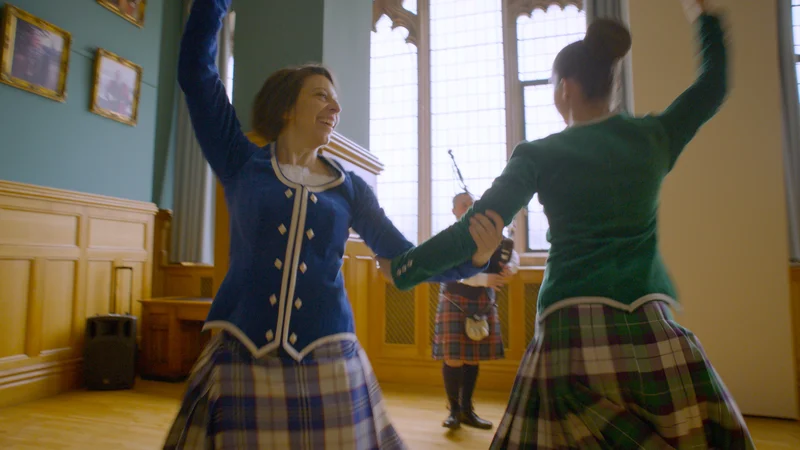
The only thing that really, really, really stumped me was playing the bagpipes in Scotland. That is really hard, really hard. Sounded terrible, sounded awful.
Frommer: Do you find that each culture dances for the same reasons? Or are there different cultural reasons that dance is introduced to an event?
Mallozzi: You're actually the first person to ask me that.
I started a course at NYU based on my work. It's called Intercultural Communication Through Dance. We talk about the different reasons, the cultural context of dances because, especially here in the United States and in Western culture, we see dance on Dancing with the Stars. [Or] So You Think You Can Dance or America's Best Dance Crew. It's very performative and [they are] incredible dancers who trained their entire lives.
The dances that we try and highlight on Bare Feet are dances that are done [for other reasons]. Some cultures do these incredibly joyful dances during funerals, which is really strange for us. We were in Malaysia and we were with the Bidayuh tribe and we started doing a bamboo dance almost similar to Filipino Tinikling. If anybody knows, it [uses] bamboo as if you're doing jump rope. You have to jump your feet in between the bamboo.
It's super joyful and I'm sweating and we're laughing and they're playing drums. I said to them, "When do you do these dances?" They said, straight-faced, "During funerals,” and I was like, whaaat?
They said ,“Well, the families are so heartbroken and everyone is so sad. We are trying to lift their spirits of the people that are mourning the dead.”
If you think about that, [dance is] like a natural antidepressant—feeling this joyful music, jumping, your endorphins are kicking in. Physically and spiritually and mentally [the dance] makes you feel better.
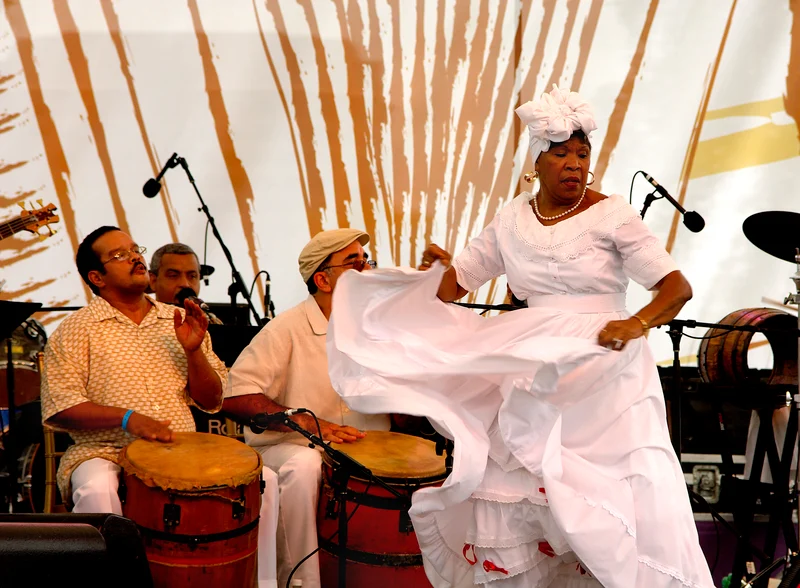
Other dances we've done [include] Bomba—there’s various styles of that throughout the Caribbean. When enslaved people [from Africa] were brought over to the Caribbean to work, they all didn't speak the same language. So they came together and created drums from the sugar cane and rum barrels and started making music and communicating that way. Each style of rhythm means something, whether it's evoking sadness, joy, lust.
Dances are very specific. [Many] dances are born out of oppression. Most dances are born out of fighting for cultural identity, or maintaining cultural identity.
When I started Bare Feet, it was for completely selfish reasons. I wanted to learn many dances and wear many amazing costumes and go around the world. But as I was creating the series, connecting with so many people, [learning about] immigration patterns… and understanding the impact that these rhythms and dances had on culture, on people, on their history, there was a heaviness of responsibility. [We wanted] to show that in the show.
We really shifted how we started making Bare Feet. Probably around season 4 was when our storytelling really started to change. This is really important stuff that we're digging into, and I'm really proud of that.
Frommer: You started out by comparing this to food shows that use food as a lens. There was a really interesting article in The New York Times a couple of months ago about the fact that when you go to many of the world's great cities and you want to try the authentic cuisine, nowadays the authentic cuisine is fusion. We live in a world where immigration has shifted what we know about flavors. And so you go to, say Paris, your best meal may not be a French meal. It may be one that's Moroccan. It may be one that's from West Africa. You never know.
Are you finding that dances are also going away from just the traditional and incorporating more elements of the current culture?
Mallozzi: 100%. It's just the evolution of being human, right? Nothing's in a bubble.
In Auckland, New Zealand, we met with a lot of Haka dancers. Your listeners [may] have seen that powerful sort of singing and chanting with the eyes coming out. They do the dance before rugby games. [This] incantation [is a way] of intimidating your opponent. You also do it when you're proud of someone as [a way of] supporting them.
But there's this new wave of new dancers that are using Haka and using action songs, which are those songs that remind me of Polynesian culture… where they're singing and talking and using their hands to depict what they're singing about. [Action songs] are very, very melodic.
This new wave is called Haka Theater, and [the dancers are] saying, look, we're breaking the rules. We're still valuing what our ancestors did, but we're breaking the rules a bit, using slightly different styles of music.

You cannot live in a bubble. It's not just all traditional folk dance that we show on the show. We show what's happening within these communities. And it's really fun.
Frommer: Well, in terms of what's happening, there's a lot more gender fluidity than there used to be. But I think of traditional dancing and many types of dancing as being a very gendered activity.
Mallozzi: It is.
Frommer: So have you ever taken the male role?
Mallozzi: Oh, always. Always. The male dances are, to me, are the most fun. Traditional male dances. They jump more often. I don't know why.
Frommer: Well, they're showing off.
Mallozzi: Yeah. Traditionally, they were showing off for the women. They were like, who's the strongest? Who's the fastest? Who has the best footwork? Who can jump the highest?
You know, and I'm pretty stocky. I'm not the most dainty girl. Let's be real. And I'm very competitive, and I really love doing this. And so I think early on it was easy for me to go in and say, "I want to learn the boys' part."
And they're like, OK, here's this crazy American. Like, we don't mind. It doesn't matter.
But what I've seen over the years is now you do see women taking on those roles.
Of course, if they say you can't participate because you're a woman, we don't go there, right? We just don't go [to places where] there's no opportunity for me to connect through dance. If it's a strict [rule that] women don't dance in this community, I'm not coming to your community to make a dance show.
Frommer: Yeah. Well, you've created a lot of magic on screen. You've won four Emmys? Congratulations.
Mallozzi: Thank you. Thank you.
Frommer: And we're talking to you at a pivotal moment because your show, like many great travel shows, like the shows of Rick Steves, like Samantha Brown's wonderful series, are on PBS. And PBS has just been defunded. In fact, worse than defunded, they're clawing back some of the money that was already given to them, which could sink some stations.
So I have to ask, what happens to your next season? What happens to your shows?
Mallozzi: I have to say first, thank you, Pauline, for having me on today to be able to talk about this.
Public media has been defunded, but it doesn't mean it's disappearing overnight, thankfully. But if that money disappears, which it looks like it will, 20% of PBS member stations will disappear. So that's really sad.
And I have to say Bare Feet and other shows that feature slower educational storytelling wouldn't exist without PBS
Our show really digs deeply into people and their stories versus advertisers and product placement, right? There is no influence from advertising. That's why it's non-commercial television.
That's why we work very hard on our storytelling because it has to maintain a certain level of truth, fact-checking, but also an educational component. That's the whole basis of public media and public television.
[So it’s disheartening to] hear PBS is being defunded ,and the National Endowment for the Arts is closing, [as is] the Department of Education. All these things that tie into the idea of arts [being] empowering. Arts are educational, arts are necessary. Public media is necessary.
But when I have interactions with fans, and I do every day, they're like, "Please don't stop."
That's where I'm like, okay, we gotta keep this going. No matter what.
Frommer: So 20% of the stations are going to close, which I would assume means there's going to be less money for shows, right? I mean, how does it work?
Mallozzi: Us independent producers—Rick Steves, Samantha Brown, all of these wonderful travel hosts—we're all independently produced and funded. I think that's something really important to say. We don't get any money from PBS, or the Corporation for Public Broadcasting.
All that money goes to run the stations and to also produce PBS News Hour, and PBS-produced shows like Nova. What we rely on, including Ken Burns and all of these bigger productions, is foundation support and sponsors.
So we are very, very lucky at Bare Feet that we've been supported by the UN Foundation, which is a family foundation; and Bloomberg Connects, which is an arts app under the Bloomberg Philanthropies. We still haven't hit our fundraising goal for season 8.
And because of everything that's been going on, it's been much more difficult. Foundations are being hit left and right because all of the [arts] funding being pulled by the government. So many more arts organizations are turning to foundations.
And then also the perceived idea that PBS is disappearing, which it's not. A lot of stations are, but the main stations, New York, Chicago, L.A., San Francisco, Dallas, San Antonio—they're not going anywhere.
They have the resources from viewers to help keep supporting the stations. It's the rural stations that don't have that support or that are really reliant on the government funding to keep those doors open.
For us, as Bare Feet, we are trying to get Season 8 out. We are in our 11th hour of fundraising, so if anyone out there wants to support, we're fiscally sponsored.
Frommer: What does fiscally sponsored mean?
Mallozzi: It means we're not a 501c3, so we can accept a tax-deductible donation through our fiscal sponsor, which is Filmmakers Collaborative and New York Women in Film and Television.
I posted just a couple of weeks ago saying, Bare Feet's not going anywhere. I can safely say Season 8 is coming out. We're not going anywhere, but if you believe in what we do, here's how you can help.
Frommer: So your show can be seen online as well as on TV?
Mallozzi: Oh yeah, we're on PBS.org, we're on the PBS app. We make our shows as accessible without a barrier to entry as much as possible. We're very much of making everything as accessible as possible. We know schools that use the show. We know organizations that support kids with disabilities, use our series and have our series free for families. That's a priority for us. It doesn't make us more money and that's not the point, right? The point of public television isn't to make money. It's to get these programs out and to share these stories of educational, informational, and entertaining programming. And for me, it's about connection. It really has transformed my life.
Frommer: Well, it's always such a delight speaking with you, Mickela. Thank you. I'm so glad that we're not saying goodbye.
Mallozzi: We're not. We are not. No. It's going to last. It's going to go on as it should.