

What follows is a transcript from the June 15, 2025, edition of the Frommer's Travel Show podcast. The interview has been edited for length and clarity. To listen to the episode, click here.
Pauline Frommer: Nobody knows what the final destination for human beings consists of, but there is a stopping place along the road to whatever happens after we die, and that is the cemetery.
Loren Rhoads has written a splendid book called 222 Cemeteries to See Before You Die, and it is anything but depressing. It's a fascinating, eye-opening look at burial places around the world.
Loren, how did you get obsessed with this topic?
Rhoads: Totally by accident, which I think is how most people get into it. My husband and I were traveling to Europe for the first time, and we ended up unexpectedly in London. One of the things I came across was this beautiful book of photographs of Highgate Cemetery.
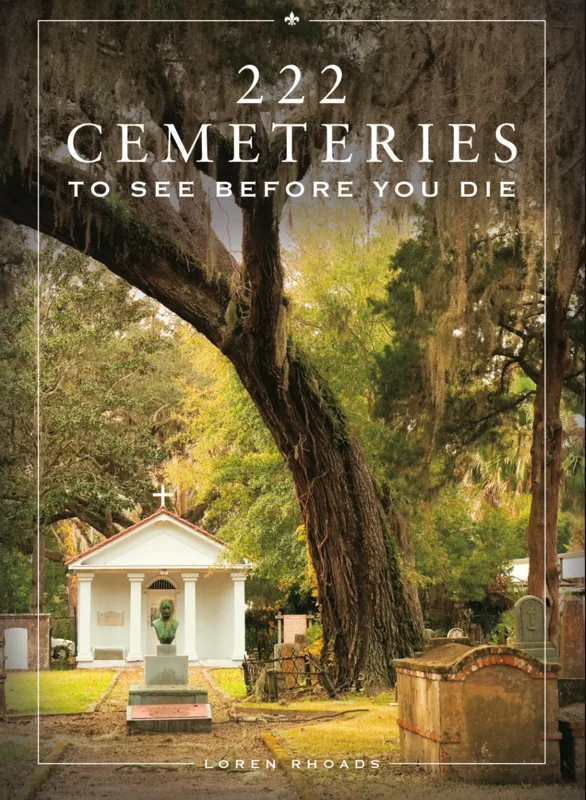
We went on a January day, we had the place to ourselves, and it was just magical. Angels completely enshrouded in ivy. I decided I needed to see more of this. I fell in love with the sculpture first. The second half of our trip was going to Paris, and we went to Père Lachaise [pictured at the top of this page], which is another extraordinary place to go.
Frommer: Often when you go into a cemetery, there are symbols that I think past generations knew better how to read than we do. Can you tell us some of the common symbols you'll see in a cemetery and what they might mean?
Rhoads: One of my favorites is a broken rosebud. That symbolizes a child who was lost too soon. There's a whole list of roses and what the roses mean. Sometimes they're the Virgin Mary, sometimes it's a mother, sometimes you'll see a gravestone with a fully opened rose and two buds if the mother and both children died at the same time.
Once you start to poke into it, you can learn a lot from what's basically a mute rock.
Frommer: One of the cemeteries that you profile in the book is God's Acre/Salem Moravian Graveyard in North Carolina. I didn't realize, first of all, that the Moravians were the very first Protestant sect. And the way they buried people in a Moravian cemetery says so much about their worldview. Can you talk a little bit about how a Moravian cemetery is organized?
Rhoad: It's fascinating. They separate men from women. They separate married women from unmarried women. And they're buried not in family groups, but as they fall. So the stones are arranged in death date order. I discovered [God's Acre] because I collect cemetery postcards, just because I think the concept of cemetery postcards is really strange.
They do an Easter ceremony at the graveyard. The entire congregation comes to the graveyard [and] they decorate all the stones with flowers. It's lovely. But it's one of those things that I would never know about if I hadn't started poking into cemeteries.
Frommer: And the stones [at the Moravian cemetery] are far more plain than they are in other cemeteries. Why is that?
Rhoads: A lot of different religious organizations have felt that the iconography and the statuary and all of that was grandiose. The point in the Moravian cemetery is all of them are equal. So they all have exactly the same stone, with exactly the same kind of information. Nobody's called out as "beloved mother" or something like that because they're all beloved. I think that's kind of beautiful that they've recorded their beliefs right there in stone.
Frommer: And not only is nobody called out, there's no differentiation between the grandness of a male grave or a female grave. I thought that also was really striking.
Rhoads: No difference between rich or poor, [either], which is something you often see in cemeteries.
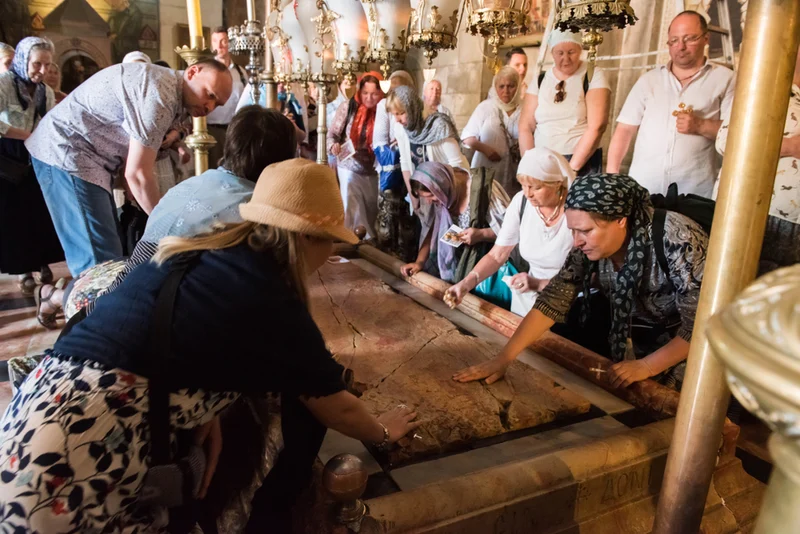
Frommer: Now, you also talk about sites that some people may not think of as cemeteries, but that are. Probably one of the most famous grave sites or tomb sites on the planet [is the] one that Christians believe Jesus Christ walked away from. Today it's the Church of the Holy Sepulcher in Jerusalem. The history of how that church came to be is so fascinating. Can you tell that story?
Rhoads: It is an amazing place. In the Bible, the story is told that Christ was buried in a borrowed tomb. And when the believers came, the tomb was empty and there was an angel sitting there and saying, Why are you looking for him here?
That [tomb] was lost for years and years. When the Crusaders first started to come to the Holy Land, they decided that this tomb was Christ's tomb and they built a church over it.
Over the years, people coming to visit the grave would chip the rock away. So it [became] fragile. At some point, they clad the whole thing in marble so that nobody could carve on the rock anymore, so it wouldn't collapse.
There isn't really any evidence that this was Christ's tomb, but there's thousands of years of belief that makes it holy.
[The church] was refurbished in 2016, with money from the World Monuments Fund, and they've taken the cladding away, so you can see the actual rock now.
Frommer: Going back almost as far, you talk about what is an archaeological site in the Burren, which is one of my favorite parts of Ireland. It's this limestone plateau that, because of the [directions of] the winds, gets wildflower seeds from across Europe and also across Africa. So when you're there, as I was several years ago, you see blossoms from all over the world. It’s just extraordinary.
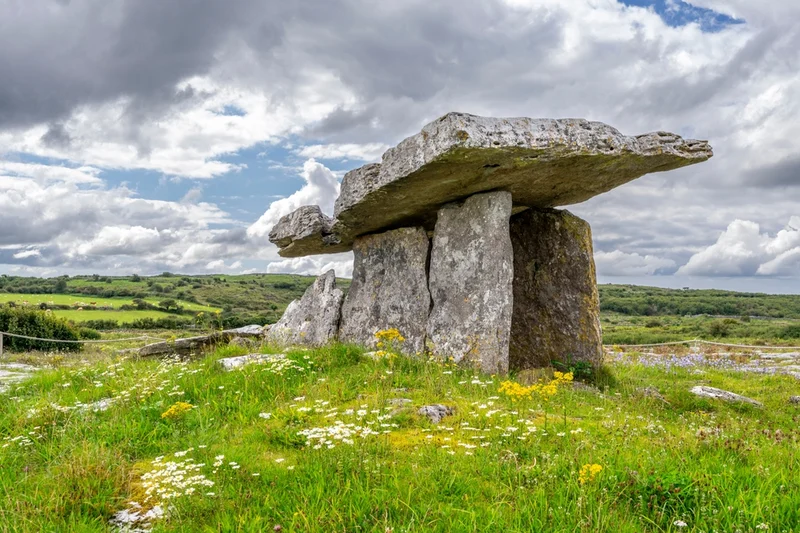
And in these fields of blossoms, there are these ancient dolmens, which are two or more massive stones going up with kind of a slate stone at the top [see below]. Archaeologists have been digging up these ancient graves. What did they find underneath the Poulnabrone dolmen in Ireland?
Rhoads: Oh, it's fascinating to me. The bare rocks that we see now were not what was originally built. But over the years, all the sod has washed away. And I didn't, when I started the research, didn't think that there would be anything left. I mean, it's hundreds and hundreds of years.
Frommer: Thousands of years, right? I mean, people were buried there 2,000 years ago or so.
Rhoads: Yeah, and they found fragments of bone. People had been cremated and their ashes, the remains, [were] buried there. And some of them had arrow points embedded in the bone. So you could see how these people died all these years ago. That there was anything left is magical. And there were pieces of jewelry, pieces of pottery—remnants of the past.
One of the things I think is really interesting about studying graves is a lot of what we know about the past comes from burial sites, from archaeology. Things that would be lost, that we would never know what people ate, what people wore, all of that would have been lost, except we've opened these graves over the years.
Frommer: And something stunning about these graves is there was nobody over the age of 40 in them. People died far younger than they do today, [even though] they were on the damn Paleo diet.
Rhoads: The other thing about this grave is, they found similar ones, in terms of construction, in far-flung places all around the world. Places nowhere near Ireland.
Frommer: What are the theories behind that, beyond aliens coming to Earth?
Rhoads: Yeah, I don't hold with the alien thing, but I do think that in the past, taking care of a dead body was a pressing concern. And the ways to take care of a dead body are kind of limited. You can cremate it. You can do sky burial, as our ancestors did.
Frommer: Sky burial is when you put it outside so the birds can eat it?
Rhoads: Yeah. Or burial. Burial is common in a lot of different cultures around the world ... because people needed to take care of their dead and make sure that they weren't going to be contagious or come back. So it's fascinating to me that you find dolmens in Spain and South America, all these different places that had no possible way to connect and share this idea.
Frommer: Astonishing, really astonishing. You also talk about the Necrópolis de Cristóbal Colón, which is in Havana and gets more visitors than almost any tourist site in all of Cuba, even though ... the government there has not maintained this cemetery well, [as] that's not part of their mandate. Tell us a little bit about that cemetery, just from a cultural standpoint.
Rhoads: Well, it has this really beautiful chapel built in the middle of it ... with white stone and the blue ocean beyond. Apparently the hurricanes have done a lot of damage there in the last couple of years, so it's in fairly rough condition. But yeah, this is the tourist thing that people tend to see. I find it's really interesting because they're not famous people buried there for the most part. But the tombs are lovingly designed and the sculpture is really beautiful.
Frommer: Well, one person who was buried there became famous after death. There was a ... teenage mother who died in childbirth and her stillborn baby was buried at her feet. But then when they dug her up—and I don't know why they dug her up—they found the baby in her arms.
Rhoads: Isn't that a lovely story?
Frommer: And because of that, people come to pray there for a successful childbirth, right?
Rhoads: Right, right, safety in childbirth.
Frommer: When I was flipping through the book, I was really, really struck by a domed ... church in Minneapolis, Minnesota.
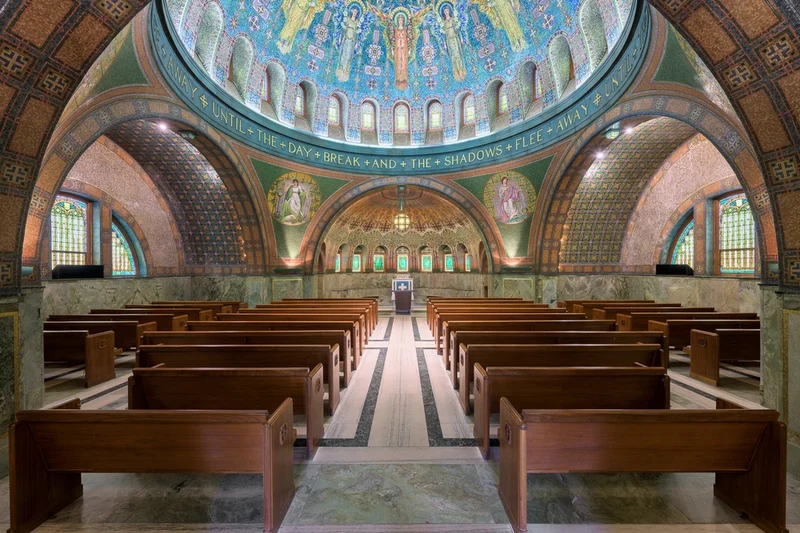
Rhoads: Oh, yes. It's called the Lakewood Cemetery. It looks like it should be in Turkey.
Frommer: Exactly—extraordinary Byzantine architecture. How did that one come to be?
Rhoads: Different cemeteries have looked for ways to make themselves stand out. It was designed ... as a Christian chapel for people to come and do funerals at, but it's based on Hagia Sophia in Istanbul.
And I think that's really lovely that whoever designed this gravitated toward the beauty and the sentiment behind it and not necessarily the history of it. And yeah, you think Minneapolis is a strange place for that, but somebody saw the original and the beauty struck their heart.
Frommer: It had nothing to do with people being of Turkish descent buried here?
Rhoads: No, not at all. Somebody liked that style of architecture. So you can get a little taste of Istanbul in the middle of Minneapolis. Who knew?
And it's really spectacular. The mosaic that covers the ceiling has gold leaf ... so it sparkles in the light.
Frommer: You also write about the Grand Canyon Pioneer Cemetery, [which] is not in the Grand Canyon [but] right nearby. What struck me about that one was how intertwined the people who are buried there were with the history of tourism in that area, right?
Rhoads: [The cemetery holds] the people who opened the original hotels along the valley ramp [and] the guides that led people into the valley in the early years and started the mule trains. [Also] people who recorded the canyon and the Native people in their paintings and photography are buried in the cemetery.
The history of water rights is recorded in the cemetery [too]. One guy built a hotel, but his rivals cut off the water to it, so he had this beautiful building, but people couldn't stay there because there wasn't any water.
Frommer: One of the things that I find particularly sad is there's a monument to a plane crash [at the cemetery]. Two pilots detoured over the canyon so that [passengers] could look out the windows of the plane to see it, and collided. They went off course for a joy ride to see the Grand Canyon from the sky and they crashed and that was it.
Rhoads: Yeah. Hundreds of people were killed in the air, and on the ground, when the planes crashed.
Frommer: You also talk a little bit about Greenwood Memorial Park in Renton, Washington, which is notable because the great guitarist Jimi Hendrix ended up being buried there. What's the story behind his flashy-looking grave?
Rhoads: When Hendrix died suddenly as a young man, there wasn't any money to give him much of a monument. His father brought him home and he was buried in a regular grave with a brass plaque—just a simple brass plaque over it.
For years, that's where he lay. [But then the] guy who opened the Experience Music Project in Seattle contacted Hendrix's father and helped him get [his son’s] musical rights back—the rights to the music that Hendrix had written. For years [the money] had gone to his manager, had gone to the record company, but the Hendrix family didn't get any of that.
They got the rights reverted to the family. And then there was money to build this amazing granite gazebo. It's by far the grandest thing in the cemetery ... [with a] life-size portrait of Hendrix and lyrics from his songs in his handwriting engraved on it. When I was there, people were leaving guitar picks ... in tribute to him. It's so worth the visit.
Frommer: That’s what was so remarkable about this book. You realize that in many destinations ... if you just take a little extra time to visit the local graveyard, you're going to learn a heck of a lot about that community, about the history.
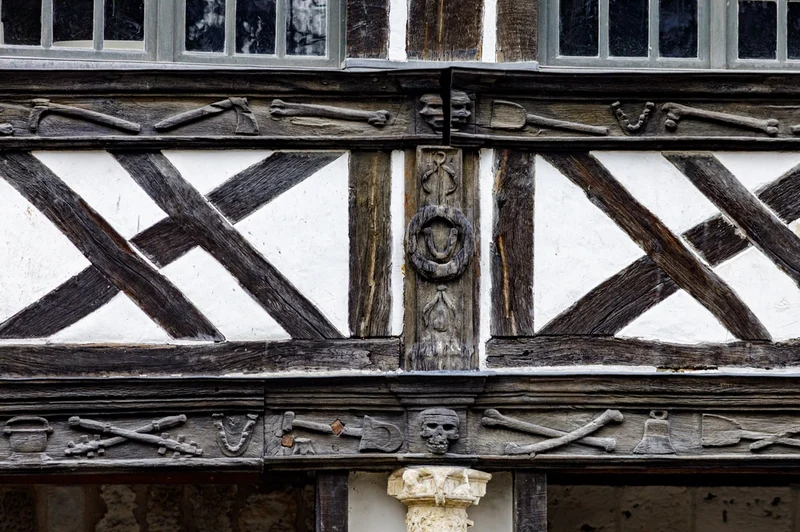
You also talk about a couple of cemeteries in Europe. One of them was Aitre Saint Maclou in Rouen, France. And I always wondered how decoration with bones in chapels came to be.
Rhoads: That's a fascinating place. During the Middle Ages, when the Black Plague was raging, I think they say one-third of everyone in Europe died. So, very quickly huge numbers of bodies had to be buried in mass graves with quicklime. There just wasn't time to do anything else. Basically, they opened the ground, they put everybody in it, threw some lime in it, threw some dirt on it, and buried the next layer of people. And so it was just masses of people. And after the plague and things settled down, they dug the bodies out of the dirt and put the bones into the ossuary surrounding.
So the carvings on this former ossuary are spades, and medics, and skulls, coffins, crossbones, all kinds of incredible stuff. And these plague pits were common in every city in Europe. This is the only one that still survives.
It's this beautiful little place full of all this history. And it's recorded on the walls, which I just think is really cool.