

Travelers in search of unique shopping finds, an unstructured stroll, or simply an escape from the rain will be richly rewarded by ducking into one of Paris's many covered passageways.
There are more than 20 of these passages couvertes scattered throughout the city. Consisting of a narrow alleyway squeezed between buildings and protected by an often-elaborate glass ceiling, each passage is lined with cafes and boutiques selling all manner of goods, from designer fashions to secondhand books.
Most of these spaces date to the first half of the 19th century, offering glimpses of the less organized, more cramped and tumbledown Paris that eventually gave way to the ordered vision of city planner Baron Haussmann.
To learn more of that history as well as info such as opening hours, visit the website of the Passages & Galleries Association.
The bulk of the passages are located on the Right Bank of the Seine River on the northern side of Paris. Many are situated within walking distance of each other and sometimes are even interconnected. Entrances can be easy to miss, so keep an eye out for the characteristic archway between buildings, often marked by an iron gate.
We've highlighted some of the most distinctive passages below. Click here to see a map of all locations mentioned in case you'd like to plan an in-person visit.
Note that many Paris shops and restaurants, including those in the passageways, close on Sundays, so that's not the best day of the week to drop by.
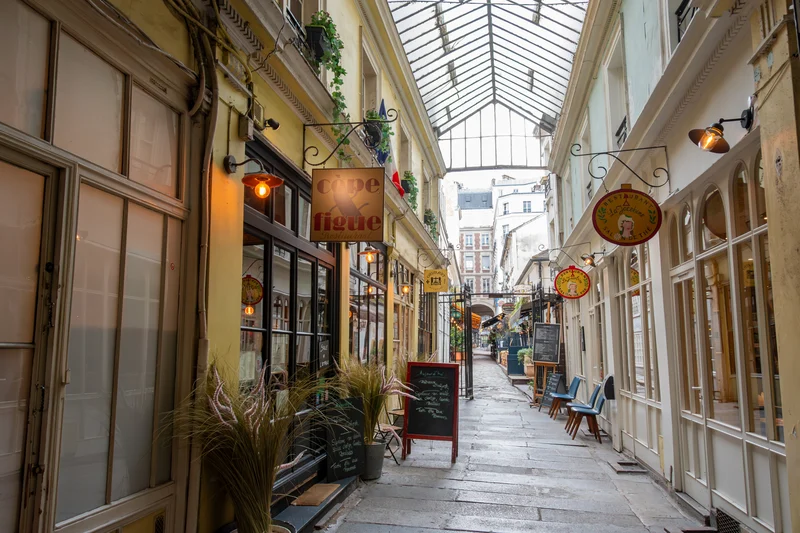
Cour du Commerce Saint-André
Entrances: 59 rue Saint-André-des-Arts, 21 rue de l’Ancienne-Comédie, and 130 boulevard Saint-Germain, 6th arrondissement
Nearest Métro: Odéon
Shop for: gourmet foodstuffs (jams, honeys, vinegars, olive oil) at Maison Brémond
This passage stands out in part because it's only partially covered, with the remainder open to the sky. Packed to the brim with cozy restaurants and cafés, Cour du Commerce Saint-André is a great place to stop if you’re in need of sustenance and want a quieter outdoor dining experience away from the hustle and bustle of the city's major streets. Le Procope, founded 1686, claims to be the oldest café in Paris.
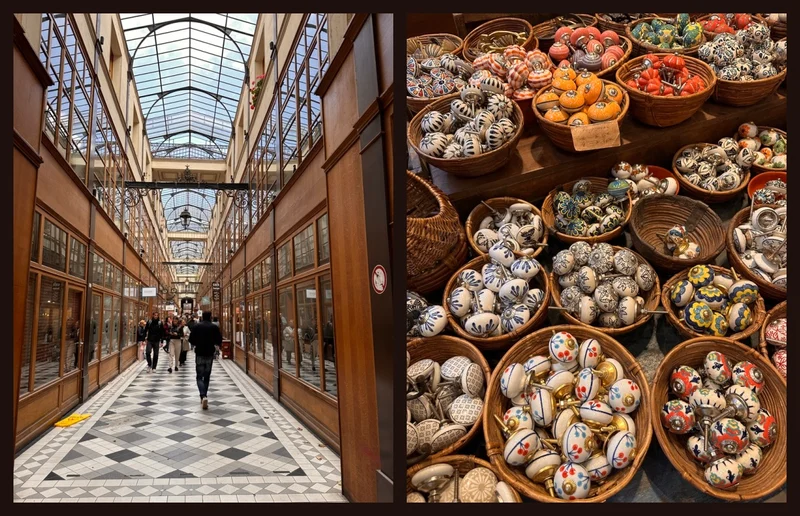
Passage du Grand-Cerf and Passage du Bourg-l’Abbé
Entrances: 145 rue Saint-Denis and 10 rue Dussoubs (Passage du Grand-Cerf); 12 rue Saint-Denis and 3 rue de Palestro (Passage du Bourg-l’Abbé), 2nd arrondissement
Nearest Métro: Étienne Marcel
Shop for: antique trinkets, yarn, custom stationery
These two interconnected passages offer a variety of food and goods under stunning vaulted glass ceilings. If you need a pick-me-up, stop at Nami Coffee shop (located just inside the entrance at 145 rue Saint-Denis) for a cappuccino and one of the best chocolate chip cookies you’ll find in Paris.
If you follow the journaling influencers of journalTok, you might already know that the Lamborghini of bespoke leather-bound notebooks is the Louise Carmen Roadbook. The brand's one and only physical boutique is located in the Passage du Grand-Cerf.
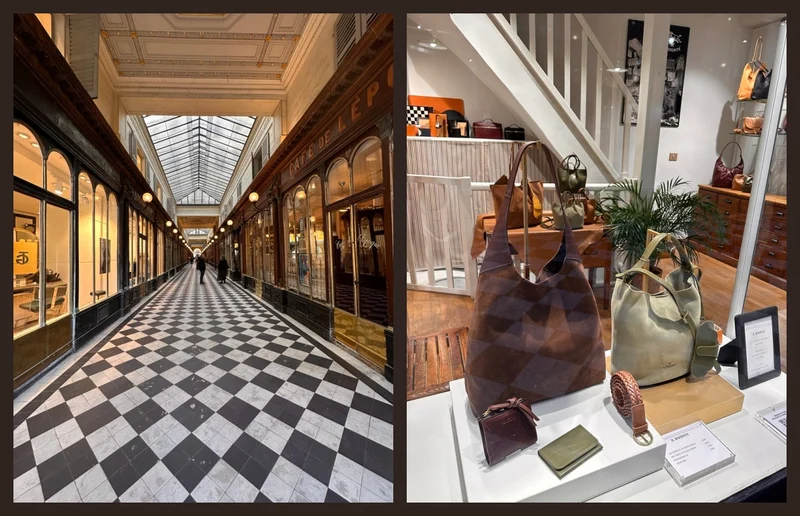
Galerie Véro-Dodat
Entrances: 2 rue du Bouloi and 19 rue Jean-Jacques Rousseau, 1st arrondissement
Nearest Métro: Louvre-Rivoli or Palais Royal-Musée du Louvre
Shop for: high-end bags and shoes
The checkerboard floor of Galerie Véro-Dodat leads to retailers predominantly on the higher end of the price spectrum. But even if you restrict yourself to window-shopping, the passage is worth a walk-through for the neoclassical architecture including elaborate carved ceilings, iron lamps, and wood-paneled store fronts.
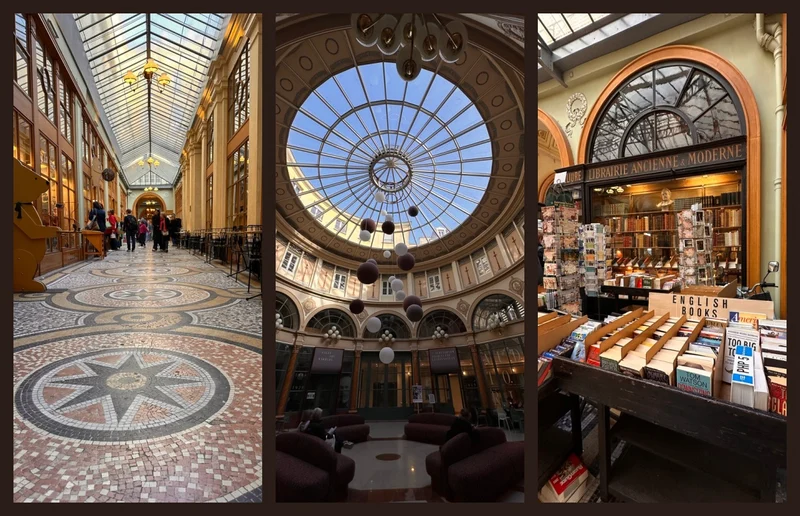
Galerie Vivienne, Galerie Colbert, and Passage des Deux-Pavillons
Entrances: 4 rue des Petits-Champs, 5 rue de la Banque, and 6 rue Vivienne (Galerie Vivienne); 7 rue des Petits-Champs and 4 rue Vivienne (Galerie Colbert); 5 rue des Petits-Champs and 6 rue de Beaujolais (Passage des Deux-Pavillons), 2nd arrondissement
Nearest Métro: Bourse
Shop for: clothes, wine, books
Technically three interconnected passages, this one is really more like one covered market. If there’s any single passage you don’t want to miss, it’s Galerie Vivienne. Designed in 1823 by the architect François-Jean Delannoy, it is arguably the grandest of the city's covered passageways, featuring brightly lit corridors, elaborate tiled floors, and a memorable glass rotunda.
Passage Choiseul
Entrances: 40 rue des Petits-Champs, 23 rue Saint-Augustin, and 40 rue Dalayrac, 2nd arrondissement
Nearest Métro: Quatre-Septembre or Pyramides
Shop for: handmade goods, sunglasses
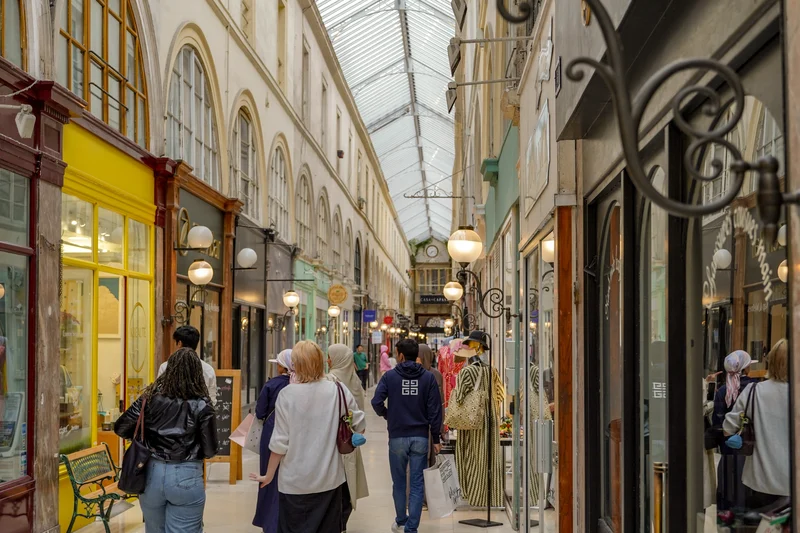
Designed and built between 1825 and 1827, Passage Choiseul contains a colorful assortment of antique and vintage shops, galleries, clothing boutiques, jewelers, and specialty businesses, some of which have been here for over a century. You’ll also find several Korean and Japanese bistros.
Passage des Panoramas, Passage Jouffroy, and Passage Verdeau
Entrances: 11 boulevard Montmartre and 10 rue Saint-Marc, 2nd arrondissement (Passage des Panoramas); 10–12 boulevard Montmartre and 9 rue de la Grange Batelière, 9th arrondissement (Passage Jouffroy); 6 rue de la Grange Batelière and 31 bis, rue du Faubourg Montmartre, 9th arrondissement (Passage Verdeau)
Nearest Métro: Richelieu-Drouot or Le Peletier
Shop for: stamps, postcards, prints, vintage clothing
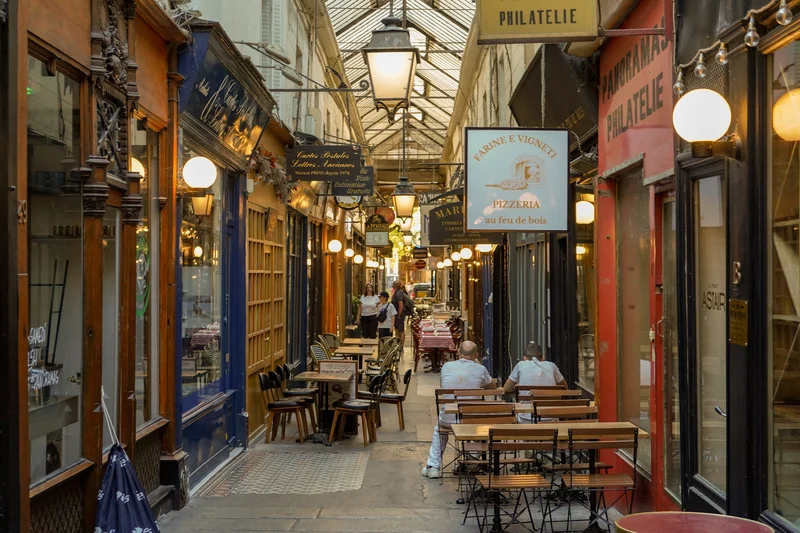
A bit like stepping into a French version of Diagon Alley, this interconnected series of passages links small restaurants with bustling shops abounding with stamps, postcards (new and vintage), and art. There's even a shop dedicated entirely to embroidery. Start either at the Passage Verdeau or the Passage des Panoramas to walk through all three in a straight line.