

Frommer’s editors independently assess all travel products featured on our site. In some cases, we may receive an affiliate commission from the purchase of products made from the links below.
There’s no doubt that Chicago is a beautiful city, but beautiful days in Chicago—like 75 degrees at the lakefront, 74 at Midway, 73 at O'Hare kind of days—are rare enough to be treasured.
That wasn’t lost on legendary 1980s Hollywood writer-director John Hughes, whose era-defining teenage coming-of-age dramedies were mostly set in and around the midwest city’s North Shore suburbs, where Hughes spent his formative years.
Released in the summer of 1986, Hughes’s Ferris Bueller’s Day Off chronicles a high-risk sunny spring day of hooky played by wily high school senior Ferris (Matthew Broderick), his girlfriend, Sloane (Mia Sara), and his neurotic best friend, Cameron (Alan Ruck).
Part romp, part earnest exploration of young adulthood's anxieties, the movie has endured across 4 decades as both an ‘80s Americana time capsule and a timeless celebration of taking life by the horns, even (or especially) to the chagrin of grown-up squares.
And for Chicagoans in particular, the film is cherished for the sheer amount of beautifully shot footage of the city, which in the movie appears to be having one of those rare perfect days mentioned earlier, as engineered by Hughes and location manager Charles Newirth.
Attempting to re-create the teen trio’s skip day is impractical due to the amount of ground covered, but fans of the film can get a good overview of the city by seeing it from the perspective of one of its most famous (fictional) day-trippers.
After all, the onscreen verisimilitude of Chicago and its residents was important to Hughes. “It wouldn’t be his first fairy tale to take place in Chicago," writes Jason Klamm in his new behind-the-scenes book about the film, Ferris Bueller…You’re My Hero. “But it would be the first to feature it, to paint a full picture of it. Ferris Bueller’s Day Off is John Hughes coming home.”
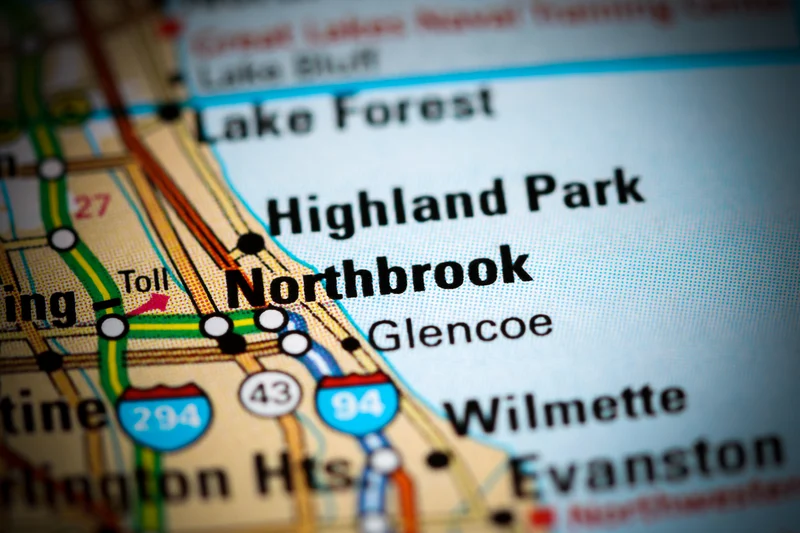
Ferris’s Hometown: Northbrook and Winnetka
The town of Shermer, Illinois—where many Hughes films take place, including Bueller—may be fictional, but it’s based on the very real Northbrook, which was originally named Shermerville and was where Hughes attended high school.
Exterior shots of the Bueller house were actually captured in California, but there’s plenty of the real Northbrook in the film, including exterior footage of Glenbrook North High School at 2300 Shermer Rd., where Ferris and Sloane make their incognito escape from school.
Behind the Northbrook Public Library stands a John Hughes Memorial Bench at 1201 Cedar Lane, where visitors can recall one of the film’s best visual gags, the Save Ferris water tower—or at least the message-free structure that replaced the original.
Ferris’s mom works in downtown Winnetka near the Tudor-style buildings surrounding Chestnut Court. Winnetka was also where much of the sequence was filmed for our hero's mad dash through neighbors' yards in order to beat his parents back home.
(Fun fact: Winnetka appears in another Hughes classic—Home Alone.)
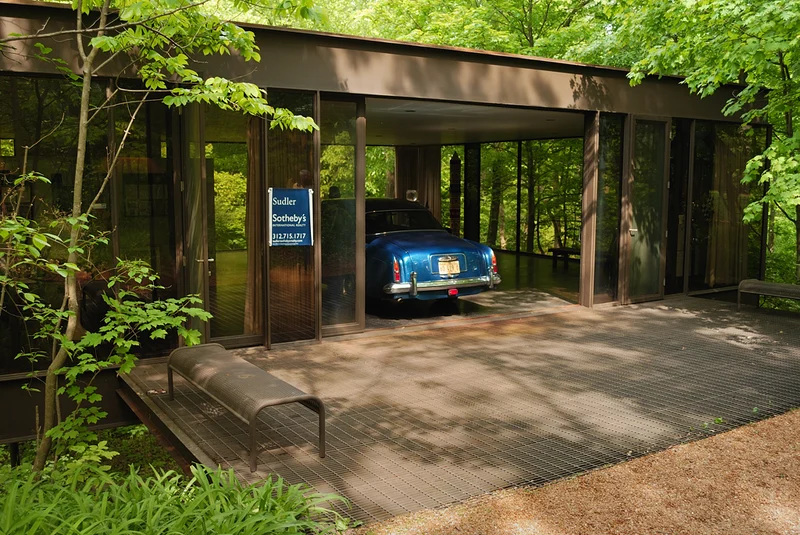
Cameron’s Home: The Ben Rose House in Highland Park
Designed by modernist architect A. James Speyer, a protege of Ludwig Mies van der Rohe, the Ben Rose House (370 Beech St., Highland Park) is where Ferris Bueller’s most emotionally rich scene unfolds.
Nearly in the clear from absconding with Cameron's strict father’s treasured 1961 Ferrari 250 GT California Spyder, our truants hatch a bad plan (attempting to roll back the car's odometer by letting the tires run in reverse) that becomes a catastrophic plan when an angrily defiant Cam kicks the Ferrari one time too many, causing it to crash through a big window in the garage pavilion and into the wilderness below.
Klamm’s retelling of how the legendary sequence was made can be read in a book excerpt recently published in Chicago magazine.
Visitors can’t tour the home because it’s a private residence, but you can see it from the street.
A-1 EZ OK Park: Washington Madison Wells Self Park
Leaving the suburbs for the city proper now, we come to the garage where Ferris and co. stash the car while in town. The real place (172 W. Madison St.) doesn't have valet service, but given how the parking attendants in Bueller (played by original Sonic Youth drummer Richard Edson and Larry "Flash" Jenkins) treat nice vehicles, self-parking might be the better option.
Chez Quis: 22 W. Schiller St.
The exterior of the snooty restaurant where Ferris and friends steal a reservation from “the sausage king of Chicago” is actually a private residence, but is visible from the street. If you’re in the mood to eat pancreas nearby, The Purple Pig, located about a half-mile away (444 N. Michigan Ave.), serves sweetbreads.
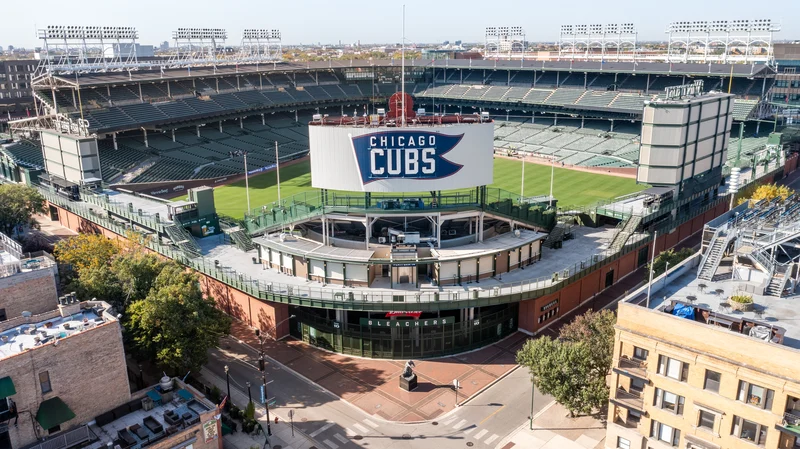
Wrigley Field
There are plenty of fantastical elements to Ferris Bueller’s Day Off, but skipping daily obligations to take in a weekday afternoon Cubs game at Wrigley (1060 W. Addison St.) isn’t one of them. We really do that here. The Ferris File launched an impressive forensic analysis to determine the movie trio’s actual seats: section 101, row 6, seats 101, 102, and 103.
Wrigley is rare among U.S. ballparks in that it remains rooted in an actual neighborhood, right next to public transit, two- and three-flat brick residences, and a walkable district of bars, restaurants, and hotels.
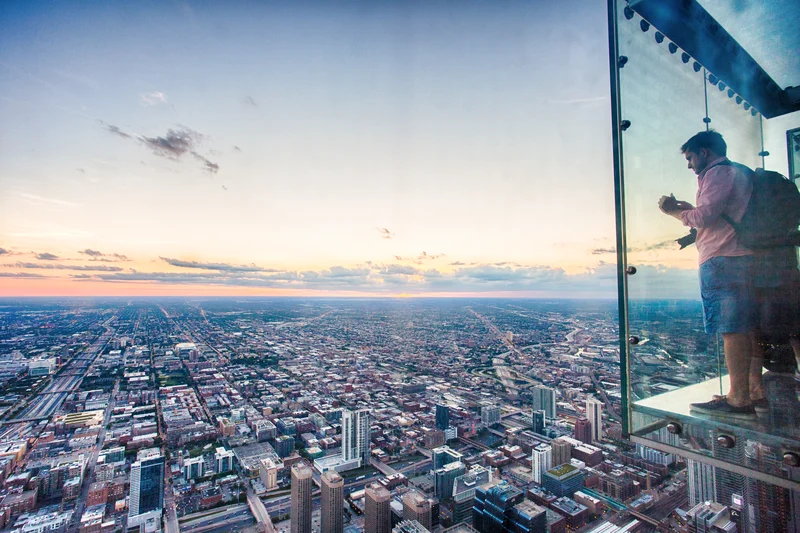
Sears Tower: Willis Tower Skydeck
At the time of filming, the Sears Tower (now Willis; 233 S. Wacker Drive) was the tallest building in the world, a record the skyscraper held for decades.
Interestingly, the thunk you hear when the trio lean their heads up against the glass is authentic, according to Klamm’s research.
“The city looks so peaceful from up here,” says Sloane in the film. “Anything is peaceful from 1,353 feet,” retorts Bueller.
In 2009, the Skydeck added The Ledge, all-glass balconies that let visitors venture more than 4 feet from the building for views that can stretch upwards of 50 miles and four states away.
Glencoe Beach
You'll have to return to the northern suburbs to find the waterside spot where Cameron "blows a microchip or two" in realization of how royally screwed he is. The bench and stone overlook that appear onscreen are situated next to Lake Michigan near Glencoe Beach (160 Hazel Ave., Glencoe).
OK, back to the city.
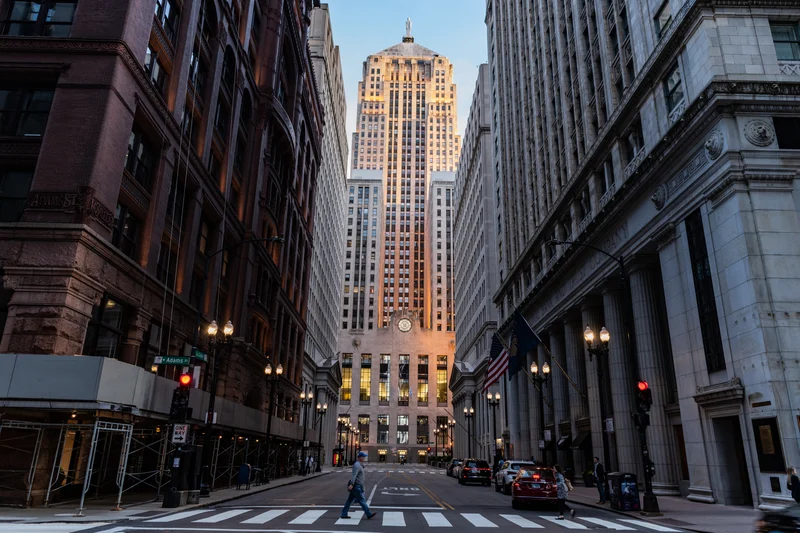
Chicago Board of Trade
Only in Reagan’s America would a bunch of kids sneak out of school to voluntarily witness the esoteric hand signals of a throng of amped-up stock traders. In the modern era of digital fintech, there’s not really an exciting trading floor to experience anymore at the Board of Trade Building (141 W. Jackson Boulevard). There is, however, now a museum on-site where you can relive the past excitement.
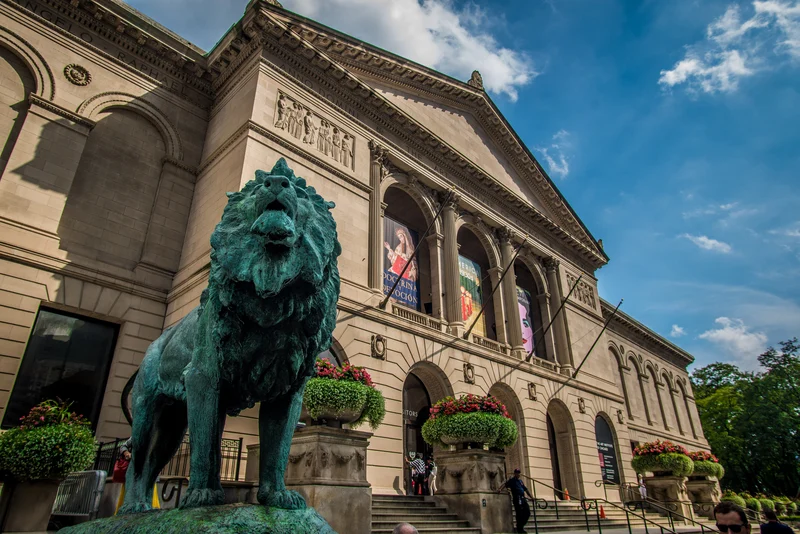
Art Institute of Chicago
The wordless, 2-minute sequence in which Ferris, Cameron, and Sloane tour the Art Institute of Chicago (111 S. Michigan Ave.) has endured as one of the most memorable in Hughes’s career.
Tonally, it’s a deviation from the rest of the film, yet gets to the heart of the whole thing.
Against an instrumental cover of The Smiths' "Please, Please, Please Let Me Get What I Want" performed by the Dream Academy, the group of friends get inspired by paintings and sculptures throughout the galleries.
While Sloane and Ferris make out in the blue light of Marc Chagall’s America Windows, Cameron further defragments while zooming in on the multitudes of colorful dots that make up Georges Seurat’s A Sunday Afternoon the Island of La Grande Jatte.
We don’t recommend you do either, but you’re welcome to take a self-guided Bueller-inspired tour curated by the museum.
Von Steuben Day Parade: Dearborn and Adams Streets
One of the lesser-discussed elements that makes older movies feel so alive are the extras. All across Chicagoland, you can still hear plenty of people today say they “were in” Ferris Bueller’s Day Off, and they’re not lying.
For the parade sequence, Hughes shot a combination of footage from the real 1985 edition of the Von Steuben Day German-American heritage celebration held in Chicago as well as a mock one staged weeks later. For the fake version, the production put out a call for extras to be paid in raffle tickets and light concessions, resulting in thousands of locals making their way into crowd shots in the film.
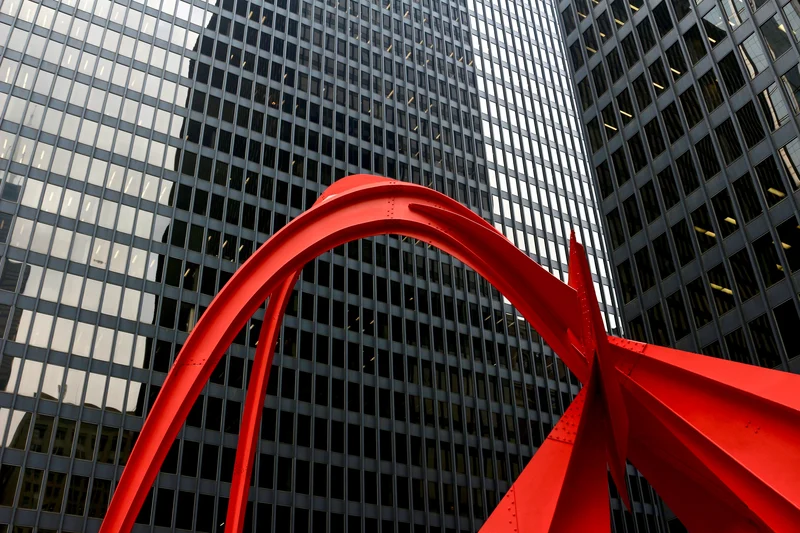
One of the most prominent background players is Alexander Calder's 53-foot-tall Flamingo sculpture, which still stands in the Federal Plaza.
The Von Steuben German Day Parade still takes place in Chicago every year, too. The 2026 edition is scheduled for Sept. 12.