

Nearly a hundred years ago, the Union Pacific Railroad commissioned architect Gilbert Stanley Underwood to design a resort hotel at its depot on the North Rim of the Grand Canyon in Arizona.
Underwood delivered a striking structure with soaring windows, wide terraces that afforded views of the canyon and mountains a hundred miles beyond, and rock construction that echoed millions of years of local geology.
Fire destroyed much of that original lodge in 1932. It was rebuilt in 1937, with an extraordinarily beautiful dining room with a high, vaulted ceiling—and this time the building and some 100 cabins around it endured. Fifty years later, in 1987, the Grand Canyon Lodge was added to the National Register of Historic Places.
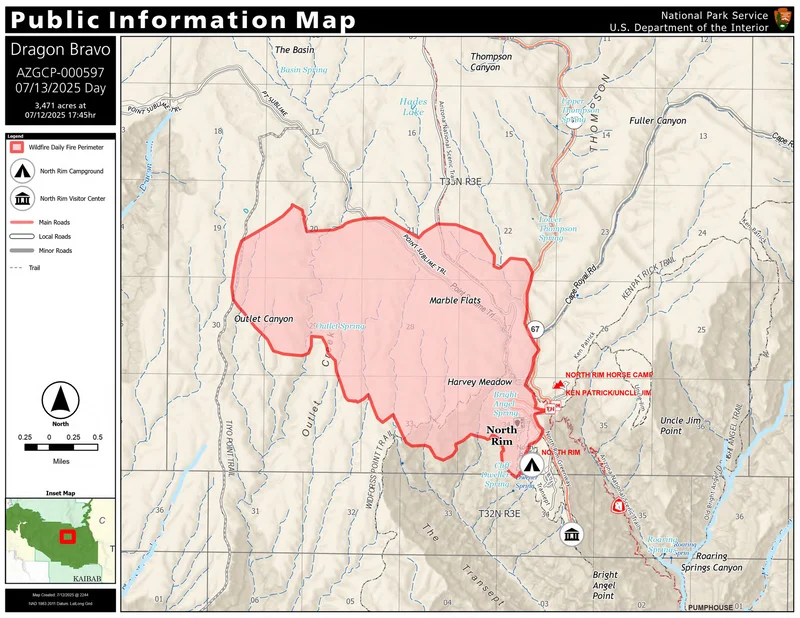
But now, nine decades after its rebirth, the Grand Canyon Lodge and some 50 or more outbuildings have fallen victim to fire, destroyed along with the park’s visitor center in a huge conflagration on July 13.
How the Grand Canyon's North Rim Wildfire Became a "Controlled Burn" Out of Control
This is how it happened.
Controlled burns are a common method for clearing forests that are choked with snags and undergrowth, which describes much of the Kaibab National Forest and the great stands of ponderosa pine along the North Rim. Those burns are a fundamental part of wildland firefighters’ tool kit, employed across the country by the U.S. Forest Service some 4,500 times a year.
The forests, usually a small area at a time, are cleared through fire, that most natural and ultimately least intrusive of agents, and most controlled burns blaze and die out with only healthful consequences for the woodlands. Indeed, where the Forest Service has put the approach into regular practice—notably, in Yellowstone National Park, which suffered catastrophic fires in 1988—the method has proven highly effective.
But controlled burns that grow out of control are also a common occurrence, especially on windy days. The Dragon Bravo fire was sparked by a lightning strike on July 4, and the Forest Service tried to manage it as a controlled burn.
In the week that followed, though, high winds whipped up a firestorm that flourished in the hot, dry Southwestern summer, quickly growing too large to keep up with. The very same thing happened in 2022, when Forest Service fire crews set off a controlled burn in Santa Fe National Forest that, helped along by wind gusts, jumped the fire line and touched off the largest wildfire in New Mexico history, destroying hundreds of homes.
Arizona’s governor, Katie Hobbs, has called for an independent investigation, writing on X that “Arizonans deserve answers for how this fire was allowed to decimate the Grand Canyon National Park.” Meanwhile, as of this writing the Dragon Bravo fire and a related blaze, the White Sage fire, continue to rage, having burned more than 63 square miles and, thus far, with containment at zero percent, despite the backbreaking, perilous work of nearly 500 firefighters and support staff on the scene.
What Travelers Should Know—and Whether They Should Cancel Upcoming Trips
The National Park Service has closed the North Rim for the rest of the season, which normally extends into October.
The Grand Canyon Lodge website advises that anyone who held reservations will be contacted “with details about cancellations and next steps.”
The South Rim remains open, but, this being high season, you’ll want to book lodgings as soon as possible if you haven't already in order to visit this season. You may find it easier to stay in Flagstaff, about 75 miles from the national park's South Rim entrance.
The South Rim is the most popular access point to the Grand Canyon, and is where you'll find many of the park's iconic facilities, including Grand Canyon Village, hiking trails, campgrounds, and historic lodges that remain undamaged.
It's important to note that the South Rim and the North Rim are separated by nearly 300 miles—driving between the two takes nearly 6 hours. So in other words, it should be safe to visit the South Rim for the time being.
Keep an eye on the National Park Service's website for the Grand Canyon for news of any closures and other important info that can affect your trip.
If you had your heart set on staying at the North Rim lodge, you'll have to wait till it's rebuilt, as it is sure to be. Small consolation, perhaps, for anyone who ever fell under the spell of that magnificent original.
Gregory McNamee is a coauthor of Frommer's Arizona and the Grand Canyon.