Home > Destinations > Central and South America > Costa Rica > In Depth > Environment
Bookstore Travel Talk - Our Message Boards Tips and Tools Book a Trip Deals and News Trip Ideas, Activities, Lifestyles Hotels Destinations Frommers.com Home
Frommer's - The best trips start here. Frommer's - The best trips start here.
Sign up for our FREE Newsletters! Win a FREE Trip
  Email This Article Email Print This Article Print Get Frommer's RSS Feed RSS

Environment

Costa Rica occupies a central spot in the isthmus that joins North and South America. For millennia, this land bridge served as a migratory thoroughfare and mating ground for species native to the once-separate continents. It was also where the Mesoamerican and Andean pre-Columbian indigenous cultures met.

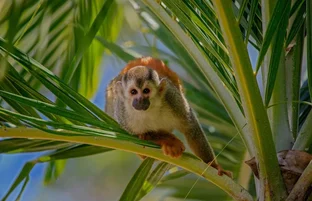
The country comprises only .01% of the earth's landmass, yet it is home to 5% of the planet's biodiversity. More than 10,000 identified species of plants, 850 species of birds, 800 species of butterflies, and 500 species of mammals, reptiles, and amphibians are found here.

The key to this biological richness lies in the many distinct life zones and ecosystems found in Costa Rica. It might all seem like one big mass of green to the untrained eye, but the differences are profound.

In any one spot in Costa Rica, temperatures remain relatively constant year-round. However, they vary dramatically according to altitude, from tropically hot and steamy along the coasts to below freezing at the highest elevations.

Costa Rica's lowland rainforests are true tropical jungles. Some are deluged with more than 200 inches of rainfall per year, and their climate is hot and humid. Trees grow tall and fast, fighting for sunlight in the upper reaches. In fact, life and foliage on the forest floor are surprisingly sparse. The action is typically 30m (98 ft.) up, in the canopy, where long vines stream down, lianas climb up, and bromeliads grow on the branches and trunks of towering hardwood trees. You can find these lowland rainforests along the southern Pacific coast and Osa Peninsula, as well as along the Caribbean coast. Corcovado, Cahuita, and Manuel Antonio national parks, as well as the Manzanillo-Gandoca Wildlife Refuge, are fine examples of lowland rainforests.

At higher altitudes you'll find Costa Rica's famed cloud forests. Here the steady flow of moist air meets the mountains and creates a nearly constant mist. Epiphytes -- resourceful plants that live cooperatively on the branches and trunks of other trees -- grow abundantly in the cloud forests, where they must extract moisture and nutrients from the air. Because cloud forests are found in generally steep, mountainous terrain, the canopy here is lower and less uniform than in lowland rainforests, providing better chances for viewing elusive fauna. Costa Rica's most spectacular cloud forest is the Monteverde Biological Cloud Forest Reserve in Guanacaste province.

At the highest reaches, the cloud forests give way to elfin forests and páramos. More commonly associated with the South American Andes, a páramo is characterized by a variety of tundralike shrubs and grasses, with a scattering of twisted, windblown trees. Reptiles, rodents, and raptors are the most common residents here. Mount Chirripó, Chirripó National Park, and the Cerro de la Muerte (Mountain of Death) are the principal areas of páramo in Costa Rica.

In a few protected areas of Guanacaste, you will still find examples of the otherwise vanishing tropical dry forest. During the long and pronounced dry season (late Nov-late Apr), no rain relieves the unabated heat. In an effort to conserve much-needed water, the trees drop their leaves but bloom in a riot of color: purple jacaranda, scarlet poró, and brilliant orange flame-of-the-forest are just a few examples. Then during the rainy season, this deciduous forest is transformed into a lush and verdant landscape. Because the foliage is not so dense, the dry forests are excellent places to view a variety of wildlife species, especially howler monkeys and pizotes (coati). Dry forests are found in Santa Rosa and Guanacaste national parks.

Along the coasts, primarily where river mouths meet the ocean, you will find extensive mangrove forests and swamps. Around these seemingly monotonous tangles of roots exists one of the most diverse and rich ecosystems in the country. All sorts of fish and crustaceans live in the brackish tidal waters. Caimans and crocodiles cruise the maze of rivers and unmarked canals, and hundreds of herons, ibises, egrets, and other marsh birds nest and feed along the silted banks. Mangrove swamps are often havens for water birds: cormorants, frigate birds, pelicans, and herons. The larger birds tend to nest up high in the canopy, while the smaller ones nestle in the underbrush. The Gulf of Nicoya is particularly popular among frigate birds and brown pelicans, as well as all manner of terns and seagulls.

Over the last decade or so, Costa Rica has taken great strides toward protecting its rich biodiversity. Thirty years ago it was difficult to find a protected area anywhere, but now more than 11% of the country is protected within the national park system. Another 10% to 15% of the land enjoys moderately effective preservation as part of private and public reserves, Indian reserves, and wildlife refuges and corridors. Still, Costa Rica's precious tropical hardwoods continue to be harvested at an alarming rate, often illegally, while other primary forests are clear-cut for short-term agricultural gain. Many experts predict that Costa Rica's unprotected forests will be gone within the early part of this century.

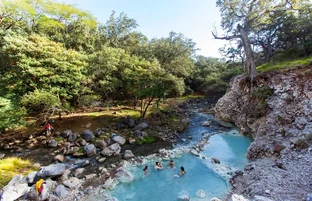
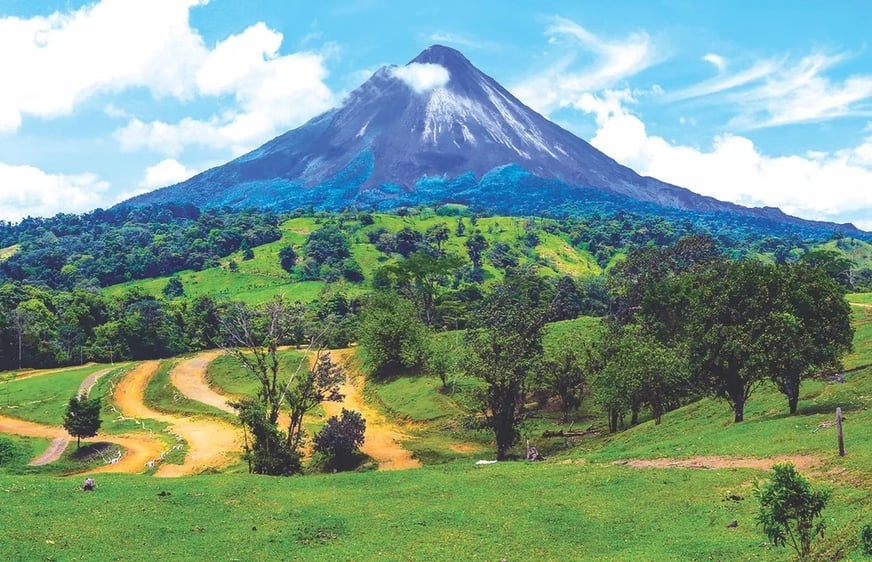
This is also a land of high volcanic and seismic activity. There are three major volcanic mountain ranges in Costa Rica, and many of the volcanoes are still active, allowing visitors to experience the awe-inspiring sight of steaming fumaroles and intense lava flows during their stay. Two volcanoes near the capital -- Poás and Irazú -- are currently active, although relatively quiet. The best places to see volcanic activity are farther north in Rincón de la Vieja National Park and at Arenal Volcano.

Searching for Wildlife

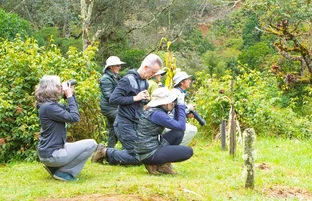
Animals in the forests are predominantly nocturnal. When they are active in the daytime, they are usually elusive and on the watch for predators. Birds are easier to spot in clearings or secondary forests than they are in primary forests. Unless you have lots of experience in the tropics, your best hope for enjoying a walk through the jungle lies in employing a trained and knowledgeable guide. (By the way, if it's been raining a lot and the trails are muddy, a good pair of rubber boots comes in handy. These are usually provided by the lodges or at the sites, where necessary.)

Here are a few helpful hints:

  • Listen. Pay attention to rustling in the leaves; whether it's monkeys up above or pizotes on the ground, you're most likely to hear an animal before seeing one.

  • Keep quiet. Noise will scare off animals and prevent you from hearing their movements and calls.

  • Don't try too hard. Soften your focus and allow your peripheral vision to take over. This way you can catch glimpses of motion and then focus in on the prey.

  • Bring binoculars. It's also a good idea to practice a little first to get the hang of them. It would be a shame to be fiddling around and staring into space while everyone else in your group oohs and aahs over a quetzal.

  • Dress appropriately. You'll have a hard time focusing your binoculars if you're busy swatting mosquitoes. Light, long pants and long-sleeved shirts are your best bet. Comfortable hiking boots are a real boon, except where heavy rubber boots are necessary. Avoid loud colors; the better you blend in with your surroundings, the better your chances are of spotting wildlife.

  • Be patient. The jungle isn't on a schedule. However, your best shots at seeing forest fauna are in the very early-morning and late-afternoon hours.

  • Read up. Familiarize yourself with what you're most likely to see. Most lodges and hotels have a copy of A Guide to the Birds of Costa Rica (Cornell University Press, 1990) and other wildlife field guides, although it's always best to have your own. A good all-around book to have is Carrol Henderson's The Field Guide to the Wildlife of Costa Rica (University of Texas Press, 2002).


    Back to Top


    Note: This information was accurate when it was published, but can change without notice. Please be sure to confirm all rates and details directly with the companies in question before planning your trip.


      Email This Article Email Print This Article Print Get Frommer's RSS Feed RSS
    Frommer's Costa Rica 2008 Frommer's Costa Rica 2008

    Author: Eliot Greenspan
    Pub Date: October 01, 2007
    Price: $19.99

    Buy Now!
    Related Titles:
    Costa Rica For Dummies, 2nd Edition
    Frommer's Belize, 2nd Edition
    Frommer's Costa Rica 2009
    Sponsored Links: What's This?
    You Never Know What's Out There. That's Why There's AIG Travel Guard.
  • Add Frommers.com RSS Feed  Add Frommers.com RSS Feed (What's This?)
    Add Frommers.com Deals & News to Your Web Site
    Add to My Yahoo!     Add to My MSN     More RSS Readers
    Add Frommers.com Podcast Add Frommers.com Podcast (What's This?)
    Home > Destinations > Central and South America > Costa Rica > In Depth > Environment