Home > Destinations > Central and South America > Costa Rica > Active Pursuits > Wildlife Watching
Bookstore Travel Talk - Our Message Boards Tips and Tools Book a Trip Deals and News Trip Ideas, Activities, Lifestyles Hotels Destinations Frommers.com Home
Frommer's - The best trips start here. Frommer's - The best trips start here.
Sign up for our FREE Newsletters! Win a FREE Trip
  Email This Article Email Print This Article Print Get Frommer's RSS Feed RSS

Wildlife Watching

In Search of Turtles

Few places in the world have as many sea-turtle nesting sites as Costa Rica. Along both coasts, five species of these huge marine reptiles come ashore at specific times of the year to dig nests in the sand and lay their eggs. Sea turtles are endangered throughout the world due to over-hunting, accidental deaths in fishing nets, development on beaches that once served as nesting areas, and the collection and sale (often illegally) of their eggs. International trade in sea-turtle products is already prohibited by most countries (including the U.S.), but sea-turtle numbers continue to dwindle.

Among the species of sea turtles that nest on Costa Rica's beaches are the olive ridley (known for their mass egg-laying migrations, or arribadas), leatherback, hawksbill, green, and Pacific green turtle. Excursions to see nesting turtles have become common, and they are fascinating, but please make sure that you and/or your guide do not disturb the turtles. Any light source (other than red-tinted flashlights) can confuse female turtles and cause them to return to the sea without laying their eggs. In fact, as more development takes place on the Costa Rican coast, hotel lighting may cause the number of nesting turtles to drop. Luckily, many of the nesting beaches have been protected as national parks.

Here are the main places to see nesting sea turtles: Santa Rosa National Park (near Liberia), Las Baulas National Marine Park (near Tamarindo), Ostional National Wildlife Refuge (near Playa Nosara), and Tortuguero National Park (on the northern Caribbean coast).

See the regional sections for descriptions of the resident turtles and their respective nesting seasons, as well as listings of local tour operators and companies that arrange trips to see sea turtles nesting.

Monkey Business

No trip to Costa Rica would be complete without at least one monkey sighting. Home to four distinct species of primates, Costa Rica offers the opportunity for one of the world's most gratifying wildlife-viewing experiences. Just listen for the deep guttural call of a howler or the rustling of leaves overhead -- telltale signs that monkeys are in your vicinity.

Costa Rica's most commonly spotted monkey is the white-faced or capuchin monkey (mono cara blanca in Spanish), which you might recognize as the infamous culprit from the film Outbreak. Contrary to that film's plot, however, capuchins are native to the New World tropics and do not exist in Africa. Capuchins are agile, medium-size monkeys that make good use of their long, prehensile tails. They inhabit a diverse collection of habitats, ranging from the high-altitude cloud forests of the central region to the lowland mangroves of the Osa Peninsula. It's almost impossible not to spot capuchins at Manuel Antonio, where they have become a little too dependent on fruit and junk-food feedings by tourists. Please do not feed wild monkeys (and try to keep your food away from them -- they're notorious thieves), and boycott establishments that try to attract both monkeys and tourists with daily feedings.

Howler monkeys (mono congo in Spanish) are named for their distinct and eerie call. Large and mostly black, these monkeys can seem ferocious because of their physical appearance and deep, resonant howls that can carry for more than a mile, even in dense rainforest. Biologists believe that male howlers mark the bounds of their territories with these deep, guttural sounds. In the presence of humans, however, howlers are actually a little timid and tend to stay higher up in the canopy than their white-faced cousins. Howlers are fairly common and easy to spot in the dry tropical forests of coastal Guanacaste and the Nicoya Peninsula.

Even more elusive are spider monkeys (mono araña in Spanish). These long, slender monkeys are dark brown to black and prefer the high canopies of primary rainforests. Spiders are very adept with their prehensile tails but actually travel through the canopy with a hand-over-hand motion frequently imitated by their less graceful human cousins on playground monkey bars around the world. I've had my best luck spotting spider monkeys along the edges of Tortuguero's jungle canals, where howlers are also quite common.

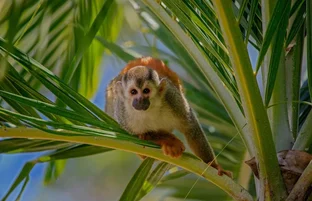
The rarest and most endangered of Costa Rica's monkeys is the tiny squirrel monkey (mono titi in Spanish). These small, brown monkeys have dark eyes surrounded by large white rings, white ears, white chests, and very long tails. In Costa Rica, squirrel monkeys can be found only at Manuel Antonio and the Osa Peninsula. These seemingly hyperactive monkeys are predominantly fruit eaters and often feed on bananas and other fruit trees near hotels in both of the above-mentioned regions. Squirrel monkeys usually travel in large bands, so if you do see them, you'll likely see quite a few.


Back to Top


Note: This information was accurate when it was published, but can change without notice. Please be sure to confirm all rates and details directly with the companies in question before planning your trip.


  Email This Article Email Print This Article Print Get Frommer's RSS Feed RSS
Frommer's Costa Rica 2008 Frommer's Costa Rica 2008

Author: Eliot Greenspan
Pub Date: October 01, 2007
Price: $19.99

Buy Now!
Related Titles:
Costa Rica For Dummies, 2nd Edition
Frommer's Belize, 2nd Edition
Frommer's Belize, 3rd Edition
Add Frommers.com RSS Feed  Add Frommers.com RSS Feed (What's This?)
Add Frommers.com Deals & News to Your Web Site
Add to My Yahoo!     Add to My MSN     More RSS Readers
Add Frommers.com Podcast Add Frommers.com Podcast (What's This?)
Home > Destinations > Central and South America > Costa Rica > Active Pursuits > Wildlife Watching